


A support ticket can look harmless while carrying a surprising amount of private information. A customer may paste an email address, an access token, a screenshot of an internal dashboard, and the history of an unrelated conversation into the same report. Sending that ticket to a language model for a simple routing decision gives the model service far more information than the decision needs.
The most useful privacy control is therefore often upstream of the API call: decide what the application actually needs to ask, and construct a smaller representation for that purpose. This guide develops that approach for a DeepSeek integration. It concentrates on decisions your application can enforce before transmission, rather than treating a prompt instruction or a provider policy as a substitute for application design.
The running example is a software support workflow that considers a ticket category, a coarse platform, and an application major version. These are illustrative design choices, not a description of a tested service. The code examples use deliberately restricted synthetic inputs. They demonstrate a verifiable boundary around a small request shape; they do not establish that a production system is anonymous, legally compliant, or suitable for every kind of support request.
1. Start with the decision, then justify each field
“Help with support” is too broad to define an outbound payload. Break the workflow into a concrete task, such as drafting one generic troubleshooting step for a known category and platform. Write down the allowed outputs before choosing inputs. If the output is one of a few routing codes, a full conversation, customer profile, and account history require a much stronger justification than the routing code itself.
For each proposed field, ask what would change if it were absent. A platform label might select the appropriate installation instructions. An application major version might distinguish supported and unsupported releases. A customer name probably changes neither. Remove fields that cannot be tied to the decision. When a field does affect the result, test whether a less detailed version preserves the useful distinction.
That last step matters. An exact device model, operating system build, browser extension list, and full version string may be useful during a difficult debugging session. They are excessive for many initial routing decisions. A coarse platform label and bounded major version may be enough for the first stage. Keep detailed diagnostics available locally for a later stage with a separately approved purpose and access path.
A purpose statement should also name what the integration cannot do. Our illustrative lane cannot diagnose arbitrary error messages, interpret attachments, or personalize advice using account history. Those limitations are intentional. A product team can then evaluate whether the smaller lane delivers enough value, rather than quietly expanding the payload whenever a difficult case appears.
Finally, ask whether an API call is necessary at all. If a small, stable lookup table maps the three permitted inputs to the desired result, a local rule may be easier to validate and operate. Data minimization includes declining to transmit information when local processing meets the requirement. A model should earn its place through a measurable benefit to the actual workflow.
2. Build a purpose-based allowlist, not a filtered ticket copy
An allowlist starts with an empty outbound object and adds only specifically approved fields. A denylist starts with a rich object and tries to remove everything dangerous. The difference becomes important as the application evolves. A new field added to a support record can silently flow through a generic serialization path, even though nobody reviewed it for model use.
For this example, the only accepted fields are category, platform, and app_major. Category must be one of billing, access, bug, or other. Platform must be one of web, android, ios, or desktop. App_major must be an integer from 1 through 99. There is no notes field, customer identifier, ticket identifier, attachment URL, or open-ended metadata object.
Rejecting unknown keys makes mistakes visible. Silently ignoring them can be acceptable in some interfaces, but it also allows callers to believe a field was processed when it was discarded. A strict boundary gives engineers a clear failure when someone tries to send a new attribute. The team must then decide whether the new attribute belongs in this purpose, needs transformation, or should remain local.
Types deserve equal attention. In Python, booleans have an integer relationship that can surprise a casual validator. A field meant to represent a version should not accept true as version one. Strings containing numbers should not be automatically converted unless that conversion is an explicitly reviewed part of the contract. Predictable rejection is easier to test than a growing collection of convenient coercions.
Keep the allowlist close to the outgoing request builder and version it as an interface. Document the reason for each field, who owns the decision, and the change process. A review should consider both direct content and combinations: even coarse attributes can become more distinctive when many are joined together. The goal is a small, justified request, not a declaration that every remaining field is universally safe.
Also distinguish the application body from the complete network exchange. An allowlisted JSON payload does not eliminate account credentials, network metadata, timing, or provider-side operational information. Those have their own controls and review requirements. Be precise about what the allowlist proves: it constrains the content your application constructs for this particular task.
3. Keep raw transcripts and attachments out of the default lane
A conversation transcript is a convenient development input because it already exists. It is also a poor default privacy boundary. It combines material written for different purposes, at different times, by different people. A detail that was necessary for an agent resolving an account problem may be irrelevant to a later routing decision. Forwarding the whole transcript carries that accumulated context into a new processing step.
Attachments widen the problem. Screenshots can contain usernames, browser tabs, notification previews, document titles, and information in the background. Logs can contain tokens and query parameters. Documents can include comments and revision history. An extraction pipeline may uncover content that was not visible in the original preview. “We only sent the attachment text” is therefore not a sufficient account of what left the application.
Prefer a structured intake path that produces the minimum fields directly. Let the user choose a category and coarse platform, and derive a major version locally from a trusted application value where appropriate. Keep the original ticket in the support system under its existing access rules. The model lane receives a newly constructed task representation, not a serialized support-system object.
If an existing workflow genuinely needs free text, treat it as a separate design problem. Define which passages are relevant, which data classes must be excluded, what local review is possible, and what happens when confidence is low. A local extraction step can reduce exposure, but its output still requires an explicit schema and testing. Moving the same raw transcript to another remote model for “sanitization” introduces another recipient.
The interface should make escalation understandable. A ticket that cannot be handled with the restricted fields can remain in a human queue. A later, reviewed diagnostic lane may use additional information under its own rules. Do not implement escalation by automatically attaching the original ticket after a model returns an uncertain result. That fallback would erase the boundary precisely when the workflow becomes difficult.
4. Use local redaction as a limited supporting control
Redaction can catch recognizable values before they leave the application. It is useful for obvious email addresses, known credential formats, or identifiers with reliable local structure. It is less reliable when meaning supplies the sensitive information. A unique job description, an unusual incident, or a sequence of places can identify someone without containing a conventional name or account number.
Pattern matching also has ordinary engineering limitations. Text may contain spelling variation, Unicode characters, partial values, escaped sequences, or data split across fields. A credential format can change. A detector can confuse an example identifier with a real one, or miss a value embedded in a file name. Image-based material requires its own extraction and validation path, which introduces further opportunities for omissions.
For that reason, a redaction pass should not be the sole permission to forward unrestricted content. Presidio’s official documentation similarly warns that automated detection cannot guarantee finding all sensitive information. [7] In the strict lane described here, free text never enters the constructed outbound messages. Redaction can still help protect local logs or support a separately reviewed workflow, but it is not a prerequisite for safely rendering the three validated fields. The schema itself removes that free-text transport route.
Be equally careful about the redactor’s operating environment. If it records rejected inputs, sends diagnostic events to another service, or runs through a remote endpoint, it can create the same exposure it was introduced to prevent. Trace the actual processing path. “Local” should describe where content is processed and stored, not merely the name of a function in an application repository.
Evaluate redaction against both missed disclosures and damaged usefulness. Replacing every unfamiliar token may hide the error code needed for troubleshooting while leaving a revealing sentence intact. Maintain synthetic examples representing the formats and languages your product accepts. Review failures as evidence of limits, and keep a conservative fallback for cases the detector cannot handle confidently.
5. Scope pseudonyms carefully and avoid anonymity claims
Some workflows need continuity across multiple requests. An application might need to connect a response to a local ticket or prevent duplicate processing. Before placing an identifier in the model prompt, ask whether that association can remain entirely in the application. A local mapping between an internal job record and the returned response often removes the need to expose a customer or ticket reference.
When an external correlation value is genuinely necessary, narrow its scope and lifetime to the task. A fresh opaque value for one operation generally creates fewer links than a stable customer alias reused across products, teams, and providers. Keep the mapping under separate access controls, and decide when it is deleted. Treat the alias as another field that needs a documented purpose.
A hash does not automatically solve the problem. Deterministically hashing a predictable email address can still allow guesses to be checked, and a stable hash links records even when the original value is not immediately recoverable. Secret-keyed transformations change some risks but introduce key management and still preserve whichever linkage the design intentionally retains. None of these mechanisms warrants casually labeling a dataset anonymous.
Context can reconnect records too. An unusual combination of platform, version, timing, and incident details may be recognizable to someone with auxiliary information. Removing direct identifiers reduces one exposure route; it does not prove that re-identification is impossible. Describe the transformation accurately, such as removal of direct identifiers or use of task-scoped pseudonyms, and assess the remaining linkability.
The strict example sends no identifiers or pseudonyms in the model messages. The application owns correlation outside those messages. That choice is feasible because this lane does not require the model to remember a person or ticket across calls. If your design requires continuity, make that requirement explicit rather than inheriting a permanent identifier from a convenient SDK field.
6. Enforce one inspectable egress gate
A privacy rule is difficult to maintain when every feature builds its own provider request. Centralize the construction of outbound messages behind a small gate. The gate should validate the exact accepted shape, select text only from trusted static vocabulary, and return the request content that the calling code is allowed to submit. Keep provider credentials and transport concerns outside the untrusted intake object.
In this example, validation rejects extra keys, missing keys, invalid enum values, incorrect types, and out-of-range versions. After validation, the builder renders the three permitted values into a fixed task template. It does not interpolate arbitrary descriptions, attach a ticket, retrieve account details, or forward exception text. This gives reviewers a compact implementation they can reason about without reading every support feature.
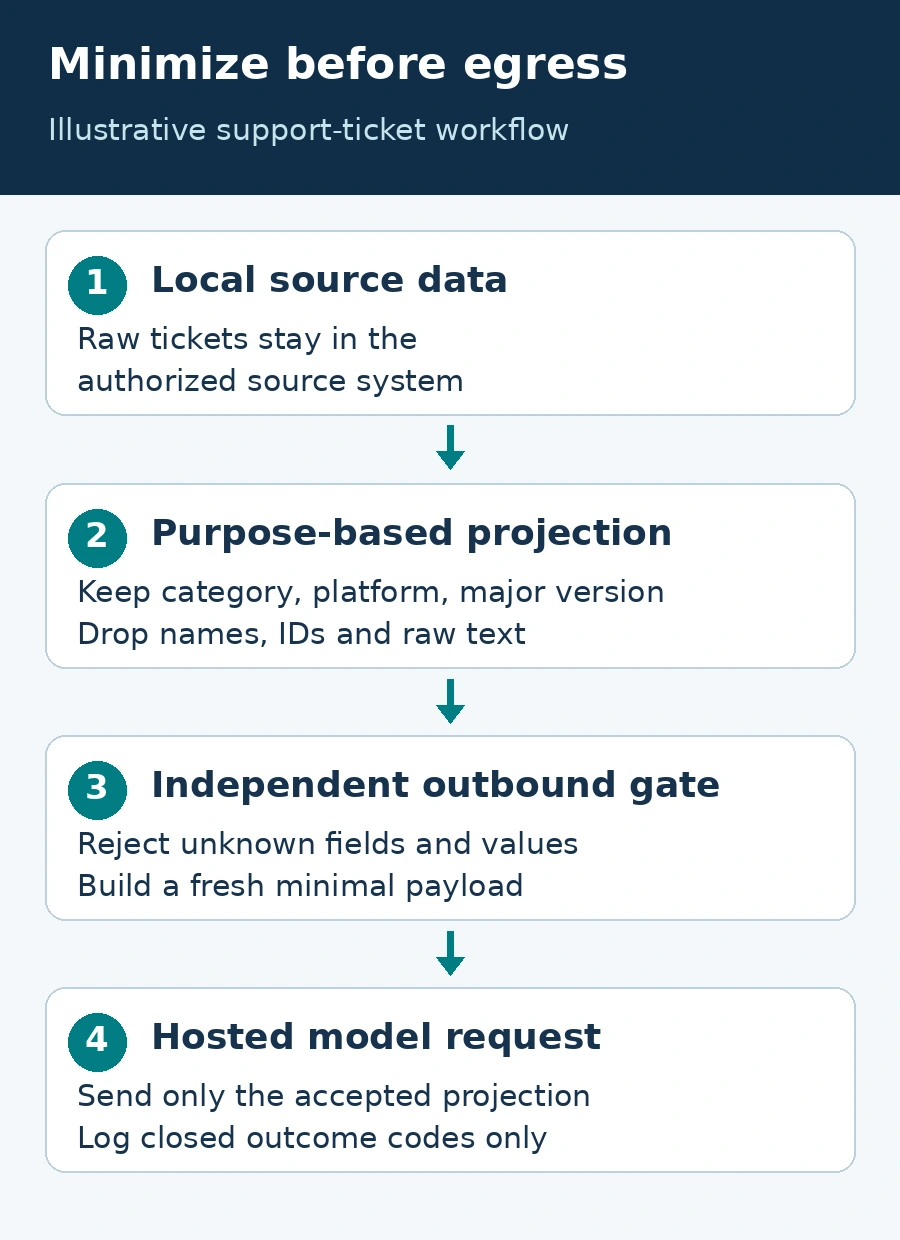
The following code is an illustrative local gate. Its narrowness is a feature: it demonstrates how to constrain an outbound representation deterministically. It does not call DeepSeek, measure a model, or verify provider behavior.
Save the following as minimize.py. It uses only Python standard-library modules.
"""Offline teaching fixture. No network calls, credentials, or real tickets."""
import json

CATEGORIES = frozenset({'billing', 'access', 'bug', 'other'})
PLATFORMS = frozenset({'web', 'android', 'ios', 'desktop'})
FIELDS = frozenset({'category', 'platform', 'app_major'})

class Rejected(ValueError):
    pass

def prepare_messages(candidate):
    # candidate is already projected by a trusted application component.
    # Reject extras instead of silently accepting a richer payload.
    if type(candidate) is not dict or set(candidate) != FIELDS:
        raise Rejected('unexpected_fields')
    category = candidate['category']
    platform = candidate['platform']
    major = candidate['app_major']
    if type(category) is not str or category not in CATEGORIES:
        raise Rejected('invalid_category')
    if type(platform) is not str or platform not in PLATFORMS:
        raise Rejected('invalid_platform')
    if type(major) is not int or not 1 <= major <= 99:
        raise Rejected('invalid_version')
    # Construct anew from validated, deliberately coarse values.
    projected = {'category': category, 'platform': platform,
                 'app_major': major}
    return [
        {'role': 'system', 'content':
         'Draft one generic troubleshooting step from these coarse facts. '
         'Do not invent account details. Do not request personal data.'},
        {'role': 'user', 'content': json.dumps(
            projected, sort_keys=True, separators=(',', ':'))},
    ]

def safe_event(outcome):
    # Closed event vocabulary; raw values and exception text never enter it.
    if type(outcome) is not str or outcome not in {'prepared', 'rejected'}:
        raise Rejected('invalid_outcome')
    return {'event': 'minimization_gate', 'policy': 'coarse-ticket-v1',
            'outcome': outcome}
For production integration, make the provider adapter accept only the gate’s validated result. Review alternate clients, background jobs, retry handlers, and debugging utilities that could bypass it. A code convention helps, but stronger enforcement may require dependency boundaries, restricted service permissions, and network controls appropriate to your deployment. Document which controls are implemented rather than implying a helper function alone prevents every outbound request.
Failure behavior is part of the contract. An invalid payload should stop this model lane and produce a bounded local error code. It should not trigger a fallback that sends the original object “for context.” Retry logic should reuse the approved minimal representation. If it reconstructs a request from a richer source record, it can accidentally reintroduce fields removed during the first attempt.
Privacy review and instruction-boundary review meet here, but they remain distinct. Minimizing a payload reduces exposed content. Separately, untrusted material must not gain authority over tools or application actions. For a deeper treatment of that second concern, see our guide to DeepSeek prompt injection prevention. The strict vocabulary in this example avoids an open-ended text channel; it does not excuse weak permissions elsewhere.
7. Make observability useful without recording raw content
A carefully minimized request can coexist with an overly revealing logging system. Framework middleware may record HTTP bodies, an error tracker may capture local variables, and an analytics event may include the original ticket when validation fails. Review the full path from intake to result, including development environments and support dashboards. The provider request is only one possible destination. OWASP’s logging guidance specifically identifies credentials, tokens, and sensitive personal data among material to exclude from direct logging. [6]
Start with operational questions and choose bounded measurements that answer them. You may need to know whether validation passed, which schema version was used, whether the provider timed out, how long processing took, and which approved routing code was returned. None of those questions inherently requires storing a transcript. Use stable error categories instead of exception messages that may embed input values.
Request and trace identifiers deserve a deliberate design. A random operational identifier can help join events, but it becomes linkable when copied into customer records or multiple analytics systems. Limit who can resolve the association, avoid placing identifiers in model instructions without a reason, and give telemetry its own retention policy. “Metadata only” should describe a reviewed set of fields, not an unrestricted object.
Pay attention to rejected requests. They are exactly where unexpected keys and content are likely to appear, so logging the rejected payload defeats the gate’s purpose. Record a bounded reason such as unknown_field or invalid_platform. If engineers need deeper diagnostic material, provide a separately controlled process using synthetic reproductions first. Do not silently enable raw capture across production traffic to investigate one failure.
Finally, verify instrumentation with the deployed configuration. Debug settings, SDK hooks, tracing exporters, and incident-response toggles can differ from the reviewed source code. An observability checklist should identify destinations and owners, not just logging statements. Include privacy assertions in integration tests so a future tracing upgrade cannot quietly restore body capture without a visible test failure.
8. Separate provider facts from application assumptions
The provider facts below concern DeepSeek’s own hosted API and published materials. Third-party hosting and self-hosted deployments require a separate review of their actual operators, terms, and data flows.
As checked on 3 October 2026, DeepSeek has API-specific Open Platform Terms of Service, effective 29 April 2026. Their scope matters: section 5.5 applies the general privacy policy to developers’ own personal information while excluding the processing rules for information collected from downstream end users. The terms also assign developers responsibilities for downstream disclosures and rights requests. Treat these as reasons to review the applicable API arrangement, rather than assuming a consumer-facing policy completely describes your application’s processing. [1]
The general privacy policy, updated 10 February 2026, lists training and improvement among its purposes, describes qualified opt-out rights, and uses purpose-based retention language rather than a universal fixed-day limit. It also states that personal data is processed and stored in the People’s Republic of China. These are statements about that policy, with the scope qualification above; they do not establish an API-wide no-training guarantee or the terms of a separately negotiated arrangement. [2]
Technical storage features need similarly careful interpretation. DeepSeek’s context caching guide describes disk caching enabled by default and approximate clearing of unused cache within hours to days. That describes one cache’s behavior, not a maximum lifetime for every copy of application data. A cache hit counter tells you about reuse, not whether operational logs, uploaded files, or other retained material have been deleted. [3]
The Responses compatibility guide says that store, prompt_cache_key, and prompt_cache_retention are unsupported and ignored; returned responses carry store: false. Do not interpret that response field as a global zero-data-retention commitment, or assume that sending an unsupported retention parameter changes backend behavior. Verify which parameters are implemented on the exact endpoint you use. An OpenAI-compatible request shape does not establish identical operational semantics. [4]
Uploaded files are another distinct resource. The Files API documentation says files have permanent storage by default when expiration settings are omitted, and documents explicit expiry and deletion options. This default therefore needs an explicit deletion decision. If a separate reviewed workflow needs an upload, choose its lifecycle deliberately and track deletion responsibility. File deletion should not be described as proof that every derived record or other storage system has been purged. The default restricted lane in this article uploads no files. [5]
Read applicable provider materials before deployment and retain a dated record of the terms and technical documentation you relied on. Distinguish a published policy from a negotiated commitment, and distinguish both from an application control you can test yourself. A claim about one product surface should not automatically be carried over to another account type, endpoint, feature, or deployment arrangement.
Context caching also needs its own review. Reusing a prompt prefix is an efficiency mechanism with a data lifecycle; it should not be treated as an application deletion mechanism or evidence that a prompt was never stored. Check the currently documented behavior and the terms applicable to your service. Our DeepSeek context caching guide provides additional implementation context.
If a requirement depends on an unanswered question, keep that uncertainty explicit. Ask which data is processed, where the relevant service operates, what purposes are permitted, which retention controls apply, and how deletion requests are handled. Do not fill gaps with assumptions borrowed from another provider. Until the requirement is resolved, the appropriate application response may be to keep that class of data out of the integration.
9. Give every retained copy an owner and a deletion path
Minimizing transmission does not settle retention. Your application can keep the source ticket, a queue message, a retry record, a model result, a trace, and a backup, each with a different lifecycle. Build an inventory around actual copies and storage systems. A single statement that “tickets are deleted” is incomplete if derived outputs or operational records survive elsewhere without an owner.
For each store, identify its purpose, access group, retention trigger, deletion mechanism, and evidence of completion. The trigger might be task completion, ticket closure, or another event defined by the organization. Choose durations through the relevant business, security, and legal review; this guide supplies no universal retention number. Shorter storage helps only when it is compatible with the real requirement and consistently enforced.
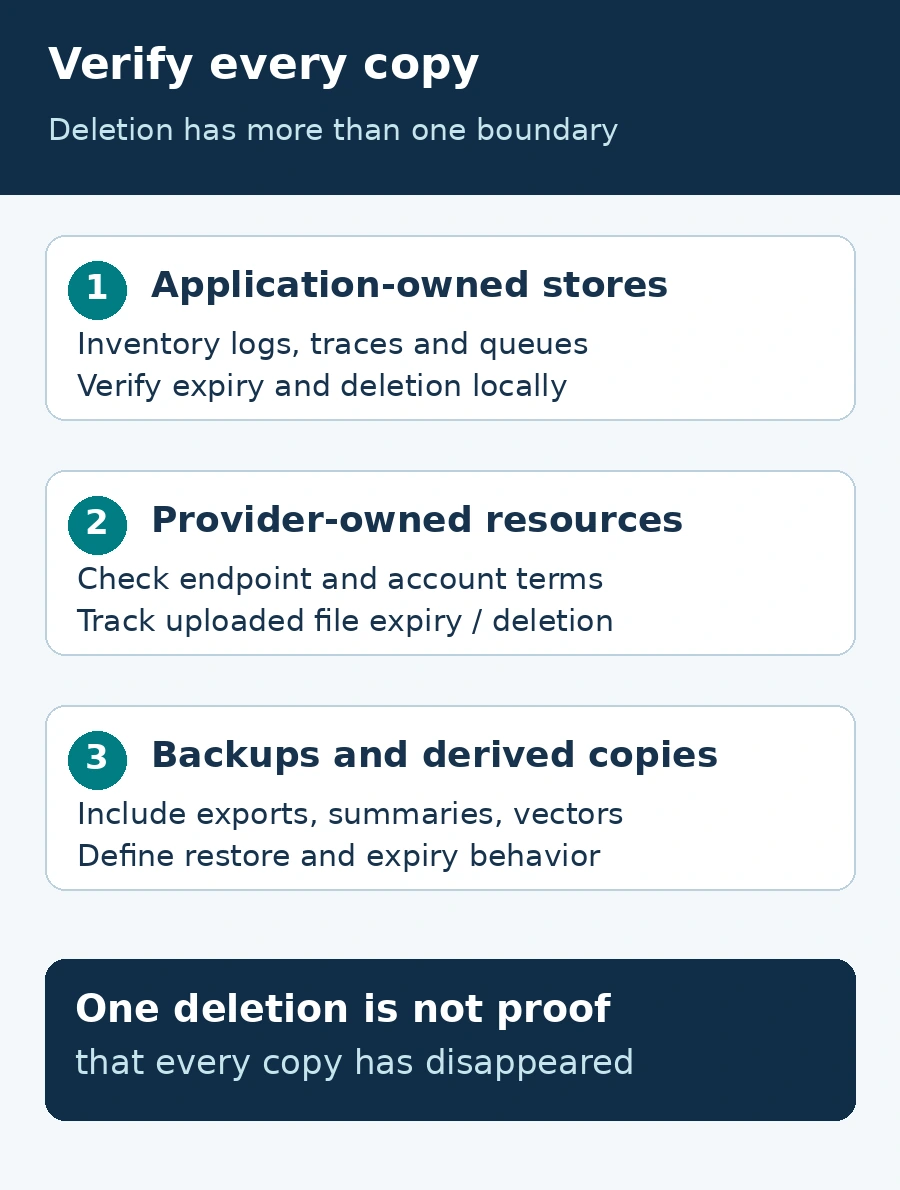
Separate active storage from backups and other delayed-deletion systems. An application delete operation may remove a live database row while backup media ages out on a different schedule. Document what happens if data is restored, including whether deletion records are reapplied. Tell internal stakeholders what is immediately inaccessible and what remains subject to an established lifecycle instead of promising instantaneous disappearance.
Derived content needs the same attention as source content. A summary can preserve a sensitive allegation or identifying detail even after the original ticket is removed. A local pseudonym mapping can reconnect otherwise opaque records. A troubleshooting result may reveal an account condition. Classify these copies according to what they contain and how they can be joined, rather than assuming generated text is harmless.
Verification should use synthetic records with known markers. Create a test ticket, exercise the allowed workflow, request or trigger deletion, and inspect each system in the inventory. Record which checks directly observed absence, which relied on a documented retention process, and which remain unresolved. Search results alone may be incomplete, so use store-specific verification where practical and authorized.
Provider-side handling requires its own evidence and appropriate contractual or support channels. An application cannot verify a provider’s internal deletion simply by discarding its local response. Likewise, expiration of one cache does not establish removal from every system involved in processing. Assign someone responsibility for resolving provider questions and revisiting the answer when features or agreements change.
10. Test leakage and usefulness with synthetic fixtures
A useful test suite begins with explicit claims. For the strict gate, the primary claim is that only the three permitted fields influence the constructed messages, under the stated validation rules. Test that claim directly. Valid combinations should produce the expected bounded representation. Extra keys, missing fields, nested objects, arbitrary strings, booleans, and invalid versions should be rejected before any transport is invoked.
Use obviously synthetic personal-data markers in rejected fixtures: a fabricated address, a fake account reference, and a nonfunctional example token. Place them in unexpected keys, nested structures, and values that resemble otherwise permitted fields. Check the captured outbound request and the test logger. The marker should appear in neither. Keep the fixture data artificial so the testing process does not itself create a new collection of real private information.
Save the following as test_minimize.py beside minimize.py, then run python -m unittest test_minimize -v.
import json
import unittest
from minimize import prepare_messages, safe_event, Rejected

BASE = {'category': 'bug', 'platform': 'web', 'app_major': 7}

class MinimizationTests(unittest.TestCase):
    def test_closed_projection(self):
        messages = prepare_messages(BASE)
        self.assertEqual(json.loads(messages[1]['content']), BASE)

    def test_email_field_rejected(self):
        with self.assertRaises(Rejected):
            prepare_messages({**BASE, 'email': 'demo@example.invalid'})

    def test_transcript_field_rejected(self):
        with self.assertRaises(Rejected):
            prepare_messages({**BASE, 'transcript': 'SYNTHETIC-CANARY-41'})

    def test_free_text_in_category_rejected(self):
        with self.assertRaises(Rejected):
            prepare_messages({**BASE, 'category': 'bug demo@example.invalid'})

    def test_nested_value_rejected(self):
        with self.assertRaises(Rejected):
            prepare_messages({**BASE, 'platform': {'name': 'web'}})

    def test_missing_field_rejected(self):
        with self.assertRaises(Rejected):
            prepare_messages({'category': 'bug', 'platform': 'web'})

    def test_version_type_and_bounds(self):
        for value in (True, '7', 0, 100, 7.0):
            with self.subTest(value=value), self.assertRaises(Rejected):
                prepare_messages({**BASE, 'app_major': value})

    def test_closed_logs(self):
        event = safe_event('rejected')
        self.assertEqual(set(event), {'event', 'policy', 'outcome'})
        self.assertNotIn('demo@example.invalid', json.dumps(event))
        class UntrustedText(str):
            pass
        for value in ('rejected: demo@example.invalid', [], {}, None,
                      UntrustedText('prepared')):
            with self.subTest(value=value), self.assertRaises(Rejected):
                safe_event(value)

if __name__ == '__main__':
    unittest.main()
The accompanying example was checked with eight local unittest test methods, including five version-type and boundary subcases. Those deterministic fixture tests passed without network calls. No live DeepSeek privacy test, re-identification assessment, or utility measurement was performed. The suite checks the illustrated validator and event helper; the broader evaluation described here remains work for the integrating team.
These tests establish behavior for the schema and fixtures they exercise. They do not demonstrate anonymity, complete leakage resistance, or the absence of side channels. A unit test also cannot establish what an independently configured SDK, reverse proxy, or monitoring agent records. Add integration checks at the actual transport boundary and verify that the reviewed gate is the one used by deployed callers.
Usefulness needs a separate evaluation. Create a synthetic set of realistic support situations with an expected approved route or a clear escalation outcome. Compare the restricted representation against the decision requirement. Track wrong routes, unsupported cases, and cases where the available fields cannot distinguish two outcomes. Report the result as an evaluation of that dataset and workflow, without inventing general accuracy claims.
When performance is inadequate, investigate the missing distinction before adding content. Perhaps the category definitions need improvement, a local rule can resolve the ambiguity, or the case belongs in a reviewed diagnostic lane. Adding an unrestricted notes field is a large change disguised as a small schema extension. Propose the smallest additional attribute, justify it, and repeat both the privacy and usefulness reviews.
Include change tests too. A new model version, prompt template, SDK release, or telemetry exporter can alter system behavior even when the intake form stays the same. Preserve the synthetic regression set and the expected schema contract. Require a review when allowed fields, output destinations, or logging behavior change. The test suite should make boundary changes obvious to the people responsible for approving them.
11. Constrain outputs and review the entire workflow
The response is another input to your application. The example requests a generic troubleshooting step and does not implement a response validator. For a production routing workflow, prefer allowed routing or troubleshooting codes, validate their shape, and decide what happens on an unsupported result. A model should not be able to invent an external destination, request an attachment, or cause the application to fetch account details merely by returning persuasive prose. See our DeepSeek structured output guide for related response-handling practices.
Keep retry and recovery paths consistent with the same data policy. A timeout should lead to a bounded retry, a local fallback, or a human queue. It should not automatically switch to a second provider with a richer payload. Operational resilience is easier to review when all paths share the same minimal representation. Our DeepSeek API reliability guide discusses the broader reliability concerns.
Before rollout, trace one synthetic ticket through intake, local transformation, validation, transport, response handling, telemetry, storage, and deletion. Name an owner for each boundary. Check failure paths as carefully as successful calls. Confirm that operators can diagnose common problems without enabling raw-content capture, and that unsupported tickets have a clear destination that does not silently expand data sharing.
A practical privacy architecture makes its limits visible. The team can state which fields leave the application, why they are necessary, how they are validated, where resulting records are stored, and what evidence supports deletion. DeepSeek API privacy then becomes a set of inspectable engineering decisions. The strongest starting point is a small request whose contents you can explain before it ever crosses the network.
Sources & References
Official sources checked on 3 October 2026. Documentation and policies can change; verify the terms and features applicable to your account before deployment.
- [1] DeepSeek Open Platform Terms of Service, particularly sections 3.3 and 5.5
- [2] DeepSeek Privacy Policy, updated 10 February 2026
- [3] DeepSeek Context Caching documentation
- [4] DeepSeek Responses API compatibility guide
- [5] DeepSeek Files API guide
- [6] OWASP Logging Cheat Sheet: Data to exclude
- [7] Presidio documentation and limitations

[…] and consult the applicable service documentation and terms for your organization. The site’s guide to minimizing data sent to DeepSeek covers the application-side boundary in more […]
[…] incident inspires a case, preserve the failure mechanism while removing unnecessary details. The DeepSeek API data minimization guide explains how to constrain the information sent to a hosted […]
[…] but they should be sanitized and accompanied by text descriptions of the important behavior. The DeepSeek data-minimization guide explains how to keep that request boundary […]
[…] Do not dump your entire production schema into a prompt by default. A schema may expose business relationships, internal project names, or sensitive column names even when it contains no rows. Prefer an approved analytical view with only the fields needed for the question. Invented examples are often enough to explain cardinality. If real samples are necessary, follow your organization’s data-sharing rules and minimize them using the approach in our DeepSeek data-minimization guide. […]
[…] string does not establish that the rest of the code is suitable to share. The broader guide to minimizing data before an API request explains how to make this review deliberate rather than relying on accidental […]
[…] another claim to validate and another possible place to copy private information. The broader DeepSeek data-minimization guide covers preparation and logging decisions in more […]
[…] records scope. Where privacy changes the source packet itself, apply the controls discussed in our privacy and data-minimization guide before submitting text. A redacted packet may support fewer claims, and the summary must not […]
[…] These are prerequisites for the workflow rather than evidence about the incident itself. The DeepSeek API data-minimization guide covers that separate decision in more detail, so the triage worksheet can stay focused on what the […]
[…] customer details, confidential supplier notes, or whole exports merely because they are nearby. The guide to DeepSeek API privacy and data minimization covers the separate decision about what information should reach an external […]
[…] and sensitive example values before sending a bundle to any external model service. The guide to DeepSeek API privacy and data minimization is useful when defining that preparation […]
[…] styles, and behavior; it rarely needs a production customer record. The site’s guide to minimizing data in DeepSeek API workflows explains a broader approach to keeping unnecessary information out of model […]
[…] service. Use fictional values that retain the relationships needed for the example. The guide to DeepSeek data minimization provides a broader approach. If project policy forbids sharing the source, use an approved local […]
[…] Do not assume a prompt asking for confidentiality changes a provider’s actual handling of the submitted content. Use only an approved service and a sharing scope your organization permits. DeepSeek’s official API documentation is the appropriate place to verify current integration details if you later automate the interaction; this local lesson needs no API credentials. For a broader checklist before sharing code, consult the site’s DeepSeek API privacy and data-minimization guidance. […]
[…] with synthetic equivalents, and share only the context approved for the model service you use. The DeepSeek data-minimization guide offers a practical way to reduce unnecessary disclosure before a request leaves your […]
[…] reproduces the problem, along with the relevant function and expected behavior. The site’s DeepSeek privacy and data-minimization guide covers the broader preparation workflow. The fixture in this lesson is invented and suitable for […]
[…] traces. A cache key can disclose information even when the response body is absent. The workflow in DeepSeek API privacy and data minimization is a useful companion when preparing a sanitized debugging […]
[…] examples during review rather than sending customer labels to an external model by default. Our data-minimization workflow explains how to reduce what leaves the application while preserving useful diagnostic […]