


A file can contain valid JSON and still be unsafe to update. Opening the current file in write mode may destroy yesterday’s usable snapshot before today’s replacement is ready. A worker can report an error after the replacement has already become visible. Two successful writers can overwrite one another’s work without producing a single malformed byte. These problems belong to the write lifecycle, and a useful DeepSeek prompt needs to describe that lifecycle explicitly.
This guide builds a reviewable approach around a synthetic build-manifest snapshot. The application prepares a complete document, stages it beside the destination, and publishes it with one replacement operation. The accompanying offline Python lab gives that sequence observable failure points. You will use the results to distinguish an unchanged destination from a committed replacement whose requested durability confirmation failed, then decide what the caller should do next.
The scope is deliberately narrow: bounded JSON-serializable data, a trusted local directory, and replacement of one regular file. Symlink attacks, malicious directory changes, distributed filesystems, metadata preservation, and transactional updates across multiple files require additional designs. No live DeepSeek API call or model evaluation was performed for this article. It is a practical prompting and verification workflow, with no claim that a particular model produced or passed the implementation. The lab also does not simulate physical power cuts or validate storage hardware.
Our Python CLI tools guide introduces sibling-temporary-file replacement for an output command. This article extends that narrow idea into failure classification, synchronization ordering, and recovery after publication. The main question here is what a caller can safely conclude when one of those operations fails.
Define the build manifest contract
Imagine a local build dashboard that reads build-manifest.json. Each published document contains a build identifier, a project label, a revision, a status, and a list of artifacts. An artifact has a name and a byte count. These are synthetic examples; the exercise needs no proprietary source code, credentials, actual build outputs, or connection to a production system. The writer receives a fully prepared snapshot rather than editing the destination record by record.
The reader’s immediate requirement is straightforward: whenever it opens the published path during an ordinary update, it should receive a complete earlier document or a complete replacement. It should never discover half of an artifact list because the writer is still serializing it. Define an initial state too. If the destination has never existed, a pre-commit failure should leave it absent; successful publication should create it. An existing empty or invalid file is a separate input-state problem, not something the replacement helper should silently repair by inference.
Next, specify what the snapshot represents. In this example it is a replaceable view computed from another authoritative source. A failed publication can leave the older view available while an operator investigates. That choice makes the exercise useful without suggesting that a flat file should become the sole record of deployment approvals or artifact provenance. If the file itself is the authoritative ledger, recovery requirements become considerably stronger.
Finally, record the operating assumptions beside the code. The parent directory already exists, the application controls it, payloads are small enough to serialize in memory, and no hostile process changes path components. A path supplied by an untrusted web request does not satisfy that contract merely because it ends in .json. This helper belongs behind a caller that selects an approved destination and enforces the deployment’s path policy.
Separate visibility, durability, and isolation
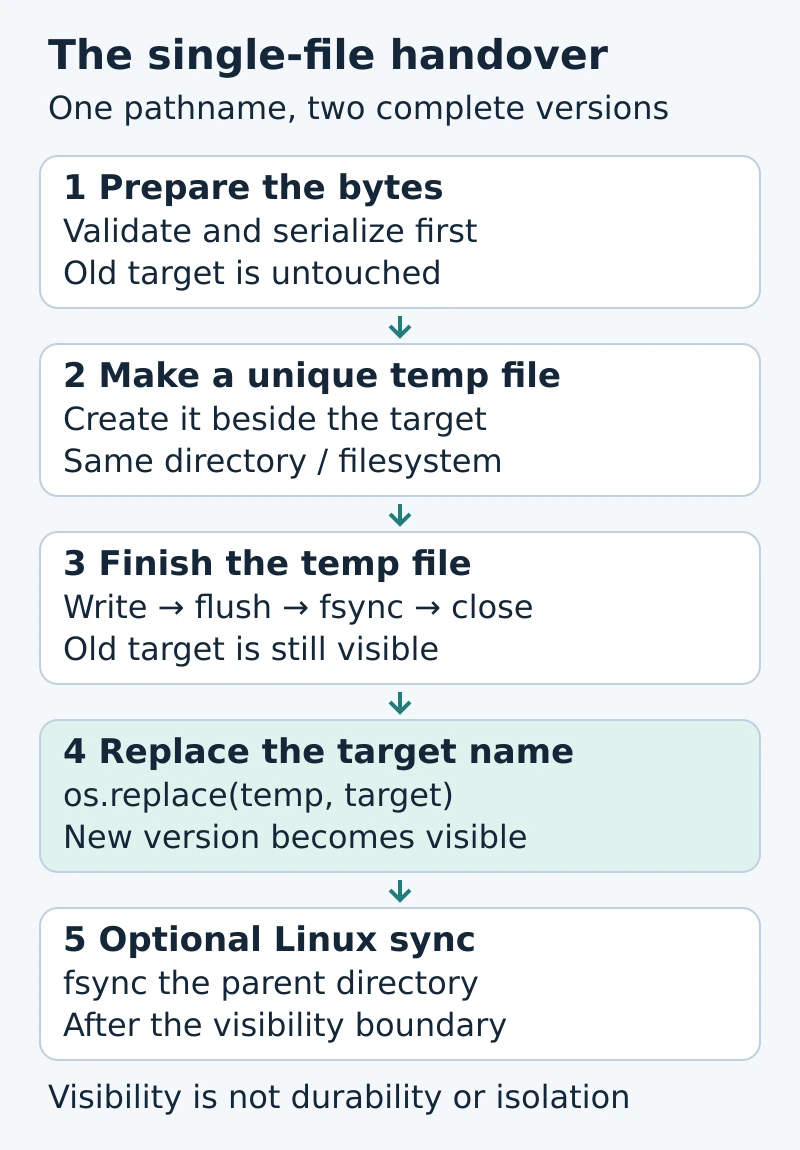
Atomic visibility describes what another process can observe through the published filename during replacement. Durability asks whether the intended state survives a relevant crash. Concurrent-update isolation asks whether one writer can unknowingly discard another writer’s change. Treat these as separate acceptance criteria. A review that says only “the write is atomic” leaves too much room for incompatible interpretations between the author, caller, and operator.
Python documents os.replace as an atomic renaming operation when successful, with possible failure across filesystems. The Linux rename documentation explains that an existing destination is replaced without a missing-name interval. An already-open reader may continue using its old file descriptor. For this lab, the reader opens the published path once, consumes that document, and closes it. That reading pattern avoids pretending that several independent opens form one consistent observation.
The durability plan has two stages. Python’s buffered file object must be flushed before synchronizing its descriptor. On Linux, synchronizing file contents does not necessarily synchronize the containing directory entry, so this design offers a separate parent-directory synchronization step after replacement. Those operations express a durability request to the underlying system. The lab can test their ordering and error reporting; it cannot certify a controller, device cache, filesystem, or power-loss behavior.
Isolation remains outside the helper’s promise. Suppose writers Cedar and Birch both prepare a snapshot from the same older revision. Cedar publishes first, then Birch publishes. Readers receive whole documents throughout, yet Cedar’s update disappears from the current path. Both replacements can be individually successful. The application must either accept this last-writer-wins policy or coordinate writers through a separate mechanism appropriate to its consistency requirements.
Give DeepSeek the failure contract
A strong prompt describes observable behavior before it requests implementation. Ask DeepSeek to identify the commit point, enumerate operations that may fail before and after it, and propose a caller-visible distinction between those outcomes. That forces the discussion toward the central design problem: a raised exception does not always mean the published state remained unchanged. A tidy function with a broad exception handler can conceal that distinction rather than solve it.
Supply a small artificial build-manifest example and the allowed environment. Keep the target path fixed within a disposable working directory. Ask for standard-library dependencies, deterministic serialization, a bounded payload contract, and tests that inspect actual destination bytes. Require the explanation to state what is excluded. This is also a useful place to forbid a fallback that opens the destination directly when replacement fails, since that fallback would discard the very property being requested.
Design and review a Python single-file JSON replacement helper.
Use synthetic build-manifest snapshots and a trusted, existing local directory.
Serialize and enforce the payload limit before creating a temporary file.
Create a unique temporary file in the destination directory.
Write all bytes, flush the Python buffer, synchronize the temporary file,
close it, and publish with os.replace.
Optionally synchronize the parent directory on Linux after replacement.
Distinguish errors before publication from errors after publication.
A post-publication durability error must explicitly say replacement happened.
Do not automatically retry or restore an older snapshot after that outcome.
Document last-writer-wins behavior and the absence of metadata preservation.
Exclude symlink attacks, malicious directories, remote filesystems,
compare-and-swap, and multi-file transactions from the guarantee.
Provide failure-injection tests that verify destination bytes, cleanup,
operation ordering, and the caller-visible outcome.
Do not claim a test ran unless you provide its actual execution evidence.
Use the first response as a proposal to inspect. Ask where an encoder failure goes, what happens if cleanup also fails, and how the caller distinguishes a rejected update from a published update with uncertain durability. These questions test the contract without relying on a model’s confidence. If you use DeepSeek through an API, consult its current official documentation for access details; this exercise needs no model identifier, pricing assumption, SDK dependency, or network request.
Prepare bytes before touching the destination
The build producer should finish its business checks before publication begins. Artifact names should have the expected shape, byte counts should satisfy the application’s rules, and the snapshot should include enough identity to support investigation. Keep that validation separate from the generic file helper. The helper should not decide whether a completed build may legitimately contain no artifacts. Readers who need that earlier stage can use our configuration validation workflow to structure explicit contracts and rejection tests.
Serialization is another preparation step with its own failures. A set, an unsupported custom object, or a circular structure can prevent conversion. The standard JSON encoder can reject non-finite floating-point values when allow_nan=False. Choose that behavior deliberately if the published document must remain strict JSON. Establish a consistent encoding and formatting policy so tests can compare exact bytes and operators can inspect diffs without incidental churn.
For the bounded snapshot in this lab, build the serialized byte payload before acquiring a temporary file. This makes “cannot represent the data” a clean pre-publication rejection and simplifies resource ownership. It does consume memory for the encoded representation, so the caller must bound the data before asking for serialization as well as checking the encoded length afterward. A final byte-size limit alone does not prevent a huge input from consuming resources during encoding.
Do not assume that a successful JSON round trip proves the business payload is correct. A document can parse perfectly while omitting an artifact or repeating an artifact name. As an extension exercise, select two visibly different valid snapshots and a known invalid input. The first establishes the old state, the second makes publication observable, and the third checks that preparation failure has no effect on the old bytes.
Stage a unique neighboring file
The temporary file is the writer’s private construction area. Give each attempt its own securely created name, and place it in the destination directory. Python’s tempfile.mkstemp creates an open temporary file and leaves closing and deletion to the caller. Providing the directory explicitly avoids relying on a system temporary location that may be on another filesystem. A predictable shared name such as build-manifest.tmp also creates unnecessary collisions between otherwise independent attempts.
Track resource ownership in a way a reviewer can follow. Initially the code owns the raw descriptor and the temporary pathname. Once a file object takes ownership of the descriptor, that object should close it. Before replacement, the temporary pathname remains eligible for cleanup. After successful replacement, that same file is the published destination and cleanup must not delete it. Explicit state makes the exceptional branches easier to audit than several loosely related existence checks.
A neighboring temporary file does not turn an untrusted directory into a safe directory. An attacker who can replace path components or alter directory contents changes the threat model. Simple preflight checks cannot fully prevent races between checking a path and using it. This article intentionally avoids presenting path normalization or a symlink check as a complete defense. Use a separately reviewed, platform-aware design when another principal can manipulate the directory tree.
Cleanup should target only the temporary file created by the current attempt. Do not use a broad wildcard during normal failure handling. Another writer may be using a matching file, and an older remnant may be valuable evidence. If deletion fails, preserve the original error and report the cleanup problem without concealing it. The operator needs both the reason publication failed and the knowledge that an uncommitted file may remain.
Locate the commit boundary
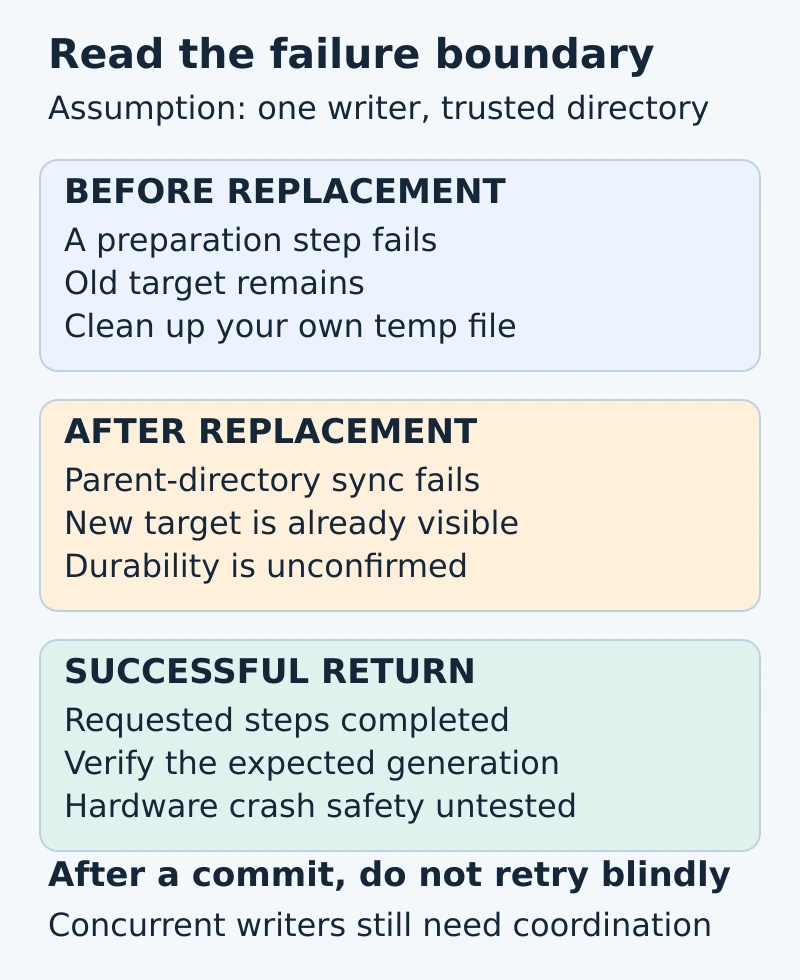
Read the implementation as two regions separated by successful replacement. In the first region, preparation and staging can fail while the old destination remains the published state. In the second, the replacement has already happened. Calling both regions “saving the file” is convenient shorthand, but it is too imprecise for exception design. Give the boundary a name in comments, tests, and the caller’s handling logic.
The staging sequence writes the prepared payload, flushes its buffered stream, synchronizes the file descriptor, and closes the stream before publication. Review the actual control flow rather than searching for the presence of familiar function names. An fsync call placed before a buffered write reaches the operating system would not establish the intended ordering. A replacement in a finally block would be especially dangerous because failed preparation could still reach publication.
Once os.replace returns successfully, set the committed state before performing any remaining operation that can raise. The optional Linux directory synchronization belongs to this later region. If the directory open, synchronization, or close operation raises an OSError, the helper must communicate that the new file was published but the requested post-publication step did not complete cleanly. A distinct exception or structured result can carry that fact. The caller should not need to infer it from a human-readable error string.
Asynchronous interruption needs an extra qualification. A signal, abrupt process termination, or interruption around the replacement syscall and its return can prevent the caller from learning which state was reached. The lab’s injected synchronous errors do not prove that every interruption can be classified. If execution disappears at that boundary, reconcile the current manifest and its identity rather than assuming that an exception or missing acknowledgement proves publication never occurred.
Here, “committed” means this process crossed the publication boundary. It does not claim that no later writer changed the path or that physical storage survived a crash. Keep those meanings separate in naming. For example, a result saying “published, directory synchronization unconfirmed” gives an operator a useful next step. A generic “write failed” message can encourage a harmful retry or a mistaken belief that the older snapshot is still current.
Read and run the offline lab
Download the complete atomic file-write lab (ZIP), including the implementation, walkthrough, author tests, independent tests and execution notes. Extract it into a disposable folder and run the commands in README.md.
The low-level API is replace_bytes(path, data, *, sync_directory=False, max_bytes=1_048_576). It accepts immutable bytes; JSON encoding remains a caller responsibility. The default size ceiling is one mebibyte, which bounds accepted bytes rather than memory already used to build them. Its ordinary path synchronizes the staged file before replacement. Setting sync_directory=True requests the additional Linux-only step; an unsupported platform is rejected before mutation.
For an OSError from directory opening, synchronization, or closing, the post-publication exception is DirectorySyncError, an OSError subclass carrying target and replacement_completed=True. The underlying directory-operation error remains available through exception chaining. Handle this outcome before a generic I/O-error branch. The helper also rejects an existing final symlink or nonregular file during inspection, but those checks do not eliminate races in untrusted directories. They are guardrails within its trusted-path contract.
The implementation below is intentionally small enough to inspect alongside its tests. Start with the public entry point, then follow its error types and helpers. Locate the caller’s creation of the final byte payload in the walkthrough, then identify the helper’s temporary-descriptor ownership transfer, replacement call, and post-commit directory operation. You should be able to point to the precise statement that changes the outcome category.
"""Single-file replacement for bounded bytes in a trusted local directory.

Python 3.12/3.13, standard library only. See README.md for the contract.
"""

from __future__ import annotations

import os
from pathlib import Path
import stat
import sys
import tempfile


class DirectorySyncError(OSError):
    """Replacement succeeded; the post-replacement directory step failed.

    This records an event, not a promise that another writer has not replaced
    the file since. Do not interpret this exception as a rolled-back write.
    """

    def __init__(self, target: Path):
        self.target = target
        self.replacement_completed = True
        super().__init__(
            f"replacement completed for {target}; directory sync/close failed; "
            "crash durability is not confirmed"
        )


def _sync_parent(parent: Path) -> None:
    """Linux-only directory fsync; preserve a sync error if close also fails."""
    fd = os.open(parent, os.O_RDONLY | os.O_DIRECTORY)
    try:
        os.fsync(fd)
    except BaseException as error:
        try:
            os.close(fd)
        except OSError as cleanup_error:
            error.add_note(f"directory descriptor close failed: {cleanup_error}")
        raise
    else:
        os.close(fd)


def replace_bytes(
    path: str | os.PathLike[str],
    data: bytes,
    *,
    sync_directory: bool = False,
    max_bytes: int = 1_048_576,
) -> None:
    """Stage, flush, fsync, close, then replace one path.

    The existing parent must be trusted and stable. An existing final symlink
    or non-regular file is rejected at inspection time, not race-proofed.
    Existing metadata is not preserved. Other writers are not coordinated.

    Default: portable os.replace path, with file fsync but no directory fsync.
    sync_directory=True: Linux-only extra directory step after replacement.
    Its OSError becomes DirectorySyncError because replacement already happened.

    max_bytes bounds accepted payload size, not memory already allocated by
    the caller. Exceptions before replacement trigger best-effort temp cleanup;
    a cleanup failure is attached as an exception note, not silently discarded.
    """
    if not isinstance(data, bytes):
        raise TypeError("data must be immutable bytes; encode text explicitly")
    if type(max_bytes) is not int or max_bytes < 0:
        raise ValueError("max_bytes must be a non-negative integer")
    if len(data) > max_bytes:
        raise ValueError(f"payload exceeds max_bytes={max_bytes}")
    if type(sync_directory) is not bool:
        raise TypeError("sync_directory must be bool")
    if sync_directory and not sys.platform.startswith("linux"):
        raise NotImplementedError("directory sync in this lab requires Linux")

    target = Path(path).absolute()  # Freeze cwd; do not resolve final symlinks.
    try:
        mode = target.lstat().st_mode
    except FileNotFoundError:
        pass
    else:
        if stat.S_ISLNK(mode):
            raise ValueError("the final target must not be a symbolic link")
        if not stat.S_ISREG(mode):
            raise ValueError("an existing target must be a regular file")

    # Same directory avoids a cross-filesystem move; never use shutil.move.
    fd, temporary = tempfile.mkstemp(prefix=".atomic-", dir=target.parent)
    try:
        try:
            stream = os.fdopen(fd, "wb")
        except BaseException as error:
            try:
                os.close(fd)
            except OSError as cleanup_error:
                error.add_note(f"temporary descriptor close failed: {cleanup_error}")
            raise
        with stream:
            if stream.write(data) != len(data):
                raise OSError("short write to staging file")
            stream.flush()                 # Python buffer -> operating system
            os.fsync(stream.fileno())      # Request file data/metadata sync
        os.replace(temporary, target)      # The visibility commit point
        temporary = None                   # Never delete target on later errors
    except BaseException as error:
        if temporary is not None:
            try:
                os.unlink(temporary)
            except FileNotFoundError:
                pass
            except OSError as cleanup_error:
                error.add_note(f"temporary cleanup failed for {temporary}: {cleanup_error}")
        raise

    if sync_directory:
        try:
            _sync_parent(target.parent)
        except OSError as error:
            raise DirectorySyncError(target) from error
The walkthrough creates its own disposable directory. It publishes an initial synthetic manifest, demonstrates how two stale revision updates lose a logical increment, and injects a directory-sync failure after publishing a completed build. Read the visible status and the exception’s commitment flag together. The test suite separately covers failures before replacement and verifies that the original bytes survive. These examples make the difference between byte completeness, revision correctness, and caller knowledge concrete.
"""Run with Python 3.12/3.13. Writes only inside its own temporary directory."""

from pathlib import Path
import json
import os
import stat
import sys
import tempfile
from unittest.mock import patch

from atomic_write import DirectorySyncError, replace_bytes


def main():
    with tempfile.TemporaryDirectory() as directory:
        target = Path(directory) / "build-manifest.json"

        def encode(snapshot):
            return (json.dumps(snapshot, sort_keys=True, allow_nan=False) + "\n").encode("utf-8")

        snapshot = {
            "build_id": "local-0042", "project": "demo-site", "revision": 1,
            "status": "running", "artifacts": [{"name": "index.html", "bytes": 128}],
        }
        replace_bytes(target, encode(snapshot))
        print("ordinary replacement:", target.read_text().strip())

        first = json.loads(target.read_bytes())
        second = json.loads(target.read_bytes())
        first["revision"] += 1
        second["revision"] += 1
        replace_bytes(target, encode(first))
        replace_bytes(target, encode(second))
        print("two stale revision updates:", json.loads(target.read_bytes())["revision"])
        print("expected with isolated updates: 3; actual: 2")

        if sys.platform.startswith("linux"):
            real_fsync = os.fsync

            def fail_directory_sync(fd):
                if stat.S_ISDIR(os.fstat(fd).st_mode):
                    raise OSError("injected directory sync failure")
                real_fsync(fd)

            with patch("atomic_write.os.fsync", side_effect=fail_directory_sync):
                try:
                    snapshot.update(revision=3, status="complete")
                    replace_bytes(target, encode(snapshot), sync_directory=True)
                except DirectorySyncError as error:
                    print("directory-sync error: replacement_completed =",
                          error.replacement_completed)
                    print("visible status after that error:", json.loads(target.read_bytes())["status"])
                    print("do not assume rollback or blindly repeat a logical update")
        else:
            print("directory-sync demonstration skipped: Linux-only lab option")

        print("leftover staging files:", len(list(Path(directory).glob(".atomic-*"))))


if __name__ == "__main__":
    main()
Keep the execution evidence separate from expected behavior. A test name describes an intention; an actual run establishes whether that version passed in that environment. Record interpreter versions, the operating system, the command, and the result with the final artifact. The recorded Linux 6.18.44 runs passed all 25 tests with zero skips on Python 3.12.14 and Python 3.13.5. Temporary directories were explicitly placed on the workspace’s overlayfs filesystem. The walkthrough and compilation checks also passed on both interpreters, and their walkthrough output matched. An independent review added 20 separately written test methods, which also passed on both interpreters. Repeated runs establish compatibility and are not additional unique tests. These are offline software checks. They neither measure DeepSeek’s coding performance nor establish crash resilience through actual power interruption, controller behavior, or storage-device fault testing.
When adapting the helper, rerun the tests after the smallest relevant change. Adding a serializer option, changing when a descriptor closes, or moving a logging statement across the commit boundary can affect the observed behavior. Save the reviewed implementation and tests together. Copying only the short happy-path function into another project discards much of the work that made its failure contract understandable.
Test outcomes and ordering
Begin with positive tests for creation and replacement. Compare the written bytes with the expected serialization and parse the result independently. Test a filename with spaces or non-ASCII characters if your deployment supports it. Check that an existing destination can be replaced and that no temporary file from the successful attempt remains. These assertions establish the mechanics without depending on unreliable timing between competing processes.
Then organize negative tests around the lifecycle. A serialization rejection should occur before temporary-file creation. A staging write failure should preserve the original destination. A temporary-file synchronization failure should prevent replacement. A replacement failure should leave the previous published bytes in place within the stated local-filesystem contract. Each test needs a concrete destination assertion, because merely expecting an exception says little about whether the old data survived.
Python’s mock library supports temporary patching and injected side effects. Patch the name the implementation actually looks up. Keep the patch’s scope narrow, especially when exercising a real temporary directory. A global replacement for a filesystem function can interfere with the test framework’s own cleanup and produce a confusing secondary failure. Prefer an observable operation log or a targeted wrapper when ordering matters, and use real file I/O for the surrounding behavior.
The most important negative test injects an I/O failure after successful replacement. Assert that the distinct post-commit outcome is raised and that fresh reads return the replacement payload. This test should fail if a future refactor labels the outcome as uncommitted, deletes the published file, or restores stale bytes. It converts the recovery rule from a paragraph in documentation into an executable regression check.
Additional generated cases can exercise payload boundaries and serialization choices, as described in our property-based testing guide. They complement the hand-written commit-boundary cases. Random payload variety will not automatically explore the one branch where directory synchronization fails after publication. Keep that state transition explicit even if the rest of the data coverage becomes more automated.
Use the failure matrix
A failure matrix is a compact agreement between the writer and its caller. Read each row as an expected software outcome under the lab’s trusted local-file assumptions. “Unchanged” refers to this attempt’s effect; it does not promise that another authorized writer stayed idle. For a destination that was initially absent, substitute “still absent” in the pre-commit rows.
| Failure point | Published path | Caller interpretation | Next step |
|---|---|---|---|
| Validation or serialization | Unchanged | Rejected before staging | Correct the payload |
| Temporary creation or write | Unchanged | Not published | Inspect resources and cleanup |
| Temporary flush, file synchronization, or close | Unchanged | Not published | Investigate I/O failure |
| Replacement fails | Prior destination remains under the stated contract | Not published | Inspect paths and permissions |
| Directory open, synchronization, or close raises OSError after replacement | Replacement was published | Committed; durability confirmation incomplete | Reconcile before another write |
| Process disappears without reporting | Must be inspected | Caller has incomplete evidence | Read and reconcile identity |
The last row deserves special attention. A process can stop after publication and before sending a success signal to its supervisor. The supervisor cannot reconstruct the outcome from the missing signal alone. Likewise, a Python finally block cannot clean up after every form of termination. Treat unreported attempts as a reconciliation problem, with the snapshot identity and current destination providing evidence.
The matrix also helps reviewers spot misleading abstractions. A wrapper that converts every exception into False erases the difference between the first and fifth rows. A queue consumer that automatically repeats every failed job may cross that same boundary unknowingly. Review the surrounding application code, not only the helper. Its retry policy, alerts, and acknowledgement behavior must preserve the outcome information the helper supplies.
Recover without blind retries
For a confirmed pre-commit rejection, repair the cause before creating another attempt. Unsupported values need a data correction; exhausted storage needs operational attention. Retrying the identical payload rapidly does not address either problem. After an infrastructure failure is corrected, decide whether the original snapshot is still current enough to publish. A newer snapshot may already exist, and the application should not restore a stale build manifest merely because an older job is retryable.
A post-commit durability error requires a different response. Preserve the attempt’s snapshot identifier, capture the stage and underlying error, and read the published document through a new descriptor. Compare the current identity with the intended identity. A match establishes what is currently visible; it does not retroactively prove crash durability. A different identity may mean another writer has already published a later snapshot. Do not overwrite it merely to make the earlier attempt return cleanly.
Restoring a backup after every exception is particularly risky. If publication already succeeded, the “rollback” becomes a new write that can erase a valid replacement or a subsequent writer’s work. A real rollback needs its own authorization, ordering, and consistency rules. This helper therefore reports the state it knows and leaves recovery policy to the application. An operator can investigate an ambiguous result without the library silently making another consequential decision.
Use restrained diagnostic records. An attempt identifier, target label, phase, payload size, and outcome category are generally more useful than logging the entire build manifest. Avoid turning a file-writing error into accidental disclosure of business data. If cleanup left a temporary artifact, report its presence to an appropriate operator. Any later scavenging process should use a documented ownership and age policy, with care around active writers, rather than deleting all files with a familiar suffix.
Recognize concurrent update limits
Unique temporary names prevent writers from sharing one staging file. They do not decide whose snapshot should win. Consider a dashboard refresh that starts slowly, followed by a newer refresh that finishes quickly. The newer document can be published first and then replaced by the older computation. The final JSON remains complete and well formed, but its reported build progress has moved backward. Atomic replacement alone has no concept of generation order.
Adding a revision field is useful evidence, yet checking that field immediately before replacement does not create compare-and-swap. Another writer can publish between the check and the replace. If updates must depend on the exact version previously read, introduce coordination covering the entire read, decision, and write sequence. Specify which processes participate and what happens when a holder crashes. Do not present an unrelated lock around only the final rename as a complete lost-update solution.
For authoritative state with multiple writers, a transactional storage system may be the clearer boundary. SQLite’s atomic-commit documentation describes a broader protocol involving locking, journaling, synchronization, and recovery. Its design illustrates why a small replacement helper should not claim equivalent transaction semantics. Our database migration guide is a separate workflow for changing database structures; the decision here is whether the data belongs in transactional storage in the first place.
Account for permissions and metadata
Replacement publishes the staged file as a new filesystem object at the destination name. This lab does not preserve the previous file’s ownership, permissions, ACLs, extended attributes, timestamps, or hard-link relationships. That limitation matters when a producer and consumer run under different accounts. A successful byte-level test under your own user can hide an access failure that appears only when the dashboard service tries to open the published file.
Decide the metadata policy before deployment. If the application needs a particular access mode, treat its application and verification as explicit work with failure handling and tests. Do not casually copy every property from the destination: some properties may be inappropriate, unavailable, privileged, or subject to races. The correct policy depends on who owns the directory, who reads the output, and which operating-system controls the service relies on.
Also review what is watching the path. A consumer that reopens the name for each snapshot fits the publication model better than one that expects an existing descriptor to change contents underneath it. A file watcher may need to react to replacement rather than only in-place modification. Test the actual consumer behavior in staging. The writer’s successful return is only one part of proving that the application can use the new document.
Run a focused review revision loop
After the first implementation, ask DeepSeek for a contract review without requesting a rewrite immediately. Supply the code, the failure matrix, and the test names. Ask it to identify any path that mutates the destination before commit, any path that misclassifies a post-commit error, and any resource whose ownership becomes unclear. Require each finding to name a concrete branch and an observable consequence. This keeps review comments tied to behavior.
Then choose one finding and turn it into a failing test before revising the helper. For example, if directory-sync failures currently look like ordinary rejection, first assert that the new payload remains published and that the caller receives a distinguishable outcome. Apply the smallest change that satisfies that test, then run the full suite. Our DeepSeek code review workflow provides a broader structure for evaluating suggested patches and recording evidence.
Finally, ask a second review question: what claims in the documentation exceed the implementation or tests? Look for phrases such as “crash-proof,” “safe on every filesystem,” and “thread-safe” without a precise definition. Replace them with the actual assumptions and verified checks. A model can help enumerate omissions, but the maintainer still owns the test execution, supported-platform policy, and decision to deploy.
Troubleshoot deployment failures
If replacement fails, inspect the destination’s parent directory, the temporary file’s location, and the operation’s recorded error. Confirm that both paths belong to the intended filesystem and that the process can modify the directory. Avoid adding a direct-write fallback as a quick fix. It would change the failure contract exactly when the environment is already behaving unexpectedly. Reproduce the problem with disposable data under the same service account where possible.
If a test claims the destination changed after a supposed pre-commit failure, first verify where the failure was injected. The test may have allowed replacement and failed later. If the destination did remain unchanged but temporary files accumulate, inspect cleanup errors and termination paths separately. A cleanup defect and a publication defect are different problems, and combining them under one generic alert makes investigation slower.
If readers report outdated data after successful writes, inspect snapshot identities and scheduling order before blaming JSON parsing. Check whether a reader holds an older descriptor or a slower producer published late. If Linux directory synchronization fails, retain the committed-but-unconfirmed classification and investigate support and I/O conditions in the deployed environment. Do not convert the error into a durability guarantee because the file happens to be readable immediately afterward.
Apply the release checklist
- State the supported local environment, trusted path assumptions, and payload bounds.
- Complete business validation and serialization before staging.
- Create a unique temporary file in the destination directory.
- Verify write, flush, file synchronization, close, and replacement ordering.
- Classify optional directory-sync errors as post-commit outcomes.
- Check old bytes after pre-commit failures and new bytes after post-commit failures.
- Preserve the primary error if temporary cleanup also fails.
- Document last-writer-wins behavior and metadata limitations.
- Review the caller’s retries, logs, and recovery decisions.
- Record actual test execution without claiming power-loss or model evaluation.
The useful result of this exercise is a caller that understands what happened. It can distinguish rejected input, an unpublished attempt, and a published replacement whose durability confirmation needs attention. That distinction protects recovery logic from turning a manageable I/O problem into an unnecessary overwrite. DeepSeek can help propose code and challenge its branches, while the contract and executable tests keep the final decision grounded in observable behavior.
Sources & References
The primary references below support the platform and library semantics discussed above. The build-manifest scenario, prompt, review procedure, and recovery walkthrough are original teaching examples. Consult the documentation for the exact Python version and operating system you deploy.
- Python 3.13 documentation: os — replacement and synchronization APIs.
- Python 3.13 documentation: tempfile — unique temporary creation and resource ownership.
- Python 3.13 documentation: json — serialization behavior and non-finite numbers.
- Python 3.13 documentation: unittest.mock — patching and injected side effects.
- Linux man-pages: fsync(2) — file and directory synchronization.
- Linux man-pages: rename(2) — replacement visibility and descriptor behavior.
- SQLite: Atomic Commit — the broader transactional-storage boundary.
- DeepSeek official API documentation — current service documentation, separate from this offline lab.
