


A configuration loader can accept a perfectly valid TOML document and still start an application with an unusable setting. A worker count can have the wrong type, an environment override can silently replace an important value, or an error message can print material that never belonged in a log. DeepSeek can help review these decisions and propose tests, provided the application contract comes first. The useful question is whether every accepted configuration has a deliberate meaning and every rejected configuration fails safely.
This tutorial develops that contract around a small, offline Python lab. It accepts TOML text and an explicitly supplied environment mapping, validates each supplied layer, and returns a frozen configuration object only when everything is valid. It does not read the process environment, open configuration files, contact DeepSeek, or retrieve secrets. The prompts later in the article are illustrative requests you can adapt for a code review. They are not transcripts of model responses or evidence that a model tested this implementation.
Define the configuration contract before writing a loader
Our example describes a fictional service with four top-level settings: service_name, workers, timeout, and debug. The service name is required. The other settings have defaults: four workers, a ten-second timeout, and debug disabled. Only three environment variables can override those defaults or file values: APP_WORKERS, APP_TIMEOUT, and APP_DEBUG. There is deliberately no service-name override. This creates a small enough interface that a reviewer can enumerate its behavior without needing to understand a deployment platform.
The service name must be a string containing one to forty-eight ASCII characters. It starts with a lowercase letter, continues with lowercase letters or digits, and may contain single hyphens separating nonempty groups. Examples such as queue and queue-worker-2 fit the rule. Uppercase letters, underscores, surrounding spaces, consecutive hyphens, and a trailing hyphen do not. The exact grammar is [a-z][a-z0-9]*(?:-[a-z0-9]+)*. This is a local naming policy for the example, not a claim that every hosting service uses these rules.
Workers must be an integer between one and thirty-two, inclusive. Timeout is measured in seconds and must represent a finite number greater than zero and no greater than one hundred twenty. Debug must be a Boolean in TOML. The distinction between type and value matters: the number one is valid for workers, but the Boolean true is not; the Boolean false is valid for debug, but the number zero is not. Writing these distinctions down prevents a convenience conversion from quietly changing the contract.
The document must also have the expected shape. Unknown keys and tables are errors, including a plausible-looking extra setting copied from another service. A strict configuration file is easier to audit when misspellings cannot disappear into unused data. The environment is different: unrelated names are ignored because an application normally shares that namespace with its operating context. These choices belong in the contract separately. Applying the file’s unknown-key policy to every environment variable would make an otherwise harmless caller mapping unusable.
Specify precedence and validation as separate decisions
The winning-value order is defaults, then TOML, then explicit environment overrides. Suppose the file requests eight workers and the supplied mapping contains APP_WORKERS with the string 12. The final worker count is twelve. If that variable is absent, the file’s eight workers remain. If both sources omit the field, the default four workers remain. This rule is easy to describe, but it does not yet answer what should happen when an earlier layer contains an invalid value.
This lab validates every supplied configuration value before selecting the final result. A file containing workers equal to zero remains invalid even if APP_WORKERS contains a valid twelve. That is a deliberate policy choice: an override must not conceal a broken checked-in file. An alternative system could validate only the effective merged values, but it would have a different contract and need different tests. Ask which behavior your operators expect before accepting an implementation that merges dictionaries and validates only afterward.
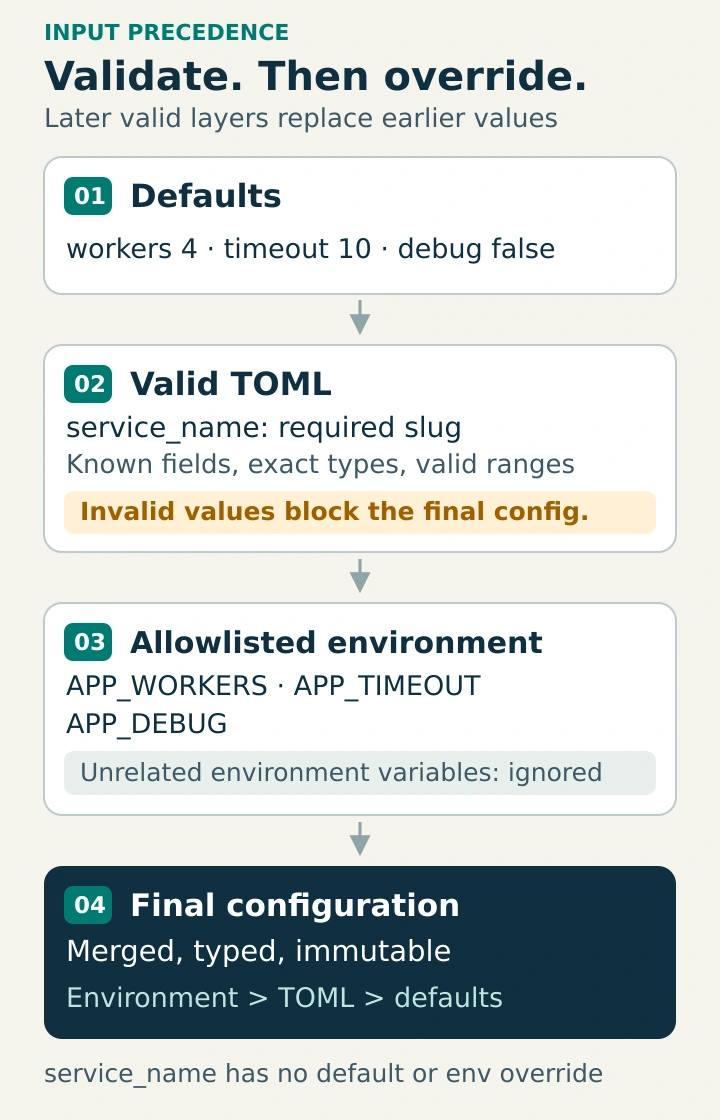
The strict policy helps when environments drift. Imagine a staging deployment that has carried a valid override for months. Someone introduces an invalid file value, but staging continues to work because the override hides it. A later deployment omits that variable and fails unexpectedly. Validating the supplied file even when it loses precedence makes that particular mistake visible earlier. This reasoning supports the example’s choice; it does not mean every layered settings system should reject all unused values in every possible context.
Absence and emptiness need separate treatment. An absent override means that the earlier layer remains eligible. An empty string means someone supplied an override with no valid value, so the load fails. Expressions that select the environment value only when it is truthy erase this distinction. The same problem appears when code silently trims whitespace or treats conversion failures as a request for the default. Those behaviors may seem forgiving, but they make the actual deployment harder to reconstruct from its declared inputs.
Preserve this order in tests as well as documentation. Test a default alone, a file replacement, an environment replacement, an absent override, an empty override, and an invalid file value beneath a valid override. Each case answers a different question. A test that checks only the final twelve-worker result proves neither that empty variables are rejected nor that the file was validated. Precedence is a family of observable decisions rather than a single successful dictionary merge.
Keep TOML types separate from environment text
Python’s standard-library tomllib module is available from Python 3.11 and parses TOML into Python values. Its loads function accepts a string, and its parse_float hook lets a caller choose how floating-point tokens are converted. The lab uses that hook to retain decimal input for validation before constructing the final timeout float. Parsing supplies structure and types; the application still has to decide which structures, values, and combinations it supports. A document can satisfy TOML syntax while violating every useful application rule.
The worker check must reject Boolean values explicitly. Python documents Boolean as a subtype of integer, so a broad integer instance check can accept true where a count was intended. In this loader the accepted type is the exact integer type produced for TOML integers, followed by the range check. Likewise, debug requires the exact Boolean type. This narrow approach is appropriate for a parser boundary with known input types; it is not a general recommendation to reject subclasses throughout ordinary application code.
Timeout has two boundaries. First, the parsed number must satisfy the exact configured interval. Then the converted runtime float must still be finite and positive. Consider a decimal token just above 120 that rounds to 120.0 during float conversion: checking only the converted float can conceal the out-of-range input. At the other end, an extremely small positive decimal can become zero as a float. The loader rejects that unusable result instead of quietly turning a positive timeout into an immediate deadline.
TOML permits special floating-point values including infinity and NaN. Their presence in the format does not make them suitable for this timeout. The lab rejects them before returning a configuration. Python’s math.isfinite function checks the final float for infinity and NaN, while a separate positive-value check rules out zero. Keeping these conditions visible is more reviewable than relying on a complicated comparison whose behavior with unusual numeric values might be misunderstood.
Give each environment override a small explicit grammar
The supplied mapping contains text, so the environment layer needs a grammar before it can have useful types. APP_WORKERS accepts one or two ASCII decimal digits with no leading zero, then applies the one-to-thirty-two range. Thus 8 and 32 are valid, while 08, +8, 8.0, and a value surrounded by spaces are not. This intentionally avoids importing every input spelling that a general-purpose numeric conversion might accept. A deployment can generate one documented spelling consistently.
APP_TIMEOUT accepts an unsigned decimal form with an optional fractional part and optional exponent. It requires a digit before the decimal point and digits after it when the point is present. The exponent can have a plus or minus sign and one to three digits. Examples such as 0.5, 10, and 1e2 are within the lexical grammar; .5, 1., +10, 01, and 1_0 are not. Passing the grammar is only the first step: the exact value must still lie in the timeout interval.
APP_DEBUG accepts exactly the lowercase strings true and false. Spellings such as TRUE, yes, on, and 1 fail instead of becoming aliases. Most importantly, the implementation must never convert a nonempty string directly with bool and assume it has interpreted a textual Boolean. The literal string false must produce a disabled flag. Test that case independently, because a deployment that can enable debug but cannot reliably disable it is a particularly costly place for permissive conversion.
The environment grammar is intentionally narrower than TOML’s numeric notation. The file layer delegates syntax to the TOML parser and then checks the resulting types and values. The environment layer accepts the specific textual interface just described. Reviewers should not assume that every accepted TOML spelling must also work as an environment override. Consistency here means predictable, documented behavior at each boundary, not forcing two different input formats to share every spelling.
There are also size limits: at most 8,192 characters of TOML text, at most 64 characters in each float token supplied to parse_float, and at most 64 characters for a recognized environment value. These are example resource limits, not a universal security guarantee. They prevent the lab from accepting arbitrarily long text through those interfaces and keep edge cases manageable. The float-token limit does not apply to TOML integer tokens; the document limit still bounds the complete input. These limits count characters rather than file bytes. A production adapter must decide its byte-reading limit separately, before constructing the string passed to this loader.
Collect useful errors without echoing submitted data
A configuration failure should tell an operator what to fix without printing the submitted configuration. The lab raises ConfigError, a ValueError subclass with an errors tuple. Its field-level diagnostics use recognized field or environment labels and fixed explanations. They do not include submitted values. Unknown keys receive a generic message rather than having their names echoed. Even a key can contain an accidentally pasted credential, so treating keys as automatically safe would weaken the same logging boundary.
When the document parses successfully, independent field errors are collected together. Their order is stable: the generic unknown-key issue first, then the TOML fields service_name, workers, timeout, and debug, followed by APP_WORKERS, APP_TIMEOUT, and APP_DEBUG. This ordering gives an operator a useful repair list and makes assertions reproducible. The error collection is also all-or-nothing: no configuration object is returned alongside warnings that leave the caller to decide whether a partly valid service should start.
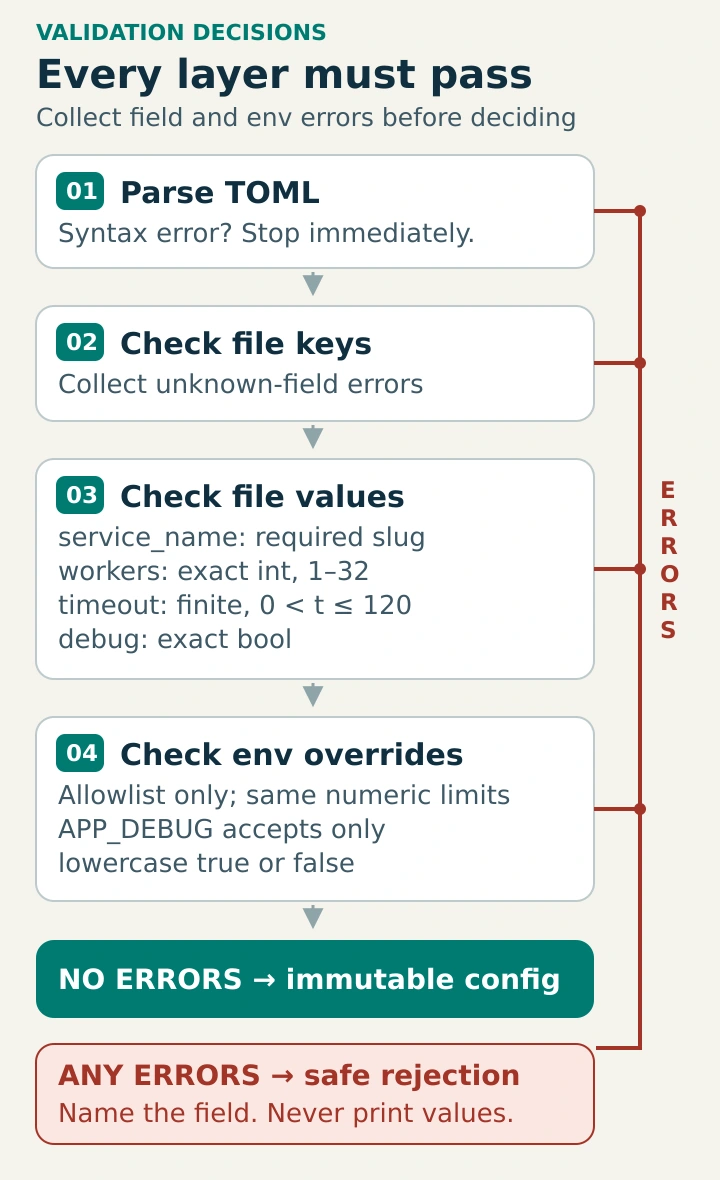
Document parsing and resource failures stop at the document stage. Once syntax is malformed, the loader cannot reliably interpret the remaining fields as an application configuration. Aggregating invented field errors after that failure would create false precision. The public exception should use a safe message instead of exposing the original parser exception text. Test the formatted traceback as well as str(error), because an exception chain can reveal an underlying message even when the top-level error looks properly redacted.
Safe diagnostics have a practical cost: an operator may need to open the approved configuration source to locate a bad value. That is preferable to making central logs another copy of all input. A production system can supplement fixed errors with safe metadata such as a release identifier, schema version, or known field source. Decide explicitly which metadata is permitted. Adding a convenient dump of the original mapping during an incident can undo the error design in a single logging statement.
Run the offline loader and inspect the public boundary
The complete implementation below is designed for Python 3.11 or later and uses the standard library. It takes the TOML document as text and receives the environment mapping from its caller. The download contains the loader and its associated tests so that the behavior can be checked without creating credentials or contacting a model service. Keep those inputs synthetic while you explore the examples. A sample service name and invented worker counts are sufficient to exercise every rule in this article.
Verification on October 5, 2026: the 63-test author suite passed on Python 3.12.14 and Python 3.13.5, in both normal and optimized execution, for four successful suite runs. The walkthrough also completed successfully in all four configurations. Python 3.11 was not available and was not executed; its inclusion in the intended compatibility range follows the required standard-library APIs. These checks cover this offline core and walkthrough, not a production deployment or an operating-system compatibility matrix.
Download the complete configuration-validation lab with the loader, runnable walkthrough, tests and instructions.
"""Offline, standard-library configuration boundary for Python 3.11+.

Call load_config(text, explicit_environment). No file, process-environment,
network, credential, or secret access happens here.
"""

from collections.abc import Mapping
from dataclasses import dataclass
from decimal import Decimal, InvalidOperation, localcontext
from math import isfinite
import re
import tomllib
from typing import cast


MAX_SOURCE_CHARS = 8192
MAX_NUMBER_CHARS = 64
MAX_ENV_CHARS = 64
FIELDS = ("service_name", "workers", "timeout", "debug")
ENV_FIELDS = (
    ("APP_WORKERS", "workers"),
    ("APP_TIMEOUT", "timeout"),
    ("APP_DEBUG", "debug"),
)
SLUG = re.compile(r"[a-z][a-z0-9]*(?:-[a-z0-9]+)*")
ENV_INTEGER = re.compile(r"[1-9][0-9]?")
ENV_NUMBER = re.compile(
    r"(?:0|[1-9][0-9]*)(?:\.[0-9]+)?(?:[eE][+-]?[0-9]{1,3})?"
)
RULES = {
    "service_name": "expected a 1..48 character lowercase ASCII slug",
    "workers": "expected an integer in 1..32",
    "timeout": "expected a finite number in (0, 120] yielding a positive float",
    "debug": "expected a boolean",
}


@dataclass(frozen=True, slots=True)
class AppConfig:
    """Read-only result; the loader, not annotations, performs validation."""

    service_name: str
    workers: int
    timeout: float
    debug: bool


class ConfigError(ValueError):
    """Fixed public diagnostics; never put input data in these messages."""

    def __init__(self, errors: list[str]) -> None:
        self.errors = tuple(errors)
        super().__init__("; ".join(self.errors))


def _decimal(token: str) -> Decimal:
    if len(token) > MAX_NUMBER_CHARS:
        raise ValueError("numeric token exceeds the resource limit")
    # A local context keeps invalid extreme exponents from changing caller flags.
    # Decimal construction from text is exact, regardless of context precision.
    with localcontext() as context:
        context.traps[InvalidOperation] = True
        return Decimal(token)


def _validate(field: str, value: object) -> str | int | float | bool:
    if field == "service_name":
        if type(value) is str and 1 <= len(value) <= 48 and SLUG.fullmatch(value):
            return value
    elif field == "workers":
        # isinstance(True, int) is True; this boundary requires the exact type.
        if type(value) is int and 1 <= value <= 32:
            return value
    elif field == "timeout":
        if type(value) in (int, Decimal):
            exact = Decimal(value)
            if exact.is_finite() and 0 < exact <= 120:
                result = float(exact)
                if isfinite(result) and 0 < result <= 120:
                    return result
    elif field == "debug":
        if type(value) is bool:
            return value
    raise ValueError(RULES[field])


def _environment_value(field: str, value: object) -> int | Decimal | bool:
    if type(value) is not str or not 1 <= len(value) <= MAX_ENV_CHARS:
        raise ValueError("expected a nonempty string of at most 64 characters")
    if field == "workers" and ENV_INTEGER.fullmatch(value):
        return int(value)
    if field == "timeout" and ENV_NUMBER.fullmatch(value):
        return _decimal(value)
    if field == "debug" and value in ("true", "false"):
        return value == "true"
    raise ValueError("invalid override spelling")


def load_config(text: str, environment: Mapping[str, str]) -> AppConfig:
    """Validate every supplied layer, then apply defaults < TOML < explicit env.

    Unknown TOML keys fail without echoing their names. Unrelated environment
    names are ignored. Invalid lower-priority values cannot be hidden by an
    override. Syntax/resource errors stop parsing; field errors are aggregated.
    """
    if type(text) is not str:
        raise ConfigError(["document: expected text"])
    if len(text) > MAX_SOURCE_CHARS:
        raise ConfigError(["document: exceeds 8192 characters"])
    if not isinstance(environment, Mapping):
        raise ConfigError(["environment: expected a mapping"])
    try:
        source = tomllib.loads(text, parse_float=_decimal)
    except (ValueError, InvalidOperation, RecursionError):
        # TOMLDecodeError subclasses ValueError. Do not expose parser messages.
        raise ConfigError(["document: invalid or unsupported TOML"]) from None

    errors: list[str] = []
    values: dict[str, str | int | float | bool] = {
        "workers": 4,
        "timeout": 10.0,
        "debug": False,
    }
    if any(field not in FIELDS for field in source):
        errors.append("document: unknown fields are not allowed")
    for field in FIELDS:
        if field not in source:
            if field == "service_name":
                errors.append("service_name (TOML): required field is missing")
            continue
        try:
            values[field] = _validate(field, source[field])
        except ValueError:
            errors.append(f"{field} (TOML): {RULES[field]}")
    for env_name, field in ENV_FIELDS:
        if env_name not in environment:
            continue
        try:
            parsed = _environment_value(field, environment[env_name])
            values[field] = _validate(field, parsed)
        except (ValueError, InvalidOperation):
            errors.append(f"{env_name} (environment): invalid override")
    if errors:
        raise ConfigError(errors)
    return AppConfig(
        service_name=cast(str, values["service_name"]),
        workers=cast(int, values["workers"]),
        timeout=cast(float, values["timeout"]),
        debug=cast(bool, values["debug"]),
    )
The public entry point is load_config(text, environment), and its result type is AppConfig. The environment argument is mandatory: pass an empty dictionary when there are no overrides. This small requirement makes the source of settings visible at each call site. A caller cannot accidentally request a load that depends on whatever happens to be in the developer’s terminal session. It also makes a bug report more useful, because a minimal reproduction can include both explicit inputs.
The returned dataclass is frozen and contains only the four validated scalar settings. Normal field assignment is therefore rejected after construction. Python describes frozen dataclasses as emulating read-only instances; this is a useful protection against accidental mutation, not an isolation mechanism against hostile code inside the process. Its purpose here is modest: application code receives a settled configuration instead of a mutable dictionary whose values can change between startup and the first unit of work.
Callers should obtain their settings through load_config rather than constructing AppConfig directly. The dataclass describes the result and prevents normal reassignment; its annotations do not perform this loader’s runtime validation. Keeping construction behind the loader is therefore part of the integration discipline. If your application needs alternative constructors, test their invariants explicitly instead of assuming that a shared result type makes every construction path equivalent.
A minimal valid document supplies only a service name such as queue-worker. With an empty mapping, its expected settings are four workers, a timeout of 10.0 seconds, and debug false. Add a valid workers value to the document and that field replaces its default. Supply APP_WORKERS with the string 12 and the environment replaces the file value, provided all supplied values remain valid. These are expected contract results, not observations about a live service or claims about DeepSeek-generated output.
"""Article walkthrough: keep this file beside reader_lab.py, then run it."""

from dataclasses import FrozenInstanceError

from reader_lab import ConfigError, load_config


def main() -> None:
    # These are synthetic strings, not os.environ or files on your machine.
    source = '''
service_name = "reader-api"
workers = 6
timeout = 2.5
debug = false
'''
    overrides = {"APP_WORKERS": "8", "APP_DEBUG": "true"}
    original = overrides.copy()
    config = load_config(source, overrides)
    print("Resolved:", config)
    print("Defaults:", load_config('service_name = "reader-api"', {}))
    print("Input mapping unchanged:", overrides == original)

    # Every supplied layer must be valid, including values later overridden.
    try:
        load_config('service_name = "reader-api"\nworkers = true',
                    {"APP_WORKERS": "8"})
    except ConfigError as error:
        print("Invalid TOML cannot be hidden:", error)

    # Related field errors are reported together; submitted values are omitted.
    invalid = '''
service_name = "Bad Name"
workers = 0
timeout = inf
debug = "false"
'''
    try:
        load_config(invalid, {"APP_DEBUG": "FALSE"})
    except ConfigError as error:
        print("All field errors:")
        for issue in error.errors:
            print(" -", issue)

    # Validate the exact decimal before converting to a runtime float.
    # A binary-float-first check could round the first value down to 120.0.
    for token in ("120.000000000000000001", "1e-999"):
        try:
            load_config('service_name = "reader-api"', {"APP_TIMEOUT": token})
        except ConfigError as error:
            print("Rejected numeric edge:", error)

    # Unrelated names in an explicitly supplied mapping are not config fields.
    ignored = {"OTHER_SETTING": "example", "APP_SERVICE_NAME": "ignored"}
    print("Unrelated names ignored:",
          load_config('service_name = "reader-api"', ignored).service_name)

    # frozen=True prevents ordinary mutation; it is not a security sandbox.
    try:
        config.workers = 99
    except FrozenInstanceError:
        print("Config fields are read-only")

    # There is intentionally no API key field. Load secrets separately in a
    # real application's approved secret boundary; never log them with config.


if __name__ == "__main__":
    main()
Integrate the loader through a small adapter rather than moving file access, environment discovery, and validation into one function. The adapter can choose the file, read a bounded amount of text using an explicit encoding, and provide selected environment values. The core remains deterministic for ordinary input mappings. If you later add a command-line interface, the related guide to DeepSeek-assisted Python CLI tools provides a separate starting point for that interface. Its behavior should be tested without changing this configuration contract accidentally.
Build tests around the ways configuration can be wrong
Begin with small fixtures that each make one decision visible. The worker boundary needs accepted cases at one and thirty-two, rejected cases at zero and thirty-three, and rejected types such as a Boolean, a float, a quoted number, and an array. Avoid checking only values comfortably inside the range. A validator can correctly accept eight while mishandling both endpoints. Keep the fixture’s other fields valid so that a failure points to the worker rule rather than an unrelated missing service name.
Service-name tests should cover the minimum and maximum lengths, a valid internal hyphen, an invalid double hyphen, leading and trailing separators, whitespace, uppercase letters, and a non-ASCII character. Give accepted and rejected names comparable shapes so the reason for the outcome is obvious. A forty-eight-character valid name and a forty-nine-character near-copy make a better boundary pair than unrelated short and long strings. The aim is to show precisely where the naming policy changes its decision.
For timeout, separate lexical validity, mathematical range, and runtime representability. Test a normal fraction, both relevant endpoints, a negative number, infinity, NaN, an exact decimal just above the upper limit, and a positive decimal that becomes zero when converted. Add a valid exponent spelling and invalid environment spellings. Do not write one large parameterized list whose assertion merely says that something failed. Identify which rule the fixture exercises so later maintainers can tell whether changing it would be a compatible improvement or a contract change.
Precedence tests should deliberately disagree across layers. A test where both the file and environment request eight workers cannot establish which source won. Use distinct valid values, then add an invalid lower-priority value under a valid override to prove the strict-layer policy. Also test a mapping containing an unrelated key. If that unrelated value resembles a setting, it should still have no effect because only the three exact recognized environment names belong to the loader’s interface.
Aggregation tests need multiple simultaneous defects and an exact expected ordering. Redaction tests should plant an unmistakable synthetic marker in a submitted value and in an unknown key, then confirm that the marker is absent from the public error and formatted traceback. Use a fake marker, never a real secret. Repeat this for malformed TOML because parser failures travel through a different branch. A single successful redaction example does not establish that every error path respects the same boundary.
Finally, test relationships between runs. Identical explicit inputs should produce equal settings. Altering an ignored mapping entry should leave the result unchanged. Changing one valid override should affect only its corresponding field. A rejected load should not mutate the caller’s mapping. These are useful candidates for the methods discussed in DeepSeek and property-based testing, although the essential examples should remain readable without an additional testing dependency. Generated cases complement an explicit contract; they cannot choose that contract for you.
Use DeepSeek to challenge a written specification
Start a DeepSeek review with the contract and a small sanitized implementation. A prompt that merely asks for a robust configuration loader leaves the most important policy decisions unspecified. The model may reasonably propose trimming strings, accepting extra Boolean spellings, ignoring unknown keys, or validating only the merged result. Each suggestion could be useful in another application. In this exercise it must be judged against the stated interface rather than accepted because it produces concise or familiar-looking code.
Use this illustrative contract-review prompt before requesting changes: “Review this configuration specification for ambiguous behavior. Separate questions about TOML syntax, field types, environment text, precedence, diagnostics, and resource limits. Identify decisions that need explicit tests. Do not invent deployment requirements or change any rule. Use only the synthetic examples provided.” Follow it with the schema and precedence policy from this article. The expected deliverable is a list of review questions and proposed test cases, which you can assess without running generated code.
A second illustrative prompt can focus on adversarial examples: “Given this loader and its contract, propose minimal inputs that would violate the contract if the implementation were wrong. For each, identify the exact rule, the expected accepted result or error category, and the smallest regression test. Pay particular attention to Boolean-versus-integer confusion, invalid shadowed file values, decimal timeout boundaries, empty overrides, and accidental value disclosure. Do not claim to have executed anything.” This makes evidence requirements explicit while preserving the reviewer’s responsibility to verify each case.
Once a failing test exists, narrow the repair request: “Suggest the smallest change that makes this failing test pass while preserving the existing contract. Explain which validation stage changes and which existing tests could regress. Do not add dependencies, read the process environment, or introduce network access.” Supply the relevant function and failure output after removing sensitive content. A narrow request is easier to review than asking for a complete rewrite whenever one boundary condition fails.
Treat every proposed defect as a hypothesis until it is reproduced or supported by direct inspection. If the model suggests a case that already passes, keep the useful coverage without inventing a bug. If it proposes a broader grammar, decide separately whether to change the product contract. The related DeepSeek code-review guide is useful context for organizing that review. Neither fluent explanation nor a long generated test file substitutes for independently executing the tests against the actual code under consideration.
Keep dotenv and operating-system behavior outside the claim
A dotenv file is an additional input source with its own parser and loading rules. This lab does not read one. If your application uses dotenv tooling, decide where its output belongs in precedence and which component is responsible for quoting, interpolation, duplicate names, empty values, and existing environment variables. Consult the documentation for the exact tool and version you choose. It would be misleading to describe this example as a universal dotenv validator when it only receives an already constructed mapping.
That separation makes integration tests easier to design. Use a disposable dotenv fixture containing harmless invented values, run the chosen loader in an isolated test context, and inspect the mapping delivered to the configuration function. Then run the normal configuration tests against that mapping. This checks two distinct interfaces: how text becomes environment-like strings, and how recognized strings become typed settings. Do not infer the first behavior from the second or patch the pure validator to compensate for undocumented adapter behavior.
Operating-system environment handling also deserves a separate test boundary. Python’s os documentation notes that os.environ maps environment names and values to strings, with Windows keys converted to uppercase. The lab’s ordinary dictionary fixtures do not reproduce every platform’s environment behavior. Their exact-key matching therefore establishes the explicit-mapping contract only. If your deployment adapter passes os.environ, test that adapter on the supported platforms instead of claiming cross-platform deployment equivalence from an offline run on one machine.
Similarly, a valid service name does not authorize a file path, identify a cloud account, prove a host exists, or grant permission to start a service. A timeout inside the permitted interval does not prove an upstream dependency can meet it. Keep configuration validation focused on guarantees the loader can actually establish. Operational checks belong to the components with the required context, and their failure handling should remain distinguishable from a malformed local setting.
Review configuration changes as deployment changes
Before adopting this pattern, examine the real startup sequence. Determine who selects the configuration file, when overrides are captured, and whether multiple workers share one resolved snapshot. A correct validator can still be integrated incorrectly if different parts of an application read different sources at different times. The deployment review should identify a clear point where validated settings become the application’s startup configuration, with subsequent changes handled through an explicit reload or restart policy.
Review defaults with the same care as explicit values. A default worker count is a resource decision, and a default timeout affects how long work can remain outstanding. The numbers in this lab make examples concrete; they are not capacity recommendations for an unknown service. If a future release changes a default, configurations that omit that field change behavior without editing their files. Include that effect in release review and add a regression fixture for the previous behavior when compatibility matters.
Decide what happens during a failed reload before enabling one. The startup loader returns no partial result, but a running service could deliberately keep its previous validated snapshot while reporting that a replacement failed. That is a separate availability policy, not a reason to accept part of the new configuration. Test that the old snapshot remains intact and that operators can distinguish the currently active configuration from the rejected candidate.
Plan schema evolution before broadening the accepted keys. Strict unknown-key rejection catches mistakes, but it also means a newer configuration can fail under an older binary during rollback. A deployment process must pair compatible artifacts or deliberately introduce a migration strategy. Avoid weakening validation simply to make every future file load successfully. A small schema version or a controlled compatibility window may help a larger application, but either addition needs its own defined semantics and tests.
Keep sensitive production configuration out of model prompts. The lab can expose its complete interface using invented names and values, so there is no need to paste an environment dump or a deployment manifest containing credentials. Review source labels, traces, and surrounding context as well as obvious value strings. The DeepSeek privacy and data-minimization guide discusses reducing what you send for assistance. A redacting loader protects one output path; it does not automatically sanitize material copied manually into a review request.
The final acceptance check should connect the prose, code, and tests. Can a maintainer point from each rule to a validation branch and a meaningful test? Does an invalid input prevent construction of the settings object? Are public errors safe in the actual logging path? Does the adapter preserve the intended distinction between absent and empty overrides? Answering those questions provides a concrete review outcome. “The configuration loads” is only one successful example among many required behaviors.
A reliable loader makes every boundary visible
DeepSeek is most useful in this workflow when asked to challenge a small, explicit contract and suggest falsifiable tests. The application owner still chooses the accepted language, precedence policy, numeric boundaries, disclosure rules, and deployment behavior. The offline lab keeps those choices observable: supplied layers are validated, allowed overrides are narrow, invalid settings produce safe errors, and successful loads return a settled object. Extend that pattern only when you can describe the new behavior clearly enough to test its failures as well as its happy path.
Sources & References
The implementation policy, synthetic scenarios, review prompts, and testing recommendations above are original examples for this tutorial. The primary references were checked on October 5, 2026. They support the specific Python and TOML behavior discussed; they do not establish that this lab is suitable for every deployment.
- Python 3.11 tomllib documentation: string parsing, parse_float, conversion behavior, and TOMLDecodeError.
- TOML version 1.0.0 specification: supported syntax and special floating-point values.
- Python built-in types documentation: Boolean’s relationship to the integer type.
- Python decimal documentation: decimal values and conversion from textual numeric input.
- Python math.isfinite documentation: checking for finite float values.
- Python dataclasses documentation: frozen instances and normal assignment behavior.
- Python os.environ documentation: process-environment mappings and Windows key normalization.

[…] build may legitimately contain no artifacts. Readers who need that earlier stage can use our configuration validation workflow to structure explicit contracts and rejection […]
[…] as an instruction to call int(). Each choice changes the interface. The same distinction matters in configuration validation with DeepSeek: recognizing an accepted value and converting an unaccepted value into something else are separate […]