


DeepSeek context caching can lower the cost of repeated input, but the useful target is a cheaper successful task, not the highest possible cache-hit percentage. A long reusable document followed by short questions is a good candidate. A different document on every request, a timestamp inserted before the reusable material, or an answer dominated by output tokens may deliver much smaller savings. You need a stable prompt layout, an honest cost ledger, and a quality check before calling the optimization successful.
This guide focuses on the engineering decisions behind that result: which prefixes can be reused, how to measure observed hits, how to calculate savings without double-counting tokens, and how to preserve access controls while sharing infrastructure. It uses the public DeepSeek API documentation checked on October 2, 2026. All numerical examples are synthetic, and the accompanying Python arithmetic and validation tests run offline. No paid API experiment or measured latency benchmark is claimed.
If you still need authentication, request construction, or streaming basics, start with our DeepSeek API integration guide. Here, the central question is narrower: after an application already works, how can you make repeated context less expensive without changing what the application is allowed to do?
1. Understand what the cache reuses
A useful mental model is a library of reusable input prefixes. The provider can reuse work associated with a qualifying earlier prefix while processing the remainder of a new request. The request still needs the relevant conversation and document content. Caching does not let an application omit that context and assume the model remembers an earlier call, and it does not return a previously generated answer as a fixed response.
DeepSeek documents automatic disk caching and matching against complete persisted prefix units. Its examples distinguish extending an earlier sequence, such as A+B followed by A+B+C, from merely sharing a beginning. In the latter example, A+B and A+C first establish a reusable common A; a later A+D can use it. Treat those letters as input sequences, not literal API fields or instructions to create a special cache object.
This distinction matters when diagnosing a surprising second request. A team may send the same document twice with different questions and expect an immediate discount on all document tokens. A shared beginning is helpful, but a qualifying unit must have been persisted. The documented system also needs seconds to construct the cache and operates on a best-effort basis. A small sequential demonstration can reveal behavior, but it cannot establish a universal hit guarantee for every future call.
The practical consequence is to make reuse possible and then observe what actually happened. Do not invent a cache identifier, add unsupported cache-control parameters, or build accounting around an assumed fixed block size. The current guide describes persistence at the ends of user input and model output, detected common prefixes, and fixed token intervals for long sequences without publishing a universal interval size. Measured usage should decide how many tokens receive each input price.
Keep three concepts separate in your design. Provider context caching reuses prefix computation. An application response cache stores an answer and returns it without a fresh model call. A retrieval cache stores search results or document fragments. Each can be useful, but they need different keys, invalidation rules, and safety checks. A hit in your retrieval cache does not prove a hit in the provider cache, and a provider hit does not prove the answer is current or correct.
2. Design a stable prefix that remains useful
Start by drawing the actual information sequence your application sends. Place stable instructions and an authorized, versioned context bundle before the varying question where that ordering makes sense for the task. Keep the question clearly separated so the model can distinguish source material from the request. This is an engineering layout recommendation, not a promise that any particular layout will receive a specified hit rate.
For a support-manual assistant, the reusable material might contain task rules, a product-version identifier, and a curated manual excerpt. The changing portion contains the user’s problem and the current constraints. Build that stable material once from a controlled template. If an engineer manually copies a slightly different version into each service, the supposedly shared prefix will drift even though it looks similar to a human reader.
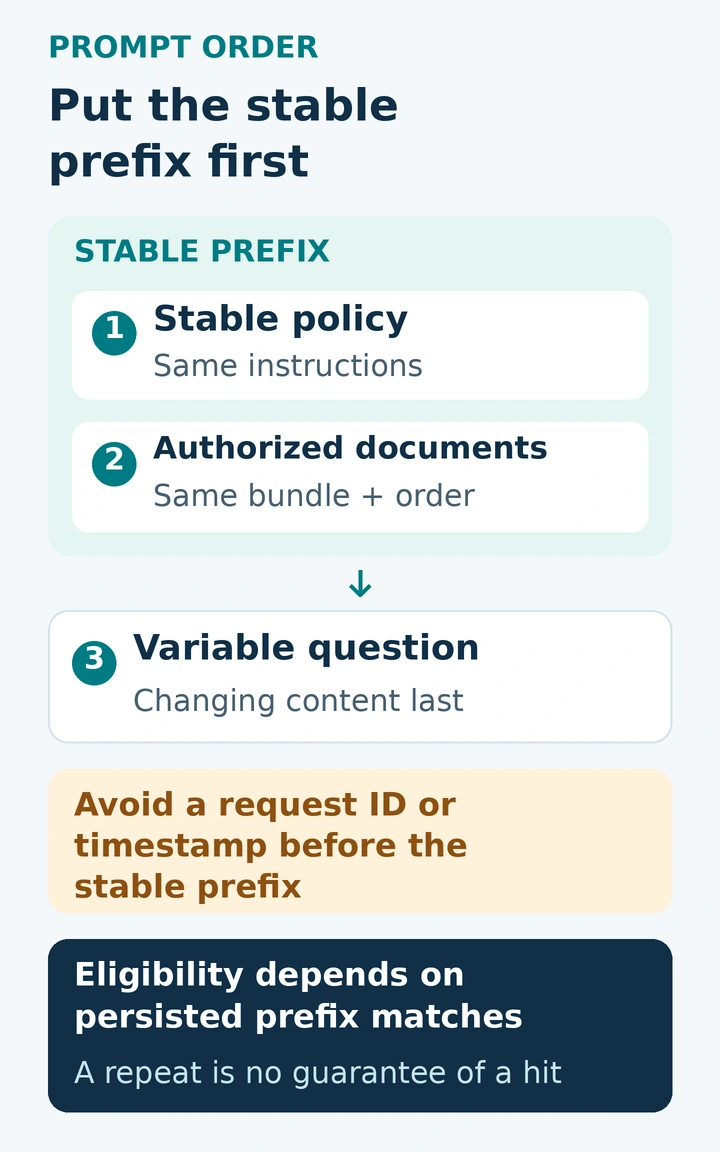
Move diagnostic metadata out of the model-visible prefix when the model does not need it. A random request identifier, current timestamp, tracing token, or rotating experiment label near the beginning can change the sequence before the expensive content. Store those values in your application telemetry instead. If the task genuinely requires the current date, provide it in the variable portion and evaluate that layout; never remove information that is necessary for a correct answer just to preserve a cache opportunity.
Deterministic assembly helps make this repeatable. Use a fixed document ordering, a consistent separator, a known text-extraction pipeline, and a reviewed template version. Normalize incidental transport differences at ingestion rather than repeatedly rewriting source text at request time. Be careful with aggressive normalization: whitespace in code, table alignment, punctuation in formulas, and quoted legal wording can carry meaning. Preserve the material the task needs even if it reduces reuse.
Version changes should be explicit. When a manual changes, generate a new bundle identity, update the content, and re-run quality checks. A lower hit rate immediately after deployment may be an acceptable cost of freshness. Do not continue sending an obsolete policy to keep the old prefix warm. Your application should choose the correct version first and let the provider charge for the resulting input, rather than letting cache economics choose which facts a user sees.
For conversations, preserve the history structure required by the API and the chosen mode. Reordering previous turns or flattening them into a different transcript can change both semantics and reuse. Summarization is a separate trade-off: a shorter history can cost less overall, but a newly generated summary changes the prefix and may lose details. Compare actual task quality and total cost for the summarized and original histories instead of treating longer cached context as inherently better.
3. Use the correct model and tariff
The current pricing page lists deepseek-flash as DeepSeek-V4.1-Flash and deepseek-v4-pro as DeepSeek-V4-Pro-0813. Record the requested model and returned model information with each experiment. Model aliases and prices can change; do not silently apply an old tariff merely because an SDK call still succeeds. The table below is a dated snapshot in US dollars per one million tokens, not a permanent price commitment.
| Model | Period | Input hit | Input miss | Output |
|---|---|---|---|---|
| deepseek-flash | Peak | $0.006 | $0.30 | $1.20 |
| deepseek-flash | Off-peak | $0.003 | $0.15 | $0.60 |
| deepseek-v4-pro | Peak | $0.044 | $1.32 | $3.96 |
| deepseek-v4-pro | Off-peak | $0.022 | $0.66 | $1.98 |
The documented peak windows are 01:00–04:00 and 06:00–10:00 UTC on weekdays, excluding Chinese public holidays; other times are off-peak. Scheduling therefore needs more than a weekday test. A simplistic calendar function will misclassify holidays, and an experiment that crosses tariff periods can confuse a scheduling discount with a caching improvement. The example calculator deliberately requires an explicit tariff bucket instead of guessing one.
For operational estimates, save the tariff version used for every calculation. Reconcile estimates with the provider’s actual billing records, especially around period boundaries or future pricing changes. Batch work can sometimes move to a lower-price period, but customer-facing requests have latency commitments. Delaying an urgent answer to save a tiny amount on input may be a poor product decision even when the arithmetic is correct.
Output has its own price. A large reduction in repeated input cost can be overwhelmed by verbose answers, repeated tool loops, or retries. Set output requirements according to the job: a concise classification result, a bounded explanation, or a structured report with a clear maximum size. Validate that the chosen limits still permit a complete answer. An artificially truncated response that forces another request often costs more than a well-sized first attempt.
4. Measure hits and costs honestly
Use the response’s usage data as the evidence for caching. The relevant counters are prompt_cache_hit_tokens and prompt_cache_miss_tokens, alongside prompt_tokens and completion_tokens. Validate that the input categories reconcile before calculating money. A missing counter is unknown telemetry, not zero. Quietly replacing missing values with zero produces attractive dashboards that cannot support a billing conclusion.
At minimum, record a request identifier, task identifier, model, template version, bundle version, tariff bucket, token counters, completion status, and elapsed time. Keep each retry as a separate attempt under the same task. Use non-content identifiers where possible. You do not need to copy the full prompt, source document, or generated answer into a cost log merely to count tokens, and doing so creates an unnecessary second collection of potentially sensitive material.
For streaming Chat Completions, the current reference places whole-request usage on the final content chunk before the stream terminator. It says usage is included even without stream_options.include_usage and there is no extra usage-only chunk. Ensure your adapter retains that usage object. A client that stops reading after it has enough visible text may lose the accounting signal. A dropped stream can leave cost uncertain even if some answer text reached the user.
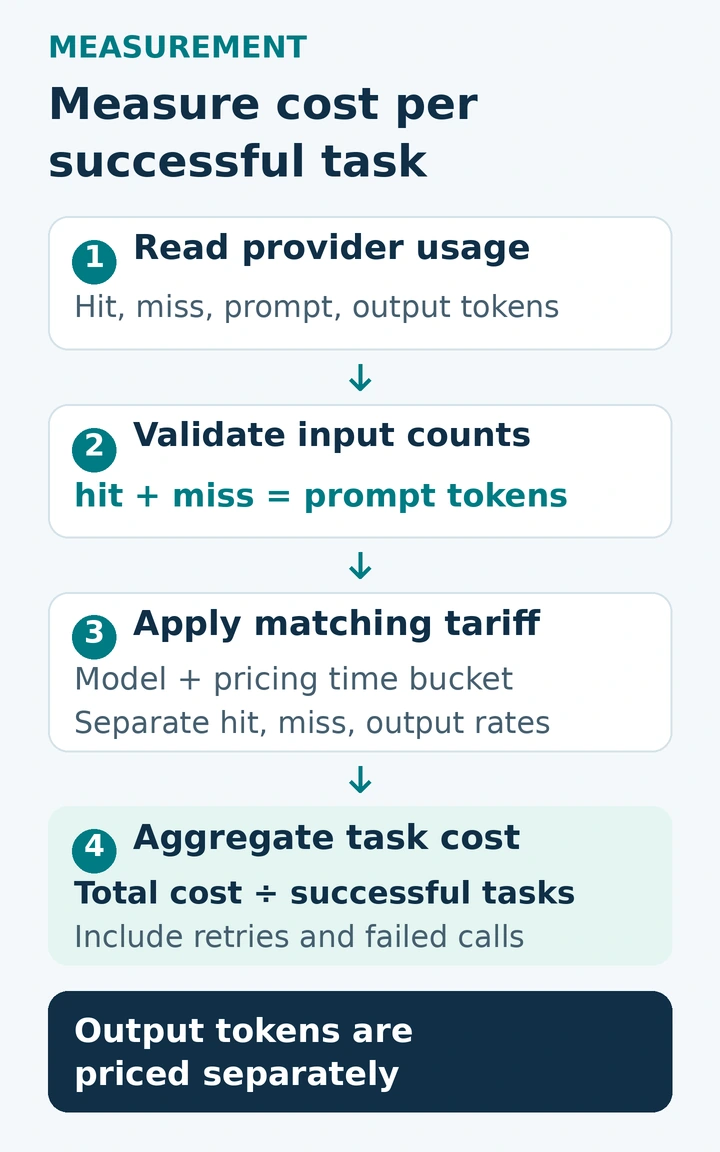
Aggregate token counts before computing a cache-hit share. Sum all hit tokens and divide by all prompt tokens for the workload. Averaging request-level percentages gives a ten-token request the same weight as a fifty-thousand-token request, which can make a dashboard misleading. Report both the weighted share and the number of requests with complete usage; otherwise, a telemetry outage may appear to improve efficiency simply by excluding expensive requests.
The more useful business denominator is completed work. Calculate total model spend across initial attempts and retries, then divide by the number of tasks that passed the application’s quality criteria. Track unresolved tasks separately. If no tasks succeed, cost per successful task is undefined, not zero. If any attempts lack complete usage, label workload spend and savings provisional; never divide only the known spend by all successful tasks and present that as complete accounting. A version with a higher hit share can still be worse if it produces more invalid outputs, stale citations, or follow-up requests. For machine-consumed responses, our structured-output validation guide explains the checks that should happen before treating a response as usable.
Do not add token detail counters to their parent totals. Reasoning-token details, when present, describe a component of completion usage; they are not a second independent billable output category to tack onto completion_tokens. Similarly, hit and miss counters partition input rather than adding extra tokens beyond prompt_tokens. Store the original usage object if your data policy permits, but use a clear, tested normalization step for the cost ledger.
5. Build an offline cost calculator
The following standard-library Python module estimates token charges from a complete usage object. It makes the tariff choice explicit, uses decimal arithmetic, and rejects inconsistent counters. Its all-miss comparison asks a narrow counterfactual: what would this same token volume cost if all input were charged at the miss rate? It does not model a different prompt design, a different output length, or a provider billing adjustment.
"""Offline USD estimates; price snapshot checked 2026-10-02, not an invoice.
Rates: official DeepSeek pricing, linked in Sources & References.
Pass the actual tariff explicitly; this module never infers it from a clock.
"""
from collections.abc import Mapping
from decimal import Decimal, localcontext

MILLION = Decimal("1000000")
PEAK_RATES = {
    "deepseek-flash": ("0.006", "0.3", "1.2"),
    "deepseek-v4-pro": ("0.044", "1.32", "3.96"),
}
FIELDS = ("prompt_cache_hit_tokens", "prompt_cache_miss_tokens",
          "prompt_tokens", "completion_tokens")


def validate_usage(usage):
    """Require full usage; absent counters are unknown, never assumed zero."""
    if not isinstance(usage, Mapping):
        raise ValueError("usage must be a mapping")
    for field in FIELDS + (("total_tokens",) if "total_tokens" in usage else ()):
        if field not in usage:
            raise ValueError(f"missing usage field: {field}")
        if type(usage[field]) is not int or usage[field] < 0:
            raise ValueError(f"{field} must be a nonnegative integer, not bool")
    hit, miss, prompt, completion = (usage[field] for field in FIELDS)
    if hit + miss != prompt:
        raise ValueError("cache hit + cache miss must equal prompt_tokens")
    if "total_tokens" in usage and usage["total_tokens"] != prompt + completion:
        raise ValueError("total_tokens must equal prompt_tokens + completion_tokens")
    return hit, miss, prompt, completion


def estimate_cost(usage, *, model, tariff_bucket):
    """Return Decimal USD costs; completion details must not be added again."""
    if not isinstance(model, str) or model not in PEAK_RATES:
        raise ValueError("unknown model; use a canonical model ID")
    if tariff_bucket not in ("peak", "off_peak"):
        raise ValueError("tariff_bucket must be 'peak' or 'off_peak'")
    hit, miss, prompt, completion = validate_usage(usage)
    with localcontext() as ctx:
        ctx.prec = max(28, len(str(prompt + completion)) + 20)
        factor = Decimal("1") if tariff_bucket == "peak" else Decimal("0.5")
        hit_rate, miss_rate, output_rate = (
            Decimal(rate) * factor for rate in PEAK_RATES[model])
        hit_cost = hit * hit_rate / MILLION
        miss_cost = miss * miss_rate / MILLION
        output_cost = completion * output_rate / MILLION
        all_miss = (prompt * miss_rate + completion * output_rate) / MILLION
        total = hit_cost + miss_cost + output_cost
        return {"cache_hit_input": hit_cost, "cache_miss_input": miss_cost,
                "output": output_cost, "total": total,
                "all_miss_total": all_miss,
                "input_savings_vs_all_miss": all_miss - total,
                "hit_share": Decimal(hit) / prompt if prompt else None}


def aggregate_cost(usages, *, model, tariff_bucket):
    """One model/tariff group; hit share is token-weighted, not request-averaged."""
    totals = [0, 0, 0, 0]
    requests = 0
    for usage in usages:
        counts = validate_usage(usage)
        totals = [left + right for left, right in zip(totals, counts)]
        requests += 1
    if not requests:
        raise ValueError("no usage records; an empty sample is not zero cost")
    result = estimate_cost(dict(zip(FIELDS, totals)), model=model,
                           tariff_bucket=tariff_bucket)
    result["requests"] = requests
    result["prompt_tokens"] = totals[2]
    return result
The sample below is synthetic. It represents 12,000 input tokens split into 10,000 hits and 2,000 misses, followed by 600 completion tokens. It is intentionally small enough to audit with a calculator. Save the module as cost_calculator.py, run the example locally, and compare the numbers with the next section before connecting any real telemetry.
# Synthetic counts; this script never calls an API.
from decimal import Decimal
from cost_calculator import aggregate_cost, estimate_cost

usage = {
    "prompt_cache_hit_tokens": 10000,
    "prompt_cache_miss_tokens": 2000,
    "prompt_tokens": 12000,
    "completion_tokens": 600,
    "total_tokens": 12600,
}
options = {"model": "deepseek-flash", "tariff_bucket": "peak"}
result = estimate_cost(usage, **options)
assert result["total"] == Decimal("0.00138")
assert result["all_miss_total"] == Decimal("0.00432")
assert result["input_savings_vs_all_miss"] == Decimal("0.00294")
print("Estimated USD:", result["total"])

cold = dict(usage, prompt_cache_hit_tokens=0,
            prompt_cache_miss_tokens=12000)
batch = aggregate_cost([cold] * 2 + [usage] * 98, **options)
assert batch["total"] == Decimal("0.14388")
print("Hypothetical 100-request USD:", batch["total"])

# Each malformed record must fail instead of becoming a cheap-looking row.
invalid = [dict(usage, prompt_cache_hit_tokens=True),
           dict(usage, prompt_cache_miss_tokens=-1),
           dict(usage, total_tokens=12000)]
missing = dict(usage)
del missing["prompt_cache_hit_tokens"]
invalid.append(missing)
for row in invalid:
    try:
        estimate_cost(row, **options)
    except ValueError:
        continue
    raise AssertionError("Invalid usage was accepted")
print("Arithmetic and invalid-record smoke tests passed")
Run the displayed smoke tests whenever you change tariffs or ingestion code. During editorial verification, a separate offline test suite checked every model-period combination, exact decimal results, mixed-request aggregation, missing counters, inconsistent totals, negative values, fractional counts, booleans masquerading as integers, and unknown model or tariff labels. The displayed checks and editorial tests validate arithmetic and data handling. They do not test a live cache, prove that the provider will produce a hit, or establish a latency benefit.
Keep the implementation deliberately separate from account credentials and network calls. This makes it safe to test using fixtures and prevents a unit test from silently consuming API credit. In a production system, the ingestion layer should also handle duplicate log delivery, request cancellation, partial stream records, and delayed reconciliation. Those are system responsibilities beyond the small calculator; describe them in your team’s accounting contract rather than pretending a short example is a complete billing service.
Decimal precision prevents binary floating-point artifacts, but it does not make the estimate an invoice. Provider rounding, credits, discounts, taxes, account arrangements, and tariff timing may change what is charged. Preserve sufficient precision internally, round for display only, and label dashboard amounts as estimates until they are reconciled. If a counter set fails validation, quarantine that record and surface a data-quality warning rather than manufacturing a plausible amount.
6. Calculate savings and the real break-even point
For one request, estimate cost as hit tokens multiplied by the hit rate, plus miss tokens multiplied by the miss rate, plus completion tokens multiplied by the output rate, with the result divided by one million. At the Flash peak prices above, the synthetic request costs $0.00006 for cached input, $0.00060 for uncached input, and $0.00072 for output. The total is $0.00138. The same 12,000 input tokens priced entirely as misses would bring the total to $0.00432.
The difference is $0.00294 per request, approximately 68.06% of the all-miss total. For 1,000 identical requests with that exact usage split, the estimate is $1.38 instead of $4.32. Notice what this calculation does and does not claim. It demonstrates a scenario at a stated tariff. It is not a measured average, a promise of 1,000 cache hits, or a claim that every application can save the same percentage.
Warm-up and misses belong in the total. In a second synthetic scenario, suppose a hundred requests each have the same prompt and output lengths, but the first two are entirely misses and the remaining ninety-eight have the demonstrated hit split. The cost is $0.14388, compared with $0.432 for a hundred all-miss requests. Savings are $0.28812, about 66.69%. The two-miss setup is an illustrative assumption, not a fixed rule about how many requests DeepSeek requires.
Now add engineering cost. If implementing and maintaining this specific optimization costs an assumed $100, and the measured saving settles at $0.00294 per successful request with no other change, about 34,014 such requests would be needed to recover that one-time amount. That calculation ignores ongoing maintenance and other infrastructure expenses. For a small internal tool, removing an unnecessary model call or shortening an overlong answer may be worth more than elaborate cache tuning.
Padding a prompt is especially easy to misjudge. Every unnecessary token has a cost, even at the hit rate, and may distract the model. To justify adding reusable material, compare the whole alternative workflow: extra input cost, any avoided calls, output changes, retrieval expense, and quality. The extra material should be there because the task benefits from it. Appending filler to chase an imagined threshold is not a reliable savings strategy.
Use a conservative sensitivity analysis before budgeting. Calculate an all-miss case, a realistic observed case, and a higher-reuse case; vary output length and retry rate as well. If the product only works financially in the most optimistic case, caching is covering a fragile business assumption. A robust design should have a spend limit, a useful degraded mode, and a plan for workloads whose reuse falls after a deployment or traffic change.
7. Choose the workload pattern before tuning the prompt
Repeated questions over one approved document bundle
This is an intuitive fit. A user has permission to a stable packet, and asks several independent questions about it. Keep that packet version and ordering stable while the questions change. Measure the full sequence, including the beginning, instead of reporting only the cheapest later call. When the packet changes, treat that as a new workload version and verify that citations still point to the current source.
Retrieval-augmented generation with changing evidence
A retrieval system often returns different passages for each query, so the reusable portion may be mainly task instructions and formatting rules. Do not freeze irrelevant passages into the prompt solely to improve reuse. Retrieval relevance, coverage, and permission filtering still come first. Compare top-k choices and bundle layouts with a fixed evaluation set, using our RAG evaluation workflow to check whether a cheaper configuration still finds and uses the right evidence.
Deterministic ordering is useful only after the correct evidence has been selected. Sorting results by document identifier might increase stability but erase a carefully chosen relevance order. That trade-off must be tested. A safer starting point is to preserve the retrieval policy, normalize each selected passage’s representation, and track the resulting reuse. Any change to ranking or context selection is a quality experiment as well as a cost experiment.
Long-running conversations and agent workflows
Append-only histories naturally retain earlier context, but histories also accumulate cost and stale assumptions. Establish when to summarize, when to retrieve fresh state, and when a new conversation should begin. Tool results may contain timestamps or large changing payloads, so a long conversation is not automatically an efficient one. Log costs by complete user task, including planning and repair loops, rather than presenting the cheapest individual model call as the whole agent cost.
Batch analysis and one-off documents
A batch that applies several questions to each document can have useful within-document reuse. A batch that sends each unique document only once may have little shared context beyond the instructions. Grouping eligible tasks can be sensible, but avoid inventing extra questions or speculative warm-up calls that have no user value. Those calls consume input and output budget, and cache persistence remains best-effort after they finish.
Time shifting is another independent lever for non-urgent batches. If a deadline permits off-peak work, calculate that benefit separately from caching so you can explain where the savings came from. Concurrency limits and downstream capacity still matter. Launching every job at once may produce retries, missed usage records, or poor service to interactive users, even if the per-token tariff is favorable.
8. Keep privacy and authorization intact
DeepSeek’s current Chat Completions documentation exposes user_id for downstream-user KVCache isolation. The rate-limit and isolation guide tells developers not to put private information in that value; its OpenAI Python SDK example passes it through extra_body. Use a stable, opaque identifier for the intended user boundary, created and managed by your application. Do not use an email address, document text, or another meaningful personal identifier merely because it is convenient.
Treat the isolation boundary as a security design choice before considering cache reuse. Authenticate the caller, establish their permitted data scope, and select only authorized context before assembling a request. Do not collapse unrelated users into one identifier to improve a hit-rate chart. A cache-isolation parameter also does not replace document-level authorization, approval for external actions, or your application’s separation of customer records.
This article’s counters and streaming rules apply to Chat Completions. The Responses interface uses different usage names and a user isolation field. Its guide says cache management is automatic and that prompt_cache_key and prompt_cache_retention are unsupported. If you use that interface, build a separate tested adapter rather than renaming fields ad hoc. A silently ignored option can look configured while providing none of the behavior your application expects.
Cache lifetime is also separate from privacy retention. The caching guide says unused entries are usually cleared within hours to days, which is not a guaranteed deletion deadline for every form of provider data. DeepSeek’s published privacy policy describes broader processing and variable retention and discusses processing/storage in China. Its scope does not by itself establish an API-specific zero-retention or no-training promise. Confirm the applicable terms and organizational data rules for your actual deployment, especially before sending confidential or regulated material.
Your own response cache deserves particular care. A key based only on the question can return one customer’s answer to another customer asking the same words. Include the relevant authorization scope, data version, model or application version, and response-policy version where appropriate. Recheck permission before serving cached content, and invalidate entries when access is revoked. These are application controls; a provider-side context-cache feature cannot supply them on your behalf.
Retrieved text and tool output remain untrusted material after they have been reused. Caching does not turn a hostile instruction into an authorized one or make a stale claim reliable. Keep external content separate from trusted application instructions, and require independent permission checks before tools perform consequential actions. Our prompt-injection prevention guide covers those boundaries in detail.
Apply the same discipline to observability. A public dashboard does not need customer identifiers, complete prompts, access tokens, or confidential document names. Prefer coarse workload labels and opaque internal references with access controls on the underlying logs. If your organization requires a particular retention period or storage region, verify that requirement against the actual service agreement and deployment configuration before sending the data. A caching discount is not evidence that a deployment meets a privacy requirement.
9. Run a defensible rollout experiment
Write the experiment question before making a prompt change. For example: can a stable, versioned manual bundle reduce estimated token cost per correct support answer without increasing tail latency or citation errors? Freeze a representative set of tasks and their expected outcomes. Include short and long questions, repeated and unique documents, ambiguous requests, and cases that should be refused or escalated. A test set consisting only of easy repeated questions will exaggerate the benefit.
First establish a baseline with the existing application. Save complete usage when available, answer-quality results, failure counts, and end-to-end latency. Then change one major factor at a time. If you simultaneously switch model, shorten outputs, change retrieval, and move jobs to off-peak hours, you may improve the system but you will not know how much context caching contributed. Report combined changes honestly rather than attributing the entire difference to one mechanism.
Cache experiments have order effects. Running the same tasks repeatedly can prepare reusable prefixes for later measurements. Record the sequence, template version, model, scope identifier, and timing. Avoid describing a first observed call as a guaranteed cold-cache request when you cannot establish provider state. The public guide does not provide a general purge control for this experiment. A careful report can say first observed pass and repeated pass without pretending those labels reveal internal cache state.
Compare comparable groups, and report distributions rather than one lucky response. Useful summaries include median and high-percentile latency, weighted input-hit share, estimated cost per successful task, error rate, and the fraction of attempts with missing usage. Keep the same quality rubric across versions. Manually inspect a sample of cases where costs improved dramatically; those cases may reveal an empty retrieval result, truncated answer, or skipped tool step rather than genuine efficiency.
Start production rollout with a limited workload that has clear rollback criteria. Choose the acceptable quality floor, spending threshold, and latency budget before looking at the results. Monitor enough real traffic to cover document changes and ordinary usage variation. If the optimization causes stale answers or permission failures, revert the application change immediately; do not wait for a statistically impressive cache-hit graph to compensate for a correctness or security regression.
10. Troubleshoot misses and misleading wins
The second request still misses. Compare the complete assembled inputs, model, and isolation scope, then check the persisted-prefix rules and construction delay. A visually repeated paragraph does not prove a complete eligible unit matched. Do not hammer the API until a hit appears. Capture the result, give legitimate subsequent work a chance to run, and evaluate the sequence as a whole.
The hit share dropped after a release. Check template changes, document versions, serialization differences, tool definitions, and whether a new timestamp or identifier moved to the beginning. A deliberate content update may explain the change and require no fix. An accidental formatting change may be worth correcting, but test the repaired prompt for semantic equivalence before deploying it.
The hit share rose but the bill did not improve. Inspect output volume, retries, model mix, tariff buckets, and total prompt length. A larger prompt can have a higher cached percentage while still costing more. Separate per-attempt input savings from the actual cost of a completed task. Also compare reconciled periods, because an estimated dashboard and a provider balance change may cover different requests or timing.
Latency did not fall. Caching can affect one part of a request, while network delay, queueing, generation length, tool execution, and your own application work remain. Measure time to first useful output and time to completed task separately. Do not promise a specific speedup from an input-price discount. If the user waits mainly for long generation or external tools, optimize those stages based on evidence.
Usage is missing or inconsistent. Inspect stream completion and adapter parsing before blaming the cache. Confirm that the collector retains the final usage-bearing chunk and associates it with the correct attempt. Mark incomplete records explicitly. A billing pipeline that guesses token counts from word counts or fills missing fields with zeros can conceal an integration bug for weeks.
11. Production checklist and common questions
- Choose a workload with genuinely reusable, authorized context
- Version prompt templates and document bundles; keep changing questions later
- Use the current model identifier and a dated, explicit tariff snapshot
- Validate usage counters and retain missing-usage warnings
- Measure weighted hit share and total cost per successful task
- Count warm-up, retries, failures, and output tokens
- Test quality, freshness, authorization, and prompt-injection boundaries
- Reconcile estimates with billing and maintain a rollback path
Do I need to enable caching with a special parameter?
The current DeepSeek guide describes caching as enabled by default. Concentrate on request structure and observed usage rather than adding an undocumented flag. Provider features differ, so do not copy another vendor’s cache-control syntax into a DeepSeek request and assume it has the same meaning.
Will cached input produce the same answer every time?
No. The provider still generates output, and generation settings and other conditions can affect it. If your product requires a previously approved fixed answer, that is an application response-cache design with its own freshness and permission checks. Context caching alone does not establish determinism.
Should I send a long document instead of retrieving passages?
Only when the task and evaluation justify it. Compare answer quality, source coverage, total tokens, and latency for both approaches. A discounted oversized prompt can still be inferior to a smaller, relevant context. The right answer depends on the document, question distribution, and application’s reliability requirements.
What should the team optimize first?
Begin with the largest avoidable cost visible in complete-task telemetry. That may be repeated input, but it may also be unnecessary calls, verbose output, repeated repairs, or a model that is more expensive than the job requires. Context caching is most valuable when it fits a sound request design and its savings remain visible after all of those factors are counted.
Bottom line: build stable context because it represents stable information, observe actual provider usage, and judge the result by successful work. A credible caching optimization has a reproducible cost calculation, a quality floor, and a clear safety boundary. Its value should survive realistic misses, changing documents, and an honest account of every attempt.
Sources & References
Primary documentation checked October 2, 2026. Product behavior and tariffs can change. The engineering layouts, synthetic scenarios, calculator, and rollout recommendations above are original analysis; they are not claims of an official performance guarantee.
- DeepSeek Context Caching guide: automatic caching, persisted prefix units, usage counters, best-effort behavior and cache lifetime.
- DeepSeek Models & Pricing: model identifiers, dated USD tariffs and peak/off-peak schedule.
- DeepSeek Chat Completions reference: usage accounting, streaming semantics and user_id isolation.
- DeepSeek Rate Limit & Isolation: opaque downstream-user identifiers, isolation and concurrency behavior.
- DeepSeek Responses API guide: automatic cache management and unsupported cache controls.
- DeepSeek Responses API reference: different usage fields and user isolation parameter.
- DeepSeek Privacy Policy: policy scope, data processing and retention; separate from cache eviction.
- DeepSeek Change Log: model and service changes that can affect a dated implementation.

[…] never stored. Check the currently documented behavior and the terms applicable to your service. Our DeepSeek context caching guide provides additional implementation […]