


A JSON Lines importer can appear to work while losing the information that would have revealed a bad batch. A repeated object key can disappear during decoding. An invalid line can vanish behind a convenient exception handler. A second event with the same identifier can replace the first in a dictionary. The resulting collection may look clean precisely because the importer discarded the evidence of ambiguity.
This guide uses DeepSeek as a potential coding and review assistant for a stricter alternative: a small Python validator whose acceptance rules are explicit, whose failures identify a physical line without echoing its contents, and whose return value represents a completely validated file. The model can suggest implementation changes or test cases. Deterministic code decides whether the bytes meet the contract.
The example is deliberately narrow. It accepts event objects with three fields and returns immutable application records. It does not repair malformed input, guess missing values, silently ignore unfamiliar fields, or skip rejected records. Those choices make it suitable for teaching a reliable boundary between an incoming file and downstream application logic. They also make its limitations visible enough to assess before adapting it.
Start with a contract that makes rejection meaningful
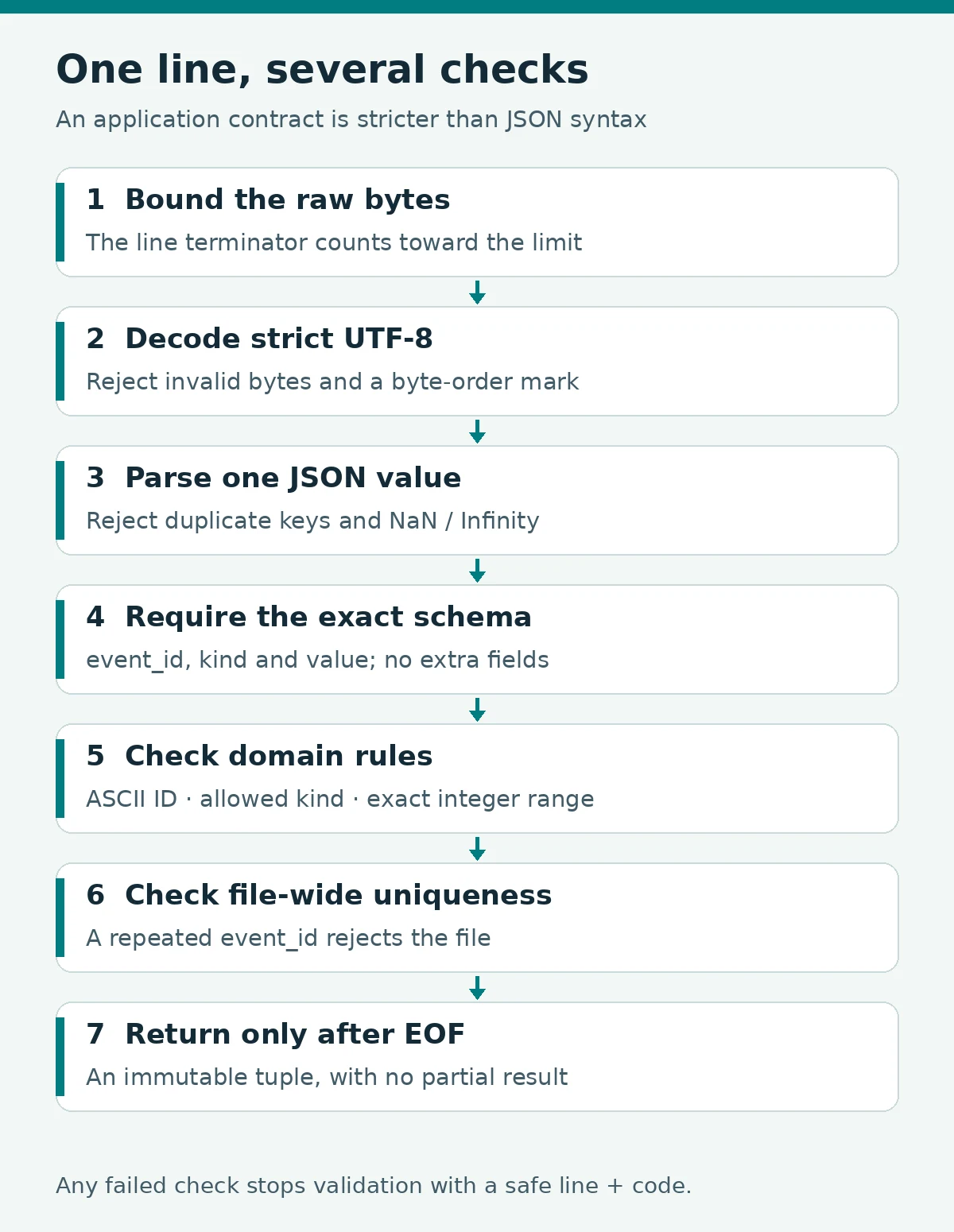
The function we will examine is validate_jsonl(path, max_line_bytes=65536, max_records=10000). On success, it returns a tuple of frozen Event records with event_id, kind, and value attributes. On invalid input, it stops at the first detected failure. An empty file is valid and produces an empty tuple. That empty result means the file contained no physical records; it does not mean the validator silently removed all its contents.
Each accepted record is an object containing exactly event_id, kind, and value. Its identifier is an ASCII string matching [A-Za-z0-9_-]{1,40}. Its kind is either reading or count. Its value is an integer from zero through one million, inclusive. Boolean values do not qualify as integers, and numeric strings do not qualify as numbers. Identifiers must be unique across the file.
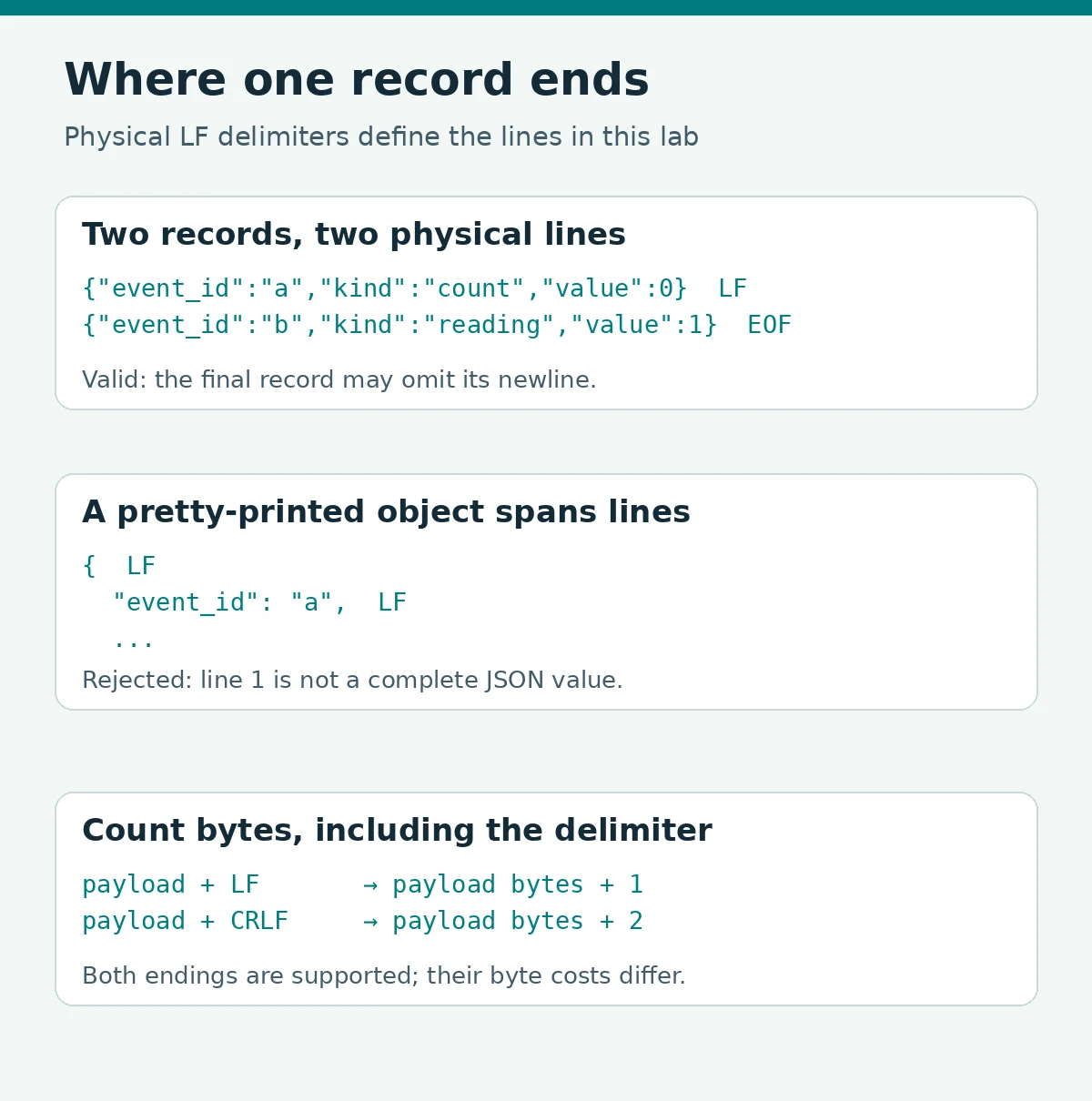
The byte-level contract matters just as much. Input must decode as strict UTF-8 without a byte order mark. Each LF-delimited physical line contains one complete JSON value, with CRLF endings and a final line without a newline supported. Blank lines are rejected. The size cap covers the raw physical line, including any delimiter bytes. A separate record cap bounds how many records the application will accept.
This is an application contract layered on a file format. It is intentionally stricter than general JSON Lines. A producer that sends an array or null may be creating a valid JSON Lines record, yet still be sending invalid input for this importer. Make that distinction clear in documentation and support messages so that users know whether to repair serialization or change the shape of their data.
Understand the file format before asking DeepSeek for code
The JSON Lines format documentation describes UTF-8 text with one valid JSON value per line. It allows values other than objects, rejects blank lines, supports CRLF, and recommends but does not require a final line terminator. Those format rules explain the framing choices here; the event schema and duplicate-identifier policy are our own additional requirements. The primary documentation is linked in the final Sources and References section.
A file containing two complete objects on separate lines is not a single ordinary JSON document containing both objects. Passing the whole file to json.load therefore uses the wrong framing model. Conversely, surrounding all the objects with an array creates one JSON document, which is a different transport contract. Neither approach is inherently wrong, but switching between them without changing the importer creates confusing failures.
There is another boundary worth drawing on paper: an escaped newline inside a JSON string is not a physical newline byte between records. The two-character escape sequence is decoded within a string after the reader has located the record. An actual line break inserted into an unfinished object splits the input into separate physical pieces. Pretty-printed objects spanning several lines do not satisfy this importer’s one-value-per-line contract.
For this particular schema, strings containing either form of newline will not become accepted identifiers or kinds anyway. Understanding the distinction is still useful. It prevents an incorrect repair, such as joining neighboring lines until the parser seems happy. That repair could merge two damaged records and obscure where the producer stopped respecting the agreed format.
Separate syntax, schema, and batch consistency
There are three independent questions at the validation boundary. First, can this physical line be decoded and parsed according to the chosen JSON rules? Second, does the resulting value have the exact structure and field types the application expects? Third, is it consistent with the records already accepted in this batch? Treating these as separate questions makes both code review and failure diagnosis easier.
A syntactically valid object can fail the schema because value is a string. A schema-valid object can fail the batch rule because its event_id appeared earlier. A file can contain thousands of individually valid records yet exceed the configured record count. None of those failures should be described merely as malformed JSON. The error category should point the producer toward the layer that needs attention.
The distinction also reduces temptation to add coercion. Converting a string to an integer might resolve a schema mismatch, but it changes the submitted value rather than proving that it met the contract. Trimming identifiers might seem harmless, but it can collapse two different source strings into one identity. This validator checks what arrived. Any normalization belongs in a separately specified transformation with its own tests.
If your source is tabular rather than object-based, the same separation of concerns appears in our guide to CSV import validation with DeepSeek. The framing details differ, so do not transfer CSV assumptions about quoted multiline fields into this JSON Lines reader.
Configuration is part of the interface too. Both limits must be positive exact integers, so zero, negative values, floats, and booleans are rejected as configuration errors before the file is opened. The default record allowance is not a promise that every deployment should accept that many records; choose limits that match the caller’s workload and memory budget.
Read bounded binary lines before decoding text
The reader opens the file in binary mode and uses a bounded readline call. Python’s I/O documentation specifies a byte limit for this binary operation and an LF terminator. That gives the validator a direct relationship between the configured limit and the incoming bytes. Text-mode decoding and newline translation would make it easier to accidentally measure characters or normalized line endings instead.
The important pattern is to request at most max_line_bytes plus one byte. If the returned piece is larger than the allowed size, the record is rejected immediately. That extra byte distinguishes an exactly permitted line from an oversized one without reading an arbitrarily long record into memory first. Checking length only after an unbounded read would discover the problem after paying the allocation cost the limit was meant to avoid.
Including delimiters in the limit is a deliberate, observable choice. A record ending in CRLF consumes two delimiter bytes, while the same payload ending in LF consumes one. A final record with no delimiter consumes neither. Near the boundary, those files can therefore receive different results even though their decoded JSON payloads are equivalent. Documenting this upfront is better than surprising users with a platform-dependent explanation later.
Do not implement the cap with the length of a decoded string. UTF-8 encodes some characters using multiple bytes, so a character count is not a byte count. This schema ultimately excludes non-ASCII identifiers, but byte accounting still happens before schema validation and must remain correct for rejected input as well as accepted input. Our Unicode handling guide explores the broader distinction between bytes and text.
Reject ambiguity before dictionary construction hides it
Duplicate keys within one object are different from duplicate identifiers across records. Consider an object that contains value twice. If decoding keeps only one occurrence, the schema checker sees a clean three-field object and loses the opportunity to flag the ambiguous source. Detecting duplicates after ordinary dictionary construction is too late because the earlier key-value pair may already be gone.
Python’s json documentation exposes object_pairs_hook for examining object members as pairs, and parse_constant for handling its nonstandard numeric constants. The implementation uses these hooks to reject repeated keys in every parsed object and reject NaN and Infinity spellings. RFC 8259 discusses interoperability problems with nonunique object names and excludes those special numbers from its number grammar. Our rejection policy makes those concerns explicit rather than relying on decoder defaults.
The hook applies to nested objects too, even though accepted events have a shallow schema. An unexpected extra field could contain a nested object with a repeated key. That input is already destined for rejection, but checking duplicates during parsing avoids a special pocket of permissive behavior. It also means that an input with several defects may fail at the parsing rule before the outer field check.
That ordering is acceptable as long as callers understand the guarantee. The validator reports the first detected failure according to its implementation, not a complete inventory of every defect present on that line. Do not write a test that assumes a schema error must win over a nested duplicate-key error unless that precedence is intentionally part of the public contract.
Make the shallow event schema genuinely strict
Checking that a few desired fields exist is weaker than checking the full field set. Here, extra fields are errors. That catches accidental producer changes such as sending units alongside value, renaming an attribute without removing the old one, or attaching metadata that downstream systems never agreed to preserve. If additional fields are needed, revise the contract deliberately instead of quietly discarding them.
The identifier rule is intentionally easy to explain and test. It permits ASCII letters, decimal digits, underscores, and hyphens, with a length between one and forty characters. It does not allow spaces, slashes, invisible formatting characters, or visually similar letters from other scripts. This is a constrained machine identifier, not a rule for validating people’s names or human language.
The value check uses an exact integer type requirement because Python booleans are a special case in integer relationships. Accepting true as a count of one would hide a producer type error. The same reasoning rejects 1.0 even though it is mathematically equal to one, and rejects the string “1” even though it could be converted. The schema specifies a representation as well as a numeric range.
A shallow schema helps keep the example auditable. It does not mean nested input cannot reach the parser: the parser must first construct enough of the value for the schema checker to reject it. This distinction becomes important when evaluating resource limits. A simple accepted shape is a useful restriction, but it does not by itself constitute a parser sandbox.
The complete validator
Download the original JSON Lines validation lab, including the validator, demonstration and reproducible local tests. Python 3.12 or later; standard library only.
The implementation below keeps framing, parsing, record validation, and batch uniqueness in one inspectable path. Read it alongside the contract rather than treating it as a generic utility for every JSON Lines dataset. In particular, its return type and limits suit bounded event batches; a large analytical export may need a different storage strategy while preserving the same rejection principles.
"""Bounded JSON Lines event validation; Python 3.12+, standard library only."""

from __future__ import annotations

from dataclasses import dataclass
import json
from os import PathLike
from pathlib import Path
import re


@dataclass(frozen=True, slots=True)
class Event:
    event_id: str
    kind: str
    value: int


class ValidationError(ValueError):
    """A safe, one-based physical-line number and fixed error code."""

    def __init__(self, line: int, code: str) -> None:
        self.line = line
        self.code = code
        super().__init__(f"line {line}: {code}")


class _DuplicateKey(Exception):
    pass


class _NonFiniteConstant(Exception):
    pass


_ID = re.compile(r"[A-Za-z0-9_-]{1,40}")
_FIELDS = {"event_id", "kind", "value"}


def _unique_object(pairs: list[tuple[str, object]]) -> dict[str, object]:
    result: dict[str, object] = {}
    for key, value in pairs:
        if key in result:
            raise _DuplicateKey
        result[key] = value
    return result


def _reject_constant(_token: str) -> None:
    raise _NonFiniteConstant


def _positive_int(value: int, name: str) -> None:
    if type(value) is not int or value <= 0:
        raise ValueError(f"{name} must be a positive int")


def validate_jsonl(
    path: str | PathLike[str],
    max_line_bytes: int = 65536,
    max_records: int = 10000,
) -> tuple[Event, ...]:
    """Validate the whole file, then return immutable events in input order.

    The byte cap includes LF or CRLF. Empty files are valid. Nonempty blank
    lines are not. Filesystem errors propagate; this function opens and closes
    its own file. ValidationError contains no input values. Configuration must
    use positive, exact ints (not bool). No persistence or transaction is done.
    """
    _positive_int(max_line_bytes, "max_line_bytes")
    _positive_int(max_records, "max_records")
    events: list[Event] = []
    seen: set[str] = set()
    line_number = 0
    with Path(path).open("rb") as source:
        while True:
            raw = source.readline(max_line_bytes + 1)
            if not raw:
                break
            line_number += 1
            if len(raw) > max_line_bytes:
                raise ValidationError(line_number, "LINE_TOO_LONG")
            if len(events) >= max_records:
                raise ValidationError(line_number, "RECORD_LIMIT")
            try:
                text = raw.decode("utf-8", errors="strict")
            except UnicodeDecodeError:
                raise ValidationError(line_number, "INVALID_UTF8") from None
            if text.startswith("\ufeff"):
                raise ValidationError(line_number, "BOM_NOT_ALLOWED")
            if not text.strip(" \t\r\n"):
                raise ValidationError(line_number, "BLANK_LINE")
            try:
                data = json.loads(
                    text,
                    object_pairs_hook=_unique_object,
                    parse_constant=_reject_constant,
                )
            except _DuplicateKey:
                raise ValidationError(line_number, "DUPLICATE_KEY") from None
            except _NonFiniteConstant:
                raise ValidationError(line_number, "NON_FINITE_NUMBER") from None
            except (ValueError, RecursionError):
                # Includes JSONDecodeError and Python's integer digit limit.
                raise ValidationError(line_number, "INVALID_JSON") from None
            if type(data) is not dict or set(data) != _FIELDS:
                raise ValidationError(line_number, "INVALID_SCHEMA")
            event_id, kind, value = data["event_id"], data["kind"], data["value"]
            if type(event_id) is not str or _ID.fullmatch(event_id) is None:
                raise ValidationError(line_number, "INVALID_EVENT_ID")
            if type(kind) is not str or kind not in ("reading", "count"):
                raise ValidationError(line_number, "INVALID_KIND")
            if type(value) is not int or not 0 <= value <= 1_000_000:
                raise ValidationError(line_number, "INVALID_VALUE")
            if event_id in seen:
                raise ValidationError(line_number, "DUPLICATE_EVENT_ID")
            seen.add(event_id)
            events.append(Event(event_id, kind, value))
    return tuple(events)
Notice where the function can return successfully: only after it has reached the end of the file without a rejection. Records accumulated internally before a later failure are not returned to the caller. That is a useful whole-return property for this function. It is not a transaction across databases, files, queues, or other external systems.
Also notice what the function does not catch. A missing file, permission failure, or I/O error is not a malformed record. Filesystem failures propagate so the caller can distinguish operational problems from validation failures. Converting every exception into an empty tuple would erase that distinction and make a broken import look like a successful empty batch.
Use safe diagnostics without pretending you know the whole file
A useful rejection identifies the one-based physical line and a stable error code. The line number refers to the file as received, including a blank or otherwise rejected line. It is not the position within a filtered collection of accepted events. That allows an operator to locate the failure without reproducing the record’s contents in ordinary logs.
Raw parser exceptions can carry more context than a service should expose. This boundary sanitizes decoding and parsing failures rather than including the submitted line, identifier, or value in the public error text. A line-and-code diagnostic is enough for routine application handling. If a human needs to inspect the source, provide access to the original artifact through an appropriately controlled workflow instead of scattering its contents across logs.
Fail-fast validation does not produce a rejected-record count for the whole file. If the third physical line fails, later lines have not been certified as valid or invalid. A dashboard should report the batch as rejected at line three, not claim that only one record was bad or that all remaining records were skipped successfully. Likewise, previously checked records are not imported records merely because they passed local checks.
For a maximum-record failure, the reader needs evidence that another physical record exists beyond the accepted allowance. The configured limit is not permission to ignore the rest of the file. Treat a file with excess input as rejected, rather than returning the first permitted prefix and giving the caller a misleadingly successful result.
In the implementation, ValidationError exposes line and code attributes, and its string form is exactly line N: CODE. For example, a boolean supplied as the value on the second line produces line 2: INVALID_VALUE. The fixed vocabulary distinguishes INVALID_UTF8, DUPLICATE_KEY, DUPLICATE_EVENT_ID, LINE_TOO_LONG, and RECORD_LIMIT among the other rejection categories. Callers should branch on the code attribute rather than scraping a human-readable traceback.
Work through the demonstration without adding hidden behavior
The demonstration accompanying the validator uses local sample files to show the call boundary and rejection handling. Keep those examples separate from a production directory, and run them with the same Python interpreter used for the validator tests. A temporary directory is useful because each example can construct its exact bytes without depending on a text editor’s newline or encoding defaults.
"""Reproducible local examples; no model requests and no external writes."""
from pathlib import Path
import tempfile

from jsonl_validator import ValidationError, validate_jsonl

GOOD = b'{"event_id":"sensor_1","kind":"reading","value":23}\n'
BAD = b'{"event_id":"sensor_2","kind":"count","value":true}\n'

with tempfile.TemporaryDirectory() as directory:
    path = Path(directory) / "events.jsonl"
    for label, content in (("valid", GOOD), ("invalid second line", GOOD + BAD),
                           ("empty", b""), ("duplicate ID", GOOD + GOOD)):
        path.write_bytes(content)
        try:
            print(f"{label}: {validate_jsonl(path)!r}")
        except ValidationError as error:
            print(f"{label}: {error}")
Actual local demonstration output:
valid: (Event(event_id='sensor_1', kind='reading', value=23),)
invalid second line: line 2: INVALID_VALUE
empty: ()
duplicate ID: line 2: DUPLICATE_EVENT_ID
Pay particular attention to the difference between constructing a fixture and claiming an observed result. A suggested input is not evidence that the implementation handles it correctly. Run the actual code, capture the result, and compare it with the expected acceptance rule. When adapting this guide, retain failing fixtures as regression tests instead of deleting them after the initial repair.
No live DeepSeek API request or interactive DeepSeek chat was used to validate the behavior described here. The model prompts later in the article are original, unexecuted templates. They are ways to request review or additional tests; they are not transcripts, measured model performance, or evidence that a particular model will consistently produce correct code.
The accompanying local verification suite contains 79 named unittest cases: 67 author tests and 12 independently written review tests. All 79 passed under Python 3.12.14 and Python 3.13.5, both normally and with Python’s optimized mode enabled, and the source passed py_compile checks. That evidence is limited to the supplied implementation, fixtures, and interpreters. It does not measure DeepSeek performance or certify every possible deployment. Deep nesting is tested without assuming that both interpreters reject at the same internal recursion threshold; a separate injected failure checks the sanitization branch.
Build a test matrix around boundaries and near misses
Start with a small accepted file whose two records have different identifiers and both permitted kinds. Then test an empty file, a file with a final LF, a file with CRLF endings, and a final record without a newline. These cases establish ordinary framing behavior before the rejection tests make the suite look like a collection of unrelated edge cases.
For the schema, test each field independently. Remove one required field, add one unknown field, make the top-level value an array, and substitute null for an object. Test an empty identifier, a forty-character identifier, and a forty-one-character identifier. Include an identifier containing a space and one containing a non-ASCII letter. A boundary test should make its intended difference visible.
For value, include zero and one million as accepted endpoints, then negative one and one million plus one as rejected neighbors. Test true, false, a quoted numeral, and a decimal representation. A generic phrase such as “invalid values are rejected” is too vague to catch a later refactor that starts coercing booleans or strings.
Finally, test duplicate keys and duplicate identifiers separately. For keys, use raw JSON text rather than a Python dictionary, because a dictionary literal cannot preserve two identical keys for serialization. For identifiers, create two otherwise valid records with the same event_id. Tests that distinguish these cases protect both the decoder boundary and the batch consistency rule.
Test limits with the bytes that actually cross the boundary
A line-size test should calculate the complete raw line length, then exercise a limit equal to that length and a limit one byte smaller. Repeat with CRLF and with no final newline. This avoids brittle assumptions about how many bytes punctuation, whitespace, or delimiters happen to contribute. It also turns the delimiter policy into an executable specification.
For record counts, set a small limit and test a file with exactly that many records and another with one additional record. Keep every record otherwise valid so the count boundary is the reason for rejection. If the fixture also contains malformed JSON, the test may pass for the wrong reason and stop protecting the intended branch.
For encoding, write byte fixtures directly. An invalid UTF-8 sequence cannot be expressed faithfully by first asking a text encoder to produce valid UTF-8. Include the forbidden leading byte order mark as explicit bytes as well. These tests are about what arrives on disk, so they should bypass conveniences that normalize the input before the validator sees it.
Keep memory and resource claims proportional to the design
The bounded line read limits how much raw input the function requests for one physical line. The record cap limits the number of accepted Event objects. The result collection and identifier set still grow with the batch: memory is proportional to retained records and identifiers, plus the current line and parsing structures. This is not a constant-memory importer merely because it reads one line at a time.
The byte cap is a practical safeguard, not a hard limit on every parser resource. A compact but deeply nested value can exercise recursion before the shallow schema rejects it. The implementation sanitizes relevant parsing failures, including recursion and value-conversion failures, but exception handling is not a guarantee about CPU time or process memory under every possible input.
If you must process hostile uploads at service scale, evaluate isolation, request size limits, time budgets, concurrency limits, and storage quotas around the validator. Those controls belong to a deployment design and need their own tests. Do not tell DeepSeek to “make it secure” and then accept a renamed helper function as evidence that those operational requirements have been solved.
For very large legitimate datasets, a streaming or staged design may be preferable. However, yielding a record changes the observable contract because consumers can act before a later failure. If whole-batch acceptance is important, stage validated data and make the final commit explicit. Our atomic file writes guide covers a related output concern, but atomic replacement alone does not provide a database transaction or cross-system rollback.
Ask DeepSeek for a bounded review, not an unspecified rewrite
A productive model request names the acceptance contract, the implementation under review, the requested output, and the things that must stay unchanged. Without those boundaries, a helpful-looking rewrite might introduce coercion, skip blank lines, switch to text-mode reading, or replace the tuple with a generator. Each change could be reasonable for some other importer while breaking this one.
The first template below is intended for reviewing a supplied implementation. Paste the actual source where indicated and supply the precise limits and schema from this guide. It asks for falsifiable findings rather than a general impression. Do not include real event payloads if synthetic records demonstrate the same behavior, and follow your organization’s rules before sharing private code or data with a model service.
Unexecuted prompt template: audit the acceptance boundary
Review the Python validator pasted below against this contract only: strict UTF-8 without a BOM; one JSON value per LF-delimited physical line; CRLF and a final line without a newline accepted; blank lines rejected; bounded binary readline with a raw-byte cap that includes delimiters; no duplicate keys in any object; no NaN or Infinity; exact fields event_id, kind, value; ASCII identifier pattern [A-Za-z0-9_-]{1,40}; kind reading or count; exact integer value excluding bool in the inclusive range 0 to 1000000; unique identifiers; bounded record count; empty file accepted; tuple of frozen Event records returned only after complete validation. Report at most five concrete contract violations. For each, give a minimal synthetic input, the expected outcome, the relevant code path, and a proposed focused test. If you find none, say that you found none; do not imply a security proof. Do not rewrite the code, relax the contract, or claim you executed anything. Implementation: [paste source here].
After receiving a response, verify every proposed counterexample locally. A model can misunderstand exception order, count delimiter bytes incorrectly, or propose a string literal whose escaping does not produce the intended file. The review becomes useful when a claimed defect is translated into an exact fixture and the observed result is checked against the contract.
Use a second prompt to strengthen tests without moving the goalposts
Once the implementation has a baseline suite, ask for missing distinctions rather than an entirely new architecture. The important output is a small set of tests that make previously implicit decisions observable. Requiring each test to name the behavior it protects helps prevent a large collection of repetitive examples from masquerading as comprehensive coverage.
Unexecuted prompt template: propose discriminating regression tests
You are reviewing a deterministic Python JSON Lines validator test suite. Read the contract, implementation, and current tests pasted below. Propose exactly eight additional standard-library unittest tests that cover distinct missing behaviors. At least two must exercise raw-byte line limits including LF or CRLF, one must distinguish bool from int, one must preserve duplicate JSON keys in a raw text fixture, one must test a duplicate identifier across separate records, and one must check that public rejection text does not echo a synthetic secret marker. Use temporary local files and no network calls, model calls, new packages, random timing assertions, or production data. Keep the existing acceptance contract unchanged. State expected outcomes from the contract, but label all tests unexecuted. If a requested category is already fully covered, explain the overlap and replace it with another specific uncovered boundary. Return the tests and a short behavior-to-test checklist. Contract: [paste]. Implementation: [paste]. Existing tests: [paste].
These templates do not require JSON mode. They ask for code review and test design, not a machine-ingested JSON response. DeepSeek’s official JSON Output documentation describes a separate formatting feature and notes considerations such as truncated or empty responses. Even when a model response is parseable JSON, the application’s schema and batch rules still need independent validation. Our structured output guide develops that distinction further.
Troubleshoot the producer before relaxing the validator
If a file fails on its first line, inspect its origin and exact bytes before changing parsing rules. A UTF-8 byte order mark, an exported JSON array, a Markdown code fence, or a pretty-printed object can all explain an immediate failure. They call for different producer fixes. Automatically stripping every unfamiliar prefix would erase those distinctions and could admit input the application never intended to accept.
If a file fails only after transfer between systems, compare line endings and raw lengths around the rejection. Because the limit includes delimiters, a near-limit payload may pass with LF and fail with CRLF. That is not an excuse to trim arbitrary whitespace silently; it is a reason to agree on serialization and leave adequate space below the configured maximum.
If a duplicate identifier appears, investigate what the identifier is supposed to mean. It may indicate a retry, a producer bug, or two source events accidentally assigned the same identity. Choosing the first or last event is a business decision with consequences for downstream results. The validator deliberately refuses to make that decision by overwriting one record with another.
If users complain that only one error is shown, explain the fail-fast contract. A separate diagnostic tool could scan further and collect bounded error summaries, but it would need explicit rules for oversized lines, resource usage, and safe reporting. Do not turn the import function into a permissive collector simply to make a support screen look friendlier.
Exercises that expose hidden assumptions
First, take a valid record and add harmless-looking whitespace until its raw line length sits exactly at the limit. Predict what happens when LF becomes CRLF without changing the payload. Then run the fixture and explain the result in terms of bytes, not visible characters. This exercise makes the size contract concrete and catches accidental delimiter stripping before measurement.
Second, create a file with two accepted-looking records followed by an invalid third record. Put a counter in the caller after the validation call and confirm that the caller cannot iterate a successful result from that failed invocation. Then discuss what would change if the function yielded each record immediately. The goal is to understand the difference between whole-return validation and transactional side effects.
Third, propose a new requirement allowing optional units. Write down whether units may be absent, null, or an empty string; which kinds may use it; and whether old consumers can safely ignore it. Only then modify the schema and tests. This turns a seemingly small extra-field request into a precise compatibility decision instead of an ad hoc exception.
Finally, use generated examples to explore combinations after the deterministic boundaries are covered. A property might assert that serializing accepted Event values with unique identifiers produces an accepted batch within the configured byte and record limits. Another might assert that inserting a repeated identifier always rejects. Our property-based testing guide explains how to complement specific regression fixtures with broader input exploration.
A release checklist for the import boundary
- Publish the exact field set, identifier alphabet, integer representation, permitted kinds, and inclusive numeric range for producers
- State that limits count raw line bytes including delimiters and that blank lines and excess records reject the batch
- Keep encoding, parser, schema, uniqueness, and operational failures distinguishable at the caller boundary
- Verify that duplicate keys are tested with raw JSON text and duplicate identifiers are tested across physical records
- Check that public errors include a one-based physical line and safe code without echoing submitted contents
- Run boundary fixtures under the deployment interpreter and preserve every confirmed defect as a regression test
- Document the retained-record memory cost and keep parser limits separate from stronger deployment resource controls
- Keep model suggestions reviewable, and never replace an executed assertion with a claim that an assistant approved the implementation
The most useful outcome is not a validator that accepts as much input as possible. It is a boundary that makes acceptance meaningful. A successful return says the whole file met a specific, reviewable contract. A rejection says where the first detected problem occurred without quietly rewriting the source into something easier to accept.
DeepSeek can help articulate that contract, inspect a proposed implementation, and suggest cases that a developer overlooked. The dependable part of the workflow is what happens next: preserve the original bytes, turn claims into tests, execute those tests, and keep the acceptance rules visible when requirements change. That is how an AI-assisted importer avoids converting uncertainty into silent data loss.
Sources and References
The following primary sources were checked on October 5, 2026. They support the format, decoder, stream, and API-formatting background above. The event schema, import policy, exercises, prompt templates, and operational recommendations are the editorial design of this guide.
- JSON Lines format documentation: encoding, per-line values, line endings, and final terminators
- Python json documentation: document decoding, object-pair and numeric hooks, decoder behavior, and untrusted-input cautions
- Python io documentation: bounded binary line reads and text-versus-binary stream behavior
- RFC 8259: The JSON Data Interchange Format: object-name interoperability and the JSON number grammar
- DeepSeek JSON Output documentation: API formatting guidance and response caveats

[…] formats. Newline-delimited records have delimiter and text-decoding questions covered in our JSON Lines validation guide. Here, newline and zero bytes can appear freely inside a payload. Searching for a familiar […]