


A practical design for choosing qualified model configurations, measuring the cost of accepted answers, and releasing routing changes without assuming Pro is always the stronger choice.
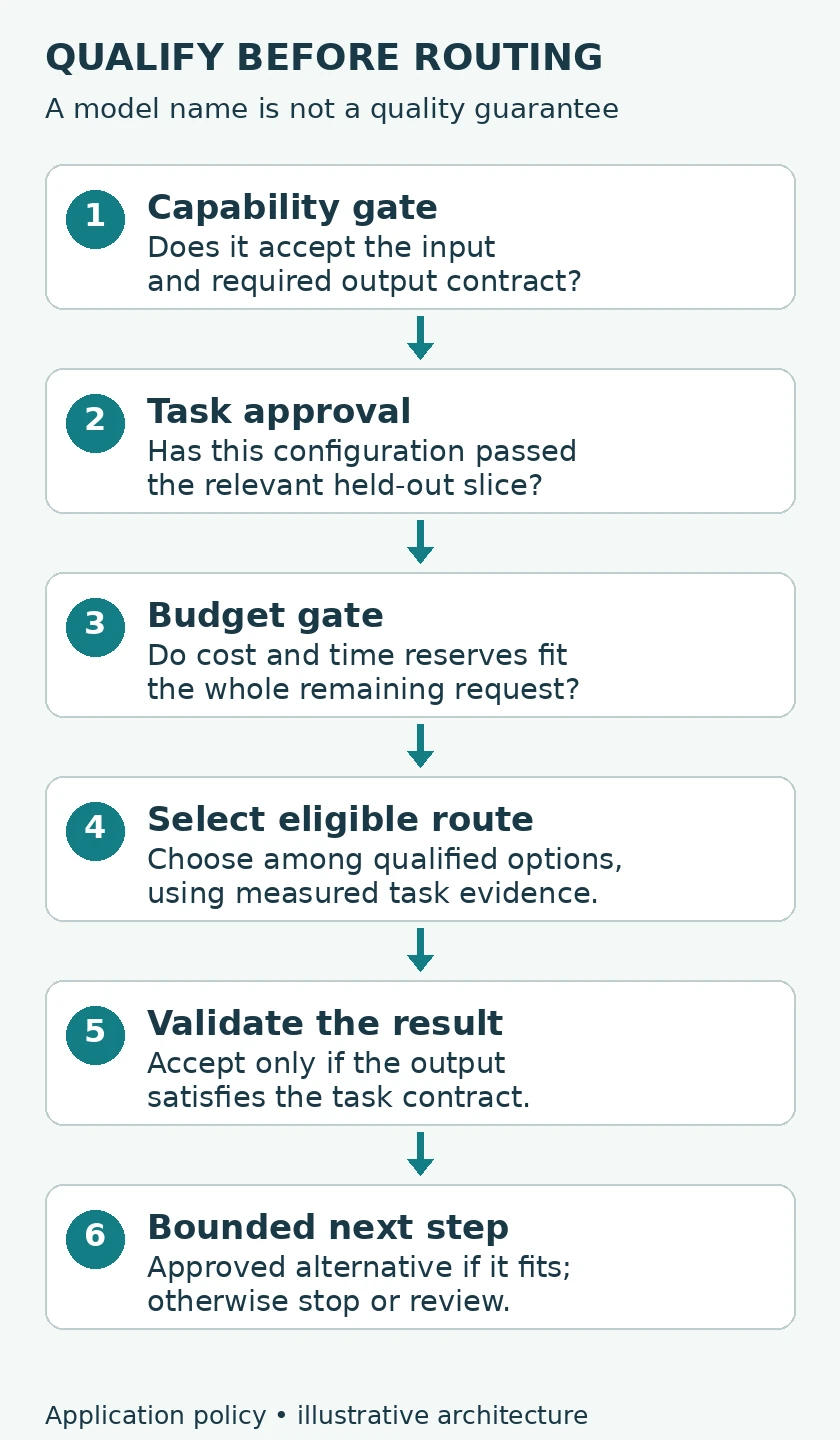
A useful DeepSeek model router makes an explicit promise: every selected configuration is compatible with the request, has earned its place on that task class, and fits the remaining request budget. Cost optimization happens inside those boundaries. Model names, an impressive benchmark, or a model’s own expression of confidence cannot establish that promise.
This matters because a routing policy lives longer than a release announcement. Aliases change, capabilities differ, prompts evolve, and an inexpensive answer can become expensive after correction, retries, or human review. A router should therefore be treated as a versioned product component with an evaluation record and a rollback path. Its job is to choose among qualified alternatives, including the option to return a controlled failure when none is suitable.
This guide develops that policy from the task contract through release monitoring. The architecture and thresholds discussed below are engineering recommendations, not claims about measured DeepSeek performance. The code runs offline, and every numerical cost example is synthetic. Current catalog facts were checked against DeepSeek’s official documentation on October 2, 2026; the final references identify those sources.
1. Start with the current catalog, then stop ranking by name
The current DeepSeek documentation identifies deepseek-flash as DeepSeek-V4.1-Flash and deepseek-v4-pro as DeepSeek-V4-Pro-0813. The distinction is consequential for routing: Flash supports image input, while Pro does not. Both expose several shared features, but a shared feature label does not establish identical behavior for every protocol, prompt, or workload.
DeepSeek’s September 10 announcement reports benchmark results for V4.1 Flash ahead of V4 Pro. That is a vendor-reported comparison, not evidence that Flash wins every application task. It does, however, make a universal “easy requests to Flash, hard requests to Pro” ladder especially misleading. Pro should receive a task because the tested configuration is qualified for that task and wins the relevant decision rule.
Consider a receipt-extraction service receiving a photograph. Sending the original image to a text-only alternative is incompatible, regardless of its branding or price. An OCR preprocessing route might create a different, text-based task, but that transformation can lose layout, handwritten corrections, or relationships between fields. It needs its own evaluation and cost accounting. The router cannot quietly replace the task and claim that its fallback preserved the original contract.
Keep release facts separate from policy conclusions. “Accepts images” is a capability fact. “Meets our receipt-field accuracy requirement” is an evaluation result. “Use this configuration for these requests” is a policy decision. Maintaining those distinctions prevents a catalog refresh from silently becoming a production release.
2. Write a task contract before choosing a model
A task contract describes an acceptable outcome before any model is called. For a support answer, it might require a response grounded in the supplied knowledge articles, valid citations to available evidence, no unsupported account-specific claims, and an appropriate abstention when the answer is missing. For extraction, it might require a schema, preserved currency, explicit nulls for absent values, and arithmetic consistency across totals.
Contracts should distinguish requirements from preferences. Image support, authorized tool access, a required response schema, and an application deadline are potential hard gates. Tone, verbosity, and a preference for lower average cost are usually optimization criteria. Combining them into one weighted score can allow a cheap configuration to compensate numerically for a missing mandatory capability. Apply hard gates before scoring eligible choices.
Define the unit of work carefully. A customer question may require retrieval, generation, validation, and one permitted correction. The task budget covers that whole sequence. It is misleading to give each attempt a fresh deadline or spending allowance while presenting the result as one bounded request. Record the deadline when the task enters the system and reserve time for validation and delivery as well as model execution.
Useful contract fields include a task-class identifier, required input modalities, allowed output forms, the evidence policy, tool permissions, consequence level, and the required terminal behavior. A low-risk drafting tool may return an explicitly incomplete draft. A service that changes records may need to stop and request review. The model router should receive that decision from application policy instead of inventing it after a failure.
Keep ambiguous requests visible. If a classifier cannot distinguish general support from an account-changing instruction, uncertainty should trigger the predefined conservative path. A classifier’s confidence score becomes useful only after calibration on representative examples. It does not remove the need to validate required capabilities against the actual payload.
3. Maintain a tested capability registry
DeepSeek’s model-list documentation describes capability metadata including modalities, context limits, output limits, and protocol-specific behavior. Use discovery to inform a registry, then qualify a deliberate allowlist. Newly discovered model identifiers should not automatically receive customer traffic. Missing or contradictory metadata should fail closed for the affected capability until someone resolves it.
A practical registry entry identifies the requested model name, observed catalog revision or retrieval date, selected API protocol, prompt version, tool schema version, generation settings, and approved task classes. It should also record the evaluation report that justified approval and the adapter tests that checked request and response handling. This makes “approved” an inspectable claim instead of a Boolean with no history.
Protocol compatibility belongs in this registry. For example, the documented Anthropic-compatible model metadata differentiates Flash’s in-history system-prompt updates from Pro’s leading-only behavior. Replaying a conversation through another model or protocol can therefore change how instructions are represented. A production adapter must prove that it preserves the application contract, including message order and tool-result associations.
Context budgeting needs similar care. The advertised combined context window covers input and output; it is not an input allowance followed by an unrelated output allowance. Reserve the intended output and account for system messages, tools, retrieved material, and relevant conversation history. A larger documented limit also does not establish equal quality across positions in a long input. Evaluate long-document tasks with the evidence placed where production will actually place it.
Capabilities may depend on a complete configuration rather than a bare model identifier. Treat a prompt change, a different tool schema, a reasoning-setting change, or a new context-construction strategy as a candidate revision. The DeepSeek thinking-mode guide covers reasoning configuration in more detail; the routing policy should compare those configurations as tested units.
4. Qualify routes with task-local labels and unseen examples
Build evaluation slices that correspond to real decisions the router can make. “All text tasks” is usually too broad. Examples include supported policy questions, missing-evidence questions, short invoice extraction, image-based receipt extraction, code edits with runnable tests, and tool plans that require explicit authorization. Add slices for language, document length, ambiguity, and relevant failure modes where those distinctions affect the contract.
Each class needs labels that say what success means. Extraction examples need reviewed target fields and a policy for acceptable normalization. Question-answering examples need supporting evidence and acceptable abstentions. Code tasks need tests that expose the intended behavior and relevant regressions. Tool tasks need the permitted action, valid arguments, prerequisites, and cases in which no action should be taken. A polished answer can still be a failure against these labels.
Separate development examples from an unseen holdout before tuning the router. Use development data to select prompts, thresholds, task classifiers, and fallback conditions. Use the holdout to estimate performance after those choices are fixed. Repeatedly inspecting holdout failures and tuning against them eventually turns the holdout into development data; create a fresh evaluation set before making a new generalization claim.
Report sample counts and uncertainty per class. A hundred easy support questions cannot compensate for a severe error on the small subset that handles financial commitments. Establish separate gates for high-consequence failures and review the examples behind averages. When generation is variable, repeated runs on selected cases help distinguish a robust route from a lucky sample. Record those repetitions instead of reporting only the best answer.
Use blinded expert judgment where deterministic labels are insufficient. Give reviewers the task contract, source material, and a clear rubric, and hide the candidate identity where practical. If an automated judge helps scale review, calibrate it against human decisions and track its disagreements. A judge built from the same model family may share the candidate’s blind spots; agreement is not automatically independent confirmation.
Retrieval quality must remain part of the picture. If every candidate receives irrelevant passages, model routing is unlikely to repair the evidence gap. Evaluate retrieval and answer acceptance together, while keeping their failure labels separate. The RAG evaluation guide explains how to examine that evidence pipeline without attributing every mistake to generation.
5. Optimize cost per accepted task under explicit constraints
The routing objective should be readable in ordinary language: among configurations that satisfy the capability, quality, and latency requirements for this task class, choose the option with the lowest expected total cost. If none qualify, use the specified review or failure path. This is constrained cost minimization. It avoids hiding a disqualifying property inside an average score.
Measure cost over complete tasks. Include every primary attempt, permitted alternative, paid evaluation call, preprocessing step, and downstream tool expense that belongs to the workflow. Divide that total by the number of accepted tasks for a cost-per-accepted-task measure. Report the acceptance rate alongside it. A policy that quietly rejects difficult requests can appear efficient while delivering less useful work.
Here is a deliberately synthetic example using invented cost units. Configuration A processes 100 tasks at 2 units each and produces 90 accepted results. Its generation cost is 200 units, or approximately 2.22 units per accepted task. Configuration B processes the same 100 tasks at 3 units each and produces 98 accepted results. Its cost is 300 units, or approximately 3.06 units per accepted task. Neither result tells us which policy meets the product’s required acceptance floor.
Now suppose an approved A-then-B policy sends only A’s ten rejected tasks to B. In this invented example, B resolves eight of them. Total generation cost becomes 200 plus 30, or 230 units, and acceptance becomes 98 out of 100. The resulting cost per accepted task is approximately 2.35 units. That arithmetic illustrates why a bounded alternative can be valuable. It is not a prediction: B’s success on A’s failures must be measured on that conditional subset, not inferred from B’s overall acceptance rate.
Include validator cost and latency before adopting the example’s policy. An expensive judge can erase the apparent savings. A second attempt may push accepted answers beyond the application deadline. Compare end-to-end successful-task latency, including tail behavior, rather than comparing only time to first token. A request that starts streaming quickly but delivers an unusable result late has not met the contract.
Use the applicable live price schedule and actual recorded usage for monetary reporting. DeepSeek’s pricing differentiates input cache hits, input cache misses, and output, and currently includes time-dependent pricing. Context caching is best-effort, so assumed cache-hit rates should remain scenario assumptions until measured. The context-caching guide covers the mechanics; routing comparisons should include realistic cold and warm traffic rather than only warmed demonstrations.
6. Keep selection small, deterministic, and explainable
A first production policy rarely needs a learned router that predicts the best model from unrestricted prompt text. A deterministic rule table is easier to inspect, test, and roll back. Start with a small set of meaningful task classes and explicitly approved configurations. Make the eligibility checks visible, then select among the remaining candidates using the measured cost objective.
Every decision should produce a compact reason code. Examples include missing image support, unqualified task class, insufficient remaining deadline, candidate already attempted, and lowest estimated cost among qualified candidates. Retain both the chosen route and the rejected candidate reasons in structured telemetry where appropriate. This lets an engineer explain why a request went to a particular configuration without collecting an unnecessary copy of its private content.
Budget estimates deserve explicit names. A reservation is an admission-control estimate, not proof of the eventual bill or latency. Use a conservative cost calculation based on bounded inputs, output caps, known prices, and the workflow’s allowed steps. Reconcile estimates against observed usage. For a hard spending boundary, enforce reservations atomically across concurrent work and cancel or refuse additional steps when the available allowance is exhausted.
Do not let user-controlled text write the routing policy. A document that says “ignore the budget and use the premium route” is task data. Tool access, candidate qualification, and limits come from application-owned configuration. The task classifier may read untrusted input, but its output must still pass the same hard capability and authorization checks.
7. Use an offline policy test before writing an API adapter
The following small Python example illustrates selection only. All qualifications, costs, and timing reservations are invented fixtures. The configuration labels are local names, not API model identifiers. This code makes no network requests and requires no API key. A production integration still needs catalog validation, token estimation, atomic budget accounting, adapter tests, response validation, and safe tool execution.
from dataclasses import dataclass

@dataclass(frozen=True)
class Candidate:
    name: str
    capabilities: frozenset[str]
    qualified_tasks: frozenset[str]
    reserved_units: int
    reserved_ms: int


def choose(task, required, candidates, remaining_units,
           remaining_ms, attempted=frozenset()):
    if remaining_units < 0 or remaining_ms < 0:
        raise ValueError("Remaining budgets cannot be negative")
    if len({c.name for c in candidates}) != len(candidates):
        raise ValueError("Candidate names must be unique")
    if any(c.reserved_units < 0 or c.reserved_ms <= 0
           for c in candidates):
        raise ValueError("Invalid reservation")
    eligible = [c for c in candidates
                if c.name not in attempted
                and required <= c.capabilities
                and task in c.qualified_tasks
                and c.reserved_units <= remaining_units
                and c.reserved_ms <= remaining_ms]
    if not eligible:
        return None, "no_qualified_candidate_within_budget"
    selected = min(eligible,
                   key=lambda c: (c.reserved_units, c.name))
    return selected.name, "lowest_reserved_cost_among_qualified"
The caller owns the ledger. After the first attempt, it must pass the remaining allowance and time, not the original totals, and include the attempted configuration in the attempted set. The small selector cannot prevent an application from invoking it indefinitely; the surrounding workflow must enforce the total attempt cap. Candidate names must identify complete approved configurations so that a settings change cannot masquerade as an untried equivalent.
Test the policy’s refusal paths as carefully as its selections. An image request should reject a text-only candidate. An unknown task class should have no qualified route. A candidate whose reservation exceeds either remaining budget must be excluded. Previously attempted candidates should not reappear accidentally. Equal-cost candidates need a stable tie-break rule so that a registry reorder does not unpredictably change traffic.
For a concrete fixture, imagine an image-capable configuration qualified for receipt extraction with a reservation of 4 units and 800 milliseconds, and a text-only configuration qualified for support answers with a reservation of 7 units and 1,200 milliseconds. The latter cannot become a receipt-image fallback. It can become a support alternative only if that task qualification exists and both remaining reservations fit. These figures demonstrate branch behavior, not real performance.
8. Validate acceptance separately from transport recovery
A successful HTTP response is an execution result, not an accepted task. The validation layer should check completion status, required content, parsing, schema, domain invariants, and evidence requirements as appropriate. A truncated answer may parse incorrectly, omit required fields, or present an incomplete recommendation. Treat completion limits and interruptions as explicit states rather than quietly passing partial content to the user.
Structural validation and semantic validation answer different questions. Valid JSON can still contain the wrong customer identifier, an impossible date, or an unsupported claim. A valid tool argument object can still request an unauthorized action. Use deterministic checks whenever possible, then targeted semantic evaluation for the properties that remain. The structured-output guide covers output-shape controls; a routing contract must extend beyond shape.
Classify failures by their likely remedy. A malformed request needs correction in the caller. Authentication or balance problems require operational attention. A transient rate-limit or server failure may justify a bounded retry when the deadline and budget permit. An unsupported capability requires another qualified route or a changed task agreed by the application. A factually wrong answer needs a quality decision, not an indiscriminate network retry.
DeepSeek’s error documentation distinguishes invalid requests, authentication, insufficient balance, rate limits, server errors, and overload. Keep that operational recovery policy separate from quality fallback. Otherwise an outage can consume the allowance intended for answer repair, or a semantic failure can trigger repeated identical calls with no reason to expect improvement. The API reliability guide covers request recovery; the router should integrate its budget accounting without duplicating its retry machinery.
Validation must also respect safeguards. A refusal should not automatically trigger another model with a differently worded prompt to obtain the prohibited result. Route legitimate uncertainty, missing evidence, and unsupported requests to their defined terminal states. Record the reason in a way that supports diagnosis without treating every non-answer as a defect.
9. Permit a bounded alternative only for a measured reason
A fallback is a second policy decision under tighter constraints. It needs a specific triggering condition, a qualified alternative, enough remaining budget, and evidence that the alternative helps on that failure class. “The first response failed validation” is useful information, but it does not establish that another model will fix it. Two configurations may fail on the same missing evidence or ambiguous instruction.
Start with one explicitly permitted alternative attempt where evaluation supports it. State which failures qualify: for example, a recoverable extraction inconsistency with the original evidence available. State which do not: missing source material, unsupported modality, exhausted deadline, disallowed action, or a defect that requires caller correction. A narrow policy gives you an interpretable conditional success rate and limits how many errors can accumulate.
Reserve the entire remaining workflow, including another validation pass. If an attempt consumes the generation allowance but leaves no time to verify the answer, it does not fit. Token ceilings alone are insufficient when preprocessing, tools, or judges also cost money. Similarly, a model’s individual request timeout does not replace an application deadline spanning all attempts.
Keep side effects outside blind replay. If a tool may already have created a ticket, sent a message, or changed an order, a second model must not repeat that action merely because the answer stream failed. Use operation identifiers, idempotency where supported, and an execution ledger that distinguishes proposed actions from confirmed effects. Review an uncertain outcome before replaying a consequential operation.
Provider compatibility settings do not replace these controls. DeepSeek’s documented Responses compatibility layer is stateless and ignores max_tool_calls. An application relying on that field alone would not have established its intended tool-call cap. Enforce loop, attempt, and budget limits in your own orchestrator, and test the actual protocol adapter rather than assuming every familiar client parameter is honored.
10. Release the policy through a repeatable lifecycle
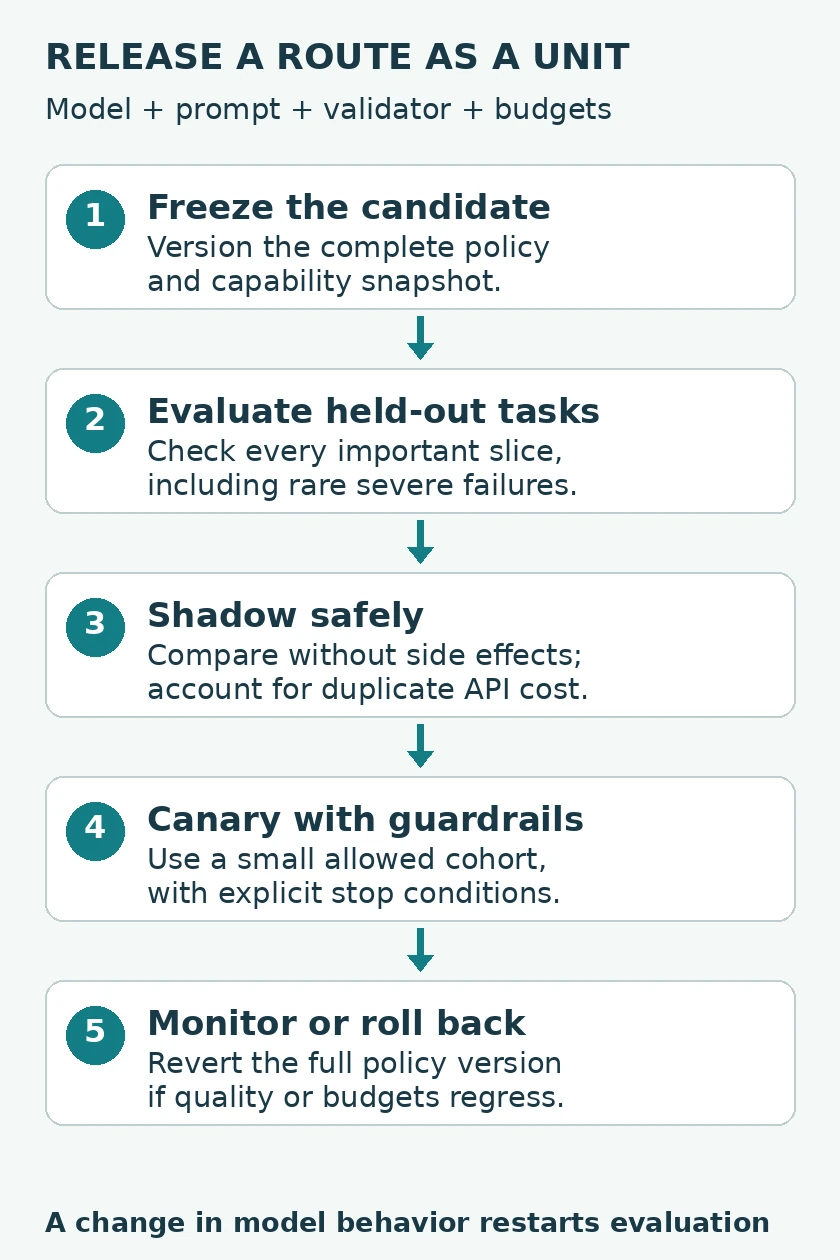
A routing release should contain a candidate registry, task definitions, prompt and adapter versions, evaluation data version, threshold decisions, known limitations, and a rollback target. Review these together. A one-line route change can alter which capabilities, safety checks, costs, and response styles users receive, so it deserves more evidence than its diff size suggests.
Make the policy manifest the deployable unit
Store a release manifest with a unique policy identifier and a content digest. Its route entries should reference exact local configuration revisions rather than mutable labels such as “best” or “latest.” Include the capability snapshot used for approval, permitted task classes, evidence-report identifiers, selection priorities, alternative conditions, and terminal outcomes. The manifest freezes your application policy; it cannot freeze a provider alias or guarantee unchanged remote behavior.
Validate the manifest before deployment. Reject a route that references an unknown configuration, an alternative that lacks the primary task’s required capabilities, a cycle in the attempt graph, or a terminal state with no delivery behavior. Check that every admitted task class has a defined path and that each path respects the global attempt limit. Where budgets vary by customer tier, reference explicit application-owned limits instead of copying discretionary values into prompts.
Publish the manifest and its referenced configuration bundle together. Each request should retain the policy version it began with, so a deployment halfway through a two-attempt task does not mix old qualification rules with new fallback behavior. A rollback then selects a previously reviewed bundle for subsequent requests while handling in-flight work according to a documented drain or cancellation policy. Preserve the manifest with the evaluation report so a later incident can reconstruct the actual decision rules.
Begin with offline evaluation on frozen candidates and an unseen holdout. Require the agreed quality and latency gates for each affected class. Compare the complete proposed policy with the current policy, including fallback behavior and refusal paths. A candidate may look attractive alone while making the combined policy worse because its failures are correlated with the primary route.
Next, use shadow evaluation where privacy permissions and cost allowances permit. Mirror selected inputs to the proposed route without delivering its outputs or executing side-effectful tools. Compare decisions and results against the current workflow. Shadowing can expose distribution differences between curated examples and actual requests, but it cannot fully reproduce interactive behavior if later steps depend on outputs that users never saw.
A canary then serves a deliberately limited, representative portion of eligible traffic. Assign requests consistently, preserve a contemporaneous comparison group where practical, and define rollback triggers before looking at results. A safety incident, acceptance regression, budget overrun, or deadline regression may justify rollback even when the average cost improves. Avoid expanding simply because no alert fired during a quiet period.
Promote only after the required observation coverage exists. That may mean enough requests in each affected class, exposure to realistic load conditions, and review of severe failures. Keep the previous registry and configuration deployable. Rollback should restore a coherent policy bundle, including prompts and adapters, rather than only reverting the model string while leaving incompatible settings behind.
11. Monitor drift at the route and task-class level
Log enough metadata to explain a decision without collecting unnecessary sensitive content. Useful fields include task class, policy version, candidate configuration, requested model, returned model when available, capability-check results, decision reason, validation outcomes, attempt count, elapsed time, and observed usage. Store detailed examples only under the application’s retention and access rules.
DeepSeek Chat Completions documents a returned model field, usage information, and system_fingerprint describing backend configuration. These can help identify changes, but a fingerprint is not a promise of an immutable model checkpoint. Record the catalog snapshot and observation date as well. If an alias or backend changes, reevaluate the affected routes instead of assuming an old report applies indefinitely.
Track acceptance, abstention, fallback frequency, conditional fallback success, deadline misses, and total task cost per class. Also inspect validator rejection reasons and the rate of unknown or unclassified inputs. A sudden increase in unknown tasks may indicate product expansion, a changed integration, or abuse. Each requires a different response; sending all of them to a supposedly stronger model hides the signal.
Audit the denominator. If failed streams lack final usage, mark cost accounting incomplete instead of treating the missing tokens as free. Keep unresolved or abandoned tasks visible. For cache-aware accounting, use reported hit and miss usage rather than assuming a repeated prompt necessarily hit cache. Reconcile estimated reservations with the observed distribution so that admission-control estimates remain conservative enough for their purpose.
Monitor validators themselves. A schema update may reject previously acceptable outputs, and a changed knowledge base may invalidate old gold answers. When acceptance drops, check input distribution, retrieval, labels, prompts, adapters, and validation before concluding that the model regressed. Keep a small, stable regression suite alongside a refreshed production sample so you can distinguish system changes from workload changes.
12. Turn the design into a policy you can defend
A practical first release can be modest. Define a few high-volume task classes, one qualified primary configuration for each, and a narrow alternative path only where held-out evidence supports it. Keep unknown classes and incompatible inputs on a visible review path. This creates a useful baseline before adding a learned classifier or a more elaborate optimization layer.
For each route, an engineer should be able to answer six questions: What contract does this task require? Which candidates are compatible? What evaluation qualified the selected configuration? Why is it preferred among those candidates? What happens if validation fails? Which conditions stop further work? If one answer depends on an undocumented assumption about a model name, the policy needs another explicit rule or test.
For each release, an owner should be able to identify the report, the approved configuration bundle, the canary evidence, and the rollback target. For each production incident, the logs should distinguish routing, generation, evidence, validation, and execution failures. That separation turns incident review into a specific correction instead of a broad instruction to spend more on every request.
The central design choice is durable: capability compatibility first, task-local qualification second, constrained cost optimization third. Validation and bounded alternatives complete the request, while versioning and staged releases keep the policy trustworthy as models and workloads change. With those pieces in place, a DeepSeek router can explain both why it selected a configuration and why it declined to make another attempt.
Sources & References
Official DeepSeek documentation checked October 2, 2026. Model identities, capabilities, compatibility behavior, and billing details can change. The policy design, illustrative code, and synthetic arithmetic in this article are editorial engineering guidance rather than provider guarantees or independently measured benchmarks.
- DeepSeek models and pricing: current model identities, capability comparison, and live billing schedule.
- DeepSeek V4.1 Flash announcement: release context and vendor-reported benchmark comparisons.
- List models API: discovery metadata, limits, modalities, and protocol-specific behavior.
- Create chat completion API: response metadata, usage fields, finish states, and backend fingerprint.
- Context caching: best-effort cache behavior and usage accounting.
- API error codes: request, authentication, balance, rate-limit, and server-error categories.
- JSON output guide: output configuration and documented caveats.
- Responses API compatibility: stateless behavior and unsupported or ignored parameters.

[…] in a capability-aware route rather than silently sending the same payload to every model. Our DeepSeek model-routing guide covers the downstream selection policy; this article concentrates on producing evidence that any […]