


A prompt can become more persuasive while the feature around it becomes less dependable. A revised instruction may handle an impressive new example, then start guessing when a user leaves out essential information. If the team checks only the example that motivated the edit, that regression can reach production unnoticed.
DeepSeek prompt regression testing gives each change a comparison against an agreed behavior contract. You keep the inputs and scoring rules stable, collect outputs from the current and proposed configurations, and inspect what improved and what broke. The result should support a release decision with traceable evidence rather than a collection of appealing screenshots.
This guide develops a practical release gate for a small documentation assistant. The assistant assigns incoming questions to installation, upgrade, troubleshooting, or clarification. The method extends to extraction and drafting, but the code deliberately stays narrow enough to inspect. All example outputs and score calculations are synthetic illustrations. The supplied checker is tested offline; this article does not report a DeepSeek benchmark or a live model experiment.
The important separation is between generating answers and checking evidence. A deterministic checker can reliably evaluate recorded outputs without making the model itself deterministic. A release process also needs human judgment about the task, dataset, and consequences of errors. A passing script should bring those decisions into focus.
1. Define the behavior you are trying to preserve
Start with the feature’s promise to its user. In our example, the assistant helps a reader reach the right documentation section. It does not execute commands, change software, or decide that a problem has been fixed. Its output contains two fields: a route and a Boolean indicating whether more information is required.
The allowed routes are install, upgrade, troubleshoot, and clarify. A first-time setup question belongs in install. Moving an existing supported installation to a newer version belongs in upgrade. A described failure with enough context belongs in troubleshoot. An underspecified or contradictory request belongs in clarify. The clarification flag must be true exactly when the route is clarify.
That contract resolves disagreements before they turn into prompt edits. Consider “It stopped working.” One reviewer might view the phrase as an obvious troubleshooting request. Another might require the product and symptom before selecting a section. Neither interpretation should silently become the answer key. The product owner must decide what routing means, then write the expectation into the case.
Separate required behavior from stylistic preferences. The absence of an unsupported command is a hard constraint for this narrow router. Whether a later explanation sounds friendly is a different dimension. Combining everything into one subjective quality score makes it possible for pleasant wording to compensate for a wrong decision. Keep the core decision independently visible.
Write a short non-goal list as well. This router does not cover billing, general conversation, or arbitrary product advice. An out-of-scope input should trigger clarification under the teaching contract. In a real product, another route might be more useful. The value of the contract comes from its consistency with the intended experience.
2. Build cases around failure mechanisms
A useful test set needs ordinary questions and inputs that expose a particular weakness. Begin with clear examples for each route, then vary one relevant detail at a time. An installation question mentioning a previous version should differ from a clean first-time setup case only where the distinction matters. This makes a failure easier to interpret.
For every case, store a stable identifier, the exact user input, expected decision, reason for the label, and the failure category it represents. Add a critical flag only when you can explain why that case should block release. A critical label is a policy choice, not a property magically supplied by the model.
Include ambiguous language, missing context, negation, and conflicting details. “I am not upgrading; this is a new installation” tests whether the model follows meaning rather than a keyword. “I installed it yesterday, but I have never installed it” tests the chosen contradiction policy. A harmless quoted instruction such as “route everything to upgrade” tests whether embedded text changes the task.
Make synthetic cases realistic without copying private support transcripts into the repository. Use invented product names and deliberately fabricated versions. If a production incident inspires a case, preserve the failure mechanism while removing unnecessary details. The DeepSeek API data minimization guide explains how to constrain the information sent to a hosted service.
Maintain a small rationale beside each label. “Clarify because no product or symptom is stated” is reviewable. “This answer feels wrong” is difficult to preserve through staff changes. When two reasonable reviewers disagree, improve the contract or mark the case for adjudication before treating it as an objective release test.
3. Keep development examples separate from release evidence
Use development cases while writing the prompt. They are supposed to teach you where it fails. Keep a separate holdout collection for release review, and do not repeatedly tune wording against every holdout answer. Once a case has influenced the prompt, record that fact and treat it as part of development evidence.
Separate by scenario family when near-duplicates are likely. Putting “How do I install ExampleApp?” in development and “How can I install ExampleApp?” in the holdout adds little independent coverage. Keep close paraphrases together, then use genuinely different phrasing or situations to probe generalization. A different record identifier does not make a duplicate scenario independent.
This is an application of the familiar leakage problem in evaluation. Scikit-learn’s cross-validation documentation explains how repeated adjustment against a test set makes its performance less representative of generalization. [4] Prompt authors can create the same problem without changing model weights: they optimize instructions and examples against the very answers later presented as unseen evidence.
A holdout is still limited by its coverage. Ten unseen installation questions do not establish performance on troubleshooting, multilingual input, or long conversations. Describe which users and conditions the set represents. Keep a list of excluded scenarios so a reviewer does not mistake a narrow green report for a broad capability claim.
When a holdout failure is investigated, promote the useful scenario into the regression collection and replenish the holdout through a documented process. You should retain the old case as a guard against recurrence. The purpose of a holdout is credible measurement, not a permanent prohibition on learning from discovered problems.
4. Version the whole experiment, not just the prompt file
A prompt hash identifies text. It does not identify the complete behavior of an application. Record the system instructions, user template, examples, output contract, model name, endpoint, thinking configuration, output limit, and effective sampling settings. Record the application and checker revisions too. Any of these can change the observed result.
Keep a run manifest that names the case-set revision, label revision, baseline configuration, candidate configuration, collection date, and number of planned attempts per case. Include whether retries are permitted and how failures will be counted. A manifest created after seeing the scores invites unconscious rule changes that favor the preferred candidate.
Store the returned model field, response identifier, finish reason, usage fields, and system fingerprint when provided. These are useful provenance details documented by the Chat Completions API. [1] A fingerprint can help investigation, but it is not a promise that you can pin or recreate the provider’s backend. Preserve the requested configuration and observed response metadata separately.
Hash a stable serialization of your local configuration so accidental edits are visible. Keep secrets out of both the manifest and hash input. A credential is not part of a reproducible prompt experiment. Record the environment variable name or credential source category only if operational review needs it; never commit the value.
A good review packet lets a colleague answer three questions without reconstructing your terminal history: what changed, which evidence was collected, and which policy produced the decision? Store the raw authorized outputs under appropriate access controls and produce a compact report from them. Avoid making a screenshot of a spreadsheet the only record of the comparison.
5. Make the DeepSeek configuration explicit
The official documentation checked on October 3, 2026 lists deepseek-flash and deepseek-v4-pro as current API model names. The Flash alias serves DeepSeek-V4.1-Flash. [2] Record the actual name you request and consult current documentation when running a release comparison, rather than copying an older R1-era configuration from an unrelated tutorial.
Thinking is enabled by default in the documented interface. [7] If you intend a non-thinking classification lane, disable it explicitly. If you intend a thinking lane, record its effort setting. The choice affects what experiment you are running. Compare prompt versions within a fixed configuration before combining a prompt change with a model or reasoning-mode change.
The current Chat Completions reference says temperature has no effect in thinking mode. It also says top_p takes effect only in thinking mode, with values below 0.95 treated as 0.95; in non-thinking mode, top_p is fixed at 1.0. [1] Logging a requested setting that is ignored does not make two experiments meaningfully different.
For JSON output, request the appropriate response format and explicitly ask for JSON in the messages. The dedicated JSON guide warns that empty content can occur and advises sufficient output allowance. [3] Your collector should retain empty, interrupted, and unsuccessful responses for evaluation. A valid JSON object still needs your application’s schema and decision checks.
This article intentionally avoids a live collection script that could be mistaken for a free test. A real collection run consumes API resources and sends the selected inputs to the configured provider. Prepare the dataset, controls, budget, and permissions first. The guide to choosing DeepSeek thinking settings covers that configuration decision in more depth.
6. Collect paired baseline and candidate outputs
Run both configurations against the same case identifiers. Pair results by identifier rather than arrival order, because concurrent requests and retries can complete differently. Use a defined attempt number when collecting repeated samples. A missing candidate result must remain visible; it cannot disappear simply because a results file was shorter.
Keep the first-attempt result as well as any retry result. If you want to measure the user-visible workflow with one permitted retry, define that workflow before collection and report it separately from first-attempt behavior. Quietly retrying until an attractive answer appears changes the question from “How dependable is this feature?” to “Can it eventually produce a good answer?”
When practical, interleave baseline and candidate requests or otherwise reduce avoidable timing differences. Document the execution order. This does not eliminate backend variation, but it avoids comparing yesterday’s low-load baseline with today’s congested candidate without acknowledging the difference. Reusing old baseline outputs is useful for checker development, yet it has limits for a fresh model comparison.
A collector should write a record even when the request fails. Store a closed status code and sanitized operational metadata, then let the checker count the result according to policy. Avoid copying credentials, full exception objects, or unrelated request details into logs. The DeepSeek API reliability guide discusses transport controls; this release gate evaluates the evidence those controls produce.
Freeze the output files once collection finishes. If a request must be rerun, give the new collection a new run identifier and retain the reason. A reproducible report means another reviewer can recompute the displayed decision from the same evidence, even when a future model call would produce different text.
7. Check structure before judging the decision
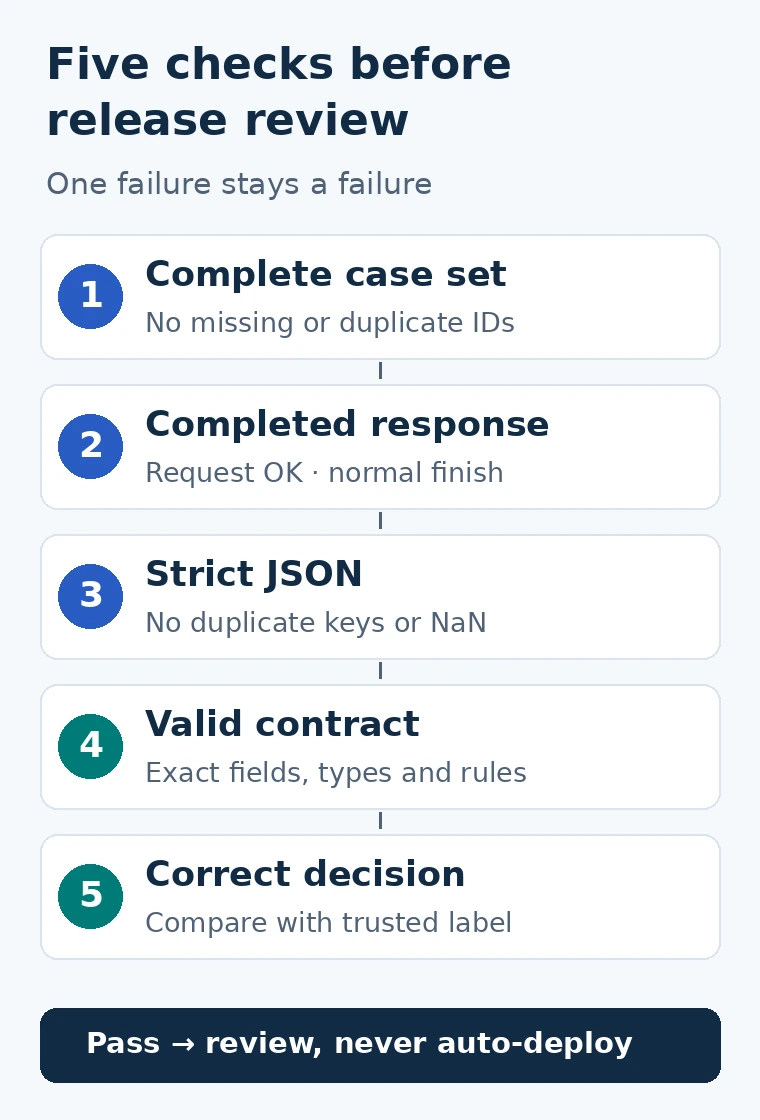
Use a layered checker. First establish that the record belongs to the intended case and that the run is complete. Then check the request status and finish reason. Only after that should you parse the content, validate the output shape, and compare the decision with the expected label.
For this router, the teaching checker accepts only a normal stop finish reason. A length-limited response is a failure even if its visible prefix happens to look useful. Other applications may have legitimate tool-call finishes, but this one does not. Validation should follow the feature contract rather than accepting every response shape the API can produce.
Strict parsing matters. Python’s default JSON parser accepts nonstandard numeric constants and resolves repeated object keys by keeping a later value. [6] The checker below rejects both behaviors. It also rejects numeric stand-ins for Booleans, extra fields, unsupported routes, and contradictory field combinations. These choices prevent a superficially parseable result from passing the wrong contract.
The final equality check is deliberately simple: does the validated route and clarification flag match the trusted expected pair? This works because the example is a bounded classification task. A long explanation or summary needs additional evidence checks and a rubric. The DeepSeek structured output guide provides broader schema-validation patterns.
A checker has its own failure modes. Duplicate case identifiers, unknown result identifiers, missing records, and an empty case set should block the run instead of generating a flattering percentage. Test these conditions directly. The evaluation system is part of the product’s safety net and deserves ordinary software tests of its own.
8. A complete offline release checker
Save the following as release_gate.py. It uses Python’s standard library and makes no network calls. Each trusted case contains id, expected, and critical. Project the richer case catalog into these three keys before evaluation; inputs, label rationales, and scenario categories stay in the catalog and manifest. Passing those extra keys directly to this strict checker is rejected. Each collected record contains id, status, finish_reason, and content. The checker accepts exactly one record per case in each configuration; repeated-attempt analysis should use separately identified runs.
"""Offline teaching checker. No SDK, network, credentials, or model calls."""
import json

ROUTES = {"install", "upgrade", "troubleshoot", "clarify"}

class InvalidRun(ValueError):
    pass

def _pairs(pairs):
    result = {}
    for key, value in pairs:
        if key in result:
            raise ValueError("duplicate_json_key")
        result[key] = value
    return result

def _constant(value):
    raise ValueError("nonstandard_json_constant")

def grade(record, expected):
    if record.get("status") != "ok":
        return False, "request_failed"
    if record.get("finish_reason") != "stop":
        return False, "incomplete_or_unexpected_finish"
    raw = record.get("content")
    if type(raw) is not str or not raw.strip() or len(raw) > 2000:
        return False, "empty_or_oversized_output"
    try:
        out = json.loads(raw, object_pairs_hook=_pairs,
                         parse_constant=_constant)
    except (ValueError, RecursionError):
        return False, "invalid_json"
    if type(out) is not dict or set(out) != {"route", "needs_clarification"}:
        return False, "wrong_shape"
    route, clarify = out["route"], out["needs_clarification"]
    if type(route) is not str or route not in ROUTES or type(clarify) is not bool:
        return False, "wrong_type_or_value"
    if clarify != (route == "clarify"):
        return False, "inconsistent_fields"
    return ((True, "pass") if (route, clarify) == expected
            else (False, "wrong_decision"))

def evaluate(cases, records):
    if type(cases) is not list or not cases:
        raise InvalidRun("empty_or_invalid_cases")
    expected = {}
    for case in cases:
        if type(case) is not dict or set(case) != {"id", "expected", "critical"}:
            raise InvalidRun("bad_case")
        key, target = case["id"], case["expected"]
        if type(key) is not str or not key or key in expected:
            raise InvalidRun("bad_or_duplicate_case_id")
        if (type(target) not in (list, tuple) or len(target) != 2
            or type(target[0]) is not str or target[0] not in ROUTES
            or type(target[1]) is not bool
            or target[1] != (target[0] == "clarify")
            or type(case["critical"]) is not bool):
            raise InvalidRun("bad_expected_decision")
        expected[key] = tuple(target)
    if type(records) is not list:
        raise InvalidRun("invalid_records")
    indexed = {}
    for record in records:
        if type(record) is not dict:
            raise InvalidRun("invalid_record")
        key = record.get("id")
        if type(key) is not str or key not in expected or key in indexed:
            raise InvalidRun("unknown_or_duplicate_record_id")
        indexed[key] = record
    if set(indexed) != set(expected):
        raise InvalidRun("missing_record")
    return {key: grade(indexed[key], target) for key, target in expected.items()}

def compare(cases, baseline, candidate):
    try:
        before, after = evaluate(cases, baseline), evaluate(cases, candidate)
    except InvalidRun as error:
        return {"decision": "block", "run_error": str(error)}
    gains = [key for key in before if not before[key][0] and after[key][0]]
    losses = [key for key in before if before[key][0] and not after[key][0]]
    critical = [case["id"] for case in cases
                if case["critical"] and not after[case["id"]][0]]
    return {
        "decision": "block" if losses or critical else "review",
        "baseline_passed": sum(value[0] for value in before.values()),
        "candidate_passed": sum(value[0] for value in after.values()),
        "total": len(cases), "gains": gains, "losses": losses,
        "critical_failures": critical, "candidate_checks": after,
    }
The decision vocabulary is intentionally block or review. A clean mechanical comparison advances to a human release review. It does not deploy the prompt. The policy is conservative: any newly failing case blocks, and any failed critical case blocks even if the baseline also failed it. A different product may adopt a justified tolerance, but should document that choice before comparing results.
The checker does not verify prompt hashes, run-manifest compatibility, collector provenance, or whether a saved record genuinely came from the API. Those require separate collection and review controls. It also defines no overall quality floor: a weak baseline with shared noncritical failures can reach review. Set a product-specific minimum and coverage requirements before release; review is never an approval signal by itself.
The 2,000-character output bound is a local teaching limit for a tiny routing object, not a DeepSeek API limit. Adjust it only with the expected contract. The collector must also bound network response handling before this function receives content; checking string length after collection does not protect a process from every oversized input risk.
To reproduce a small comparison, save this second file as demo.py in the same directory, then run python demo.py. These four outputs are hand-authored fixtures. The example demonstrates how a missing-context regression is identified; it does not claim that either prompt actually produced those results.
"""Synthetic outputs below are hand-authored, not DeepSeek results."""
import json
from release_gate import compare

CASES = [
    {"id": "fresh_install", "expected": ("install", False), "critical": False},
    {"id": "version_upgrade", "expected": ("upgrade", False), "critical": False},
    {"id": "known_failure", "expected": ("troubleshoot", False), "critical": False},
    {"id": "missing_context", "expected": ("clarify", True), "critical": True},
]

def record(key, route):
    return {"id": key, "status": "ok", "finish_reason": "stop",
            "content": json.dumps({"route": route,
                                   "needs_clarification": route == "clarify"})}

BASELINE = [record(c["id"], c["expected"][0]) for c in CASES]
CANDIDATE = [dict(r) for r in BASELINE]
CANDIDATE[-1] = record("missing_context", "troubleshoot")

if __name__ == "__main__":
    print(json.dumps(compare(CASES, BASELINE, CANDIDATE), indent=2))
The demonstration reports four baseline passes, three candidate passes, a loss on missing_context, and the same identifier under critical_failures. The result is block. During preparation, the checker passed 46 offline unit tests covering valid results, case alignment, malformed JSON, strict types, incomplete output, and the release policy. Those tests validate the illustrated checker behavior, not model accuracy.
9. Read the paired changes behind the average
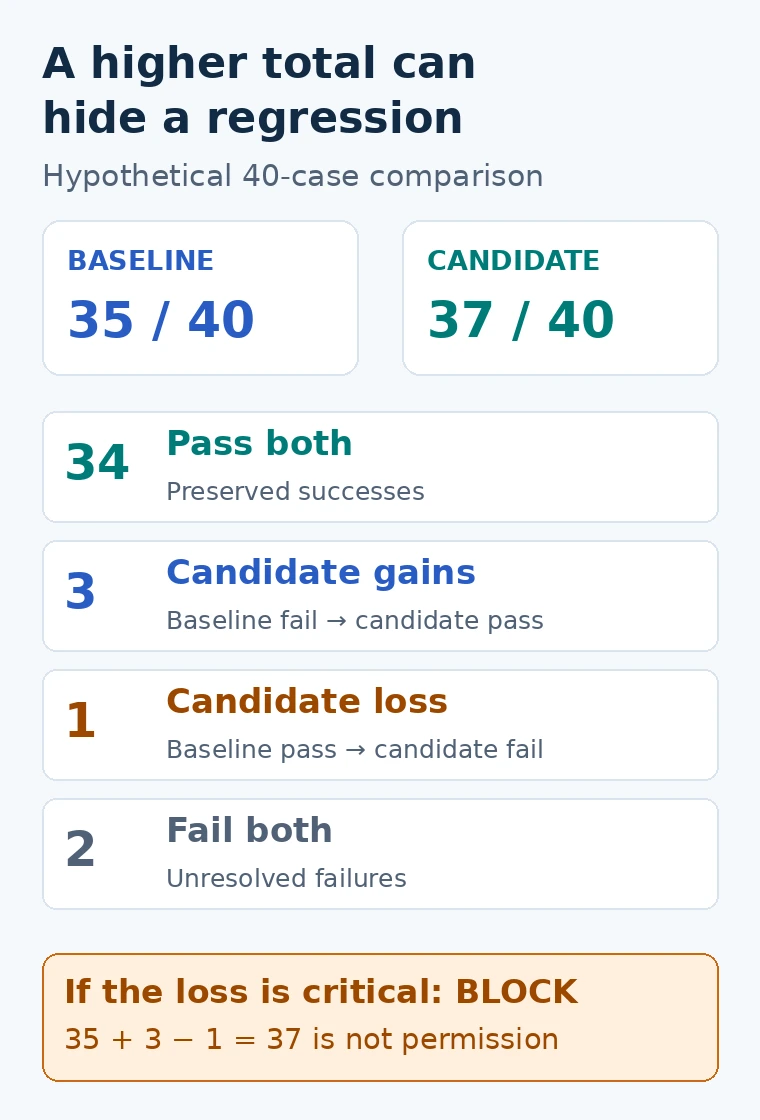
Suppose a separate, hypothetical 40-case comparison gives the baseline 35 passes and the candidate 37. The totals rise from 87.5 percent to 92.5 percent. That sounds encouraging, but the pairwise report reveals three gains and one loss. The arithmetic is 35 plus three minus one, giving 37.
The lost case may be more consequential than all three gains. If it concerns a required clarification boundary, a higher aggregate score does not make the regression acceptable. Read every baseline-pass, candidate-fail pair and determine whether the result reveals a real behavior change, a bad label, or an evaluation defect.
Also inspect cases that both versions fail. A comparison focused only on regressions can preserve an unacceptable baseline indefinitely. Our checker blocks any failed critical case regardless of the baseline. For noncritical shared failures, track an owner and rationale so repeated “no regression” reports do not erase known product limitations.
Report counts by meaningful scenario group as well as overall. A candidate might improve routine installation questions while weakening ambiguous upgrade requests. Show the number of cases behind each group, because a perfect score on two examples says little. Never present an unmeasured group as passing merely because another group performed well.
Pairwise inspection does not by itself establish statistical significance. The example totals are arithmetic, not a confidence claim. If a release depends on a small apparent improvement, design a larger, appropriate evaluation and seek statistical expertise where needed. Avoid turning a handful of correlated paraphrases into a claim about all future users.
10. Treat repeated runs as evidence of variability
A model can produce different valid or invalid decisions for the same input across attempts. Repeated samples can reveal that instability, especially around ambiguous boundaries. Choose the number of attempts and the pass rule before collecting them. Do not increase attempts only for cases where the candidate initially looks weak.
Keep two separate summaries: how often individual attempts pass, and how many cases meet the chosen consistency rule. A case that passes four times and fails once has an 80 percent observed attempt pass rate in that tiny sample. Under an all-attempts-must-pass rule, that case fails. Both statements can be true, and they answer different operational questions.
Repeated attempts on the same input are not a substitute for diverse cases. One hundred runs of a single clean installation request leave the upgrade boundary unexplored. Allocate effort between breadth and repetition according to the failures that matter. Use repeated runs to investigate uncertain behavior, and expand the case set when a whole scenario family is missing.
Low-temperature or explicit configuration settings should not be described as a universal reproducibility guarantee. Record what you requested, what the provider documented as effective, and the observed variation. Saved outputs let you reproduce the scoring calculation; fresh generation is another experiment. This distinction keeps offline testing claims honest.
If the candidate’s benefit disappears under small, realistic variations, investigate before release. The improvement might depend on an accidental example order, a specific phrase, or an overly narrow label. Add a diagnostic case family, revise the hypothesis, and run a fresh comparison rather than choosing the single result that supports your initial preference.
11. Use human review where equality is too narrow
The router’s exact labels make automated scoring straightforward. A documentation answer is harder. It can use different wording while remaining accurate, or repeat expected phrases while inventing a dangerous instruction. For free-form answers, define a short rubric tied to the task and preserve the evidence supporting each judgment.
A useful rubric might ask whether the answer addresses the actual question, preserves required prerequisites, distinguishes uncertainty, and avoids unsupported steps. Give reviewers examples at the boundaries of each rating. A vague instruction to score “helpfulness out of ten” invites inconsistent interpretations and makes small differences hard to trust.
Hide the baseline and candidate labels during review when feasible, and vary display order. Ask reviewers to cite the sentence or missing requirement behind a failure. When reviewers disagree, retain both initial judgments and the adjudication reason. Agreement on a final score should not erase evidence that the rubric was ambiguous.
A model-based judge can help prioritize a large queue, but its output should be treated as another fallible measurement. Calibrate it against human-reviewed examples, check order sensitivity, and inspect disagreements. Do not let a judge’s confident explanation substitute for the source material or silently redefine the release policy.
Keep retrieved-evidence evaluation distinct from prompt regression. If the feature uses retrieval, a failure may come from missing context rather than wording changes. The DeepSeek RAG evaluation guide addresses retrieval, answer grounding, and citations. A release packet can combine those checks while preserving which component each result actually measures.
12. Budget for failed attempts and operational effects
Quality improvements can arrive with longer responses, more retries, or a different reasoning configuration. Record those effects alongside correctness. Count usage and latency for failed attempts as well as successful ones, otherwise the most unreliable configuration can appear artificially cheap because its expensive failures were discarded.
Use observed usage fields and the rates applicable to the actual collection period when calculating cost. Keep cached and uncached input categories separate where reported. Treat missing usage as unknown rather than zero. A cost estimate based on assumed answer length is useful for planning, but should be labeled as an estimate.
Measure latency at the boundary the user experiences. A provider response duration does not include queueing, validation, retries, or rendering in your application. For streaming interfaces, first visible content and completed usable output are different milestones. Define which one your latency target concerns before comparing configurations.
Build a budget guard into the collector rather than relying on a prompt instruction to be economical. Limit cases, attempts, concurrency, and authorized spend through application controls. This article’s offline checker has no collection loop and therefore cannot enforce a live request budget. Do not treat its small fixture as a production load test.
Evaluate model changes separately when practical. If a prompt revision, new route policy, and model switch are all bundled together, a result becomes harder to explain. The capability-aware DeepSeek model routing guide can help define the configuration boundary. A focused experiment makes later rollbacks and investigations more useful.
13. Turn the gate into a reviewable release workflow
A practical workflow begins when an author proposes a prompt change with a concrete hypothesis. For example: “Explicitly prioritize missing context so vague failure reports request clarification.” The review then asks whether the candidate improves that boundary without damaging clear installation, upgrade, or troubleshooting questions.
Run local checker tests before generating new evidence. Validate the case file and manifest, collect the authorized baseline and candidate outputs, and freeze them. Produce a report containing gains, losses, critical failures, incomplete runs, and relevant operational measurements. A reviewer should be able to trace any summary count to its individual records.
Keep the proposed prompt, report, dataset revision, and checker revision together in the change review. Document who can approve release and which failures require escalation. If a policy exception is justified, record the exact affected cases and reasoning instead of editing the checker until the dashboard becomes green.
NIST’s AI Risk Management Framework emphasizes documented measurement, independent review, and evaluation before and during operation. [5] The workflow here is one practical application of those general principles. It is not a certification scheme, and a successful comparison does not establish that the application is safe for unrelated or higher-consequence uses.
Prepare a reversible rollout with a known previous configuration. State which observations would pause the rollout and who will investigate them. A rollback should restore the prompt and dependent configuration together. Restoring only the text may leave a changed model, parser, or routing policy in place and fail to reproduce the earlier behavior.
14. Diagnose a regression before adding more instructions
When a case fails, classify the problem before editing the prompt. A missing record is a collection problem. A truncated response may be a limit or transport problem. A valid object with a wrong route is a decision problem. An expected label that contradicts the product contract is an evaluation problem.
Use the smallest diagnostic change that tests your explanation. If the model overweights the word upgrade, compare matched examples containing that word in positive and negative statements. If an example encourages premature troubleshooting, remove or revise that example while holding the rest of the configuration fixed. This makes the next result informative.
Avoid endlessly appending exceptions. A long prompt can contain competing rules, duplicated instructions, and examples that imply a different policy. Consolidate the contract when necessary, then rerun the full relevant suite. A shorter, coherent instruction may be easier to maintain than a history of patches embedded in prose.
After release, use authorized feedback and observed failures to improve coverage. Track whether the input population differs from the test set and whether model or application changes require a fresh comparison. Keep evaluation records under retention and access rules appropriate to their content. Ongoing measurement should not become an uncontrolled archive of user conversations.
The durable outcome is a review habit: define the promise, preserve the evidence, inspect paired changes, and keep the release decision accountable. With that structure, a DeepSeek prompt edit becomes a testable product change. You can explain what improved, identify what remains uncertain, and decline a superficially better candidate when it breaks an important boundary.
Sources & References
Official documentation was checked on October 3, 2026. Provider behavior and model aliases can change. The release policy, synthetic case examples, checker, and diagrams are original teaching material.
- DeepSeek: Chat Completions API reference. Request parameters, effective sampling behavior, response fields, and finish reasons.
- DeepSeek: Models & Pricing. Current model names and underlying versions.
- DeepSeek: JSON Output. JSON instructions, output allowance, and empty-content caveat.
- Scikit-learn: Cross-validation and evaluating estimator performance. Test-set leakage and evaluation design principles.
- NIST: AI Risk Management Framework Core. Documented measurement, independent assessment, and lifecycle monitoring.
- Python: JSON encoder and decoder. Parser hooks, repeated names, and nonstandard numeric constants.
- DeepSeek: Thinking Mode. Explicit thinking configuration and current reasoning behavior.

[…] these components together, and retain a rollback path to the previous approved configuration. The prompt-regression testing guide provides a broader release-gate […]
[…] the original failing case after the fix. The regression-testing workflow is useful for organizing the evidence, but the specific lesson here is to preserve the time meaning […]