


A Python batch job can look concurrent and still have an unbounded backlog, ambiguous timeouts, or workers that keep running after their caller has gone away. These bugs rarely appear in a three-item happy-path demo. They show up when a downstream operation slows down, a user cancels an import, or one worker raises an exception while the producer is waiting to enqueue more work.
DeepSeek can help you examine those paths, propose small refactors, and generate adversarial test ideas. The useful workflow starts with a precise lifecycle contract. Give the model a defined resource budget and failure policy, then check its proposal against an executable local example. A convincing explanation is a hypothesis until the behavior has been observed.
This guide builds that workflow around a bounded Python asyncio batch processor. The example uses Python 3.11 or newer and only the standard library. It processes synthetic values through a fake asynchronous function. No API key, paid model call, production data, network service, or provider benchmark is required. The prompts are reusable review instructions, not transcripts of a DeepSeek session or claims about a particular model’s measured performance.
The practical result: a worker limit, a waiting-queue limit, ordered outcomes, a deliberate per-item timeout policy, and explicit shutdown behavior. You will also see what these controls do not guarantee, including requests per second, constant total memory, and rollback of external side effects.
1. Describe the lifecycle before asking for code
Imagine an internal import tool that receives a finite list of product identifiers and retrieves one piece of metadata for each identifier. A short prototype might launch every lookup immediately. A slower but simpler version might await each lookup in a loop. Neither choice tells a reviewer what should happen if a lookup never finishes or if the entire import is cancelled.
Write the contract in ordinary language first. Our batch accepts an already materialized input sequence. It runs at most a configured number of processing calls at once and keeps at most a configured number of waiting entries in its queue. It preserves input order in the returned outcomes even if completion order differs. An item that exceeds our execution deadline gets a timeout outcome. An unexpected processing error aborts the batch. A cancellation request from the caller must remain a cancellation request when it reaches the caller again.
That last distinction prevents a subtle user-experience bug. Suppose a user clicks Cancel and the interface later announces that the import completed with a few missing products. Treating cancellation as a normal empty result would make that message plausible. The lifecycle contract instead requires the enclosing operation to acknowledge that it was interrupted. The product interface can then show an interrupted state and offer an intentional retry.
Keep business policy separate from orchestration. A missing product may be a normal outcome in one tool and a release-blocking defect in another. The example cannot decide that for you. Specify expected domain failures explicitly and review any change to their treatment as a behavior change. For help turning these decisions into testable statements, the site’s guide to traceable acceptance criteria provides a complementary workflow.
2. Count active work, waiting work, and retained results separately
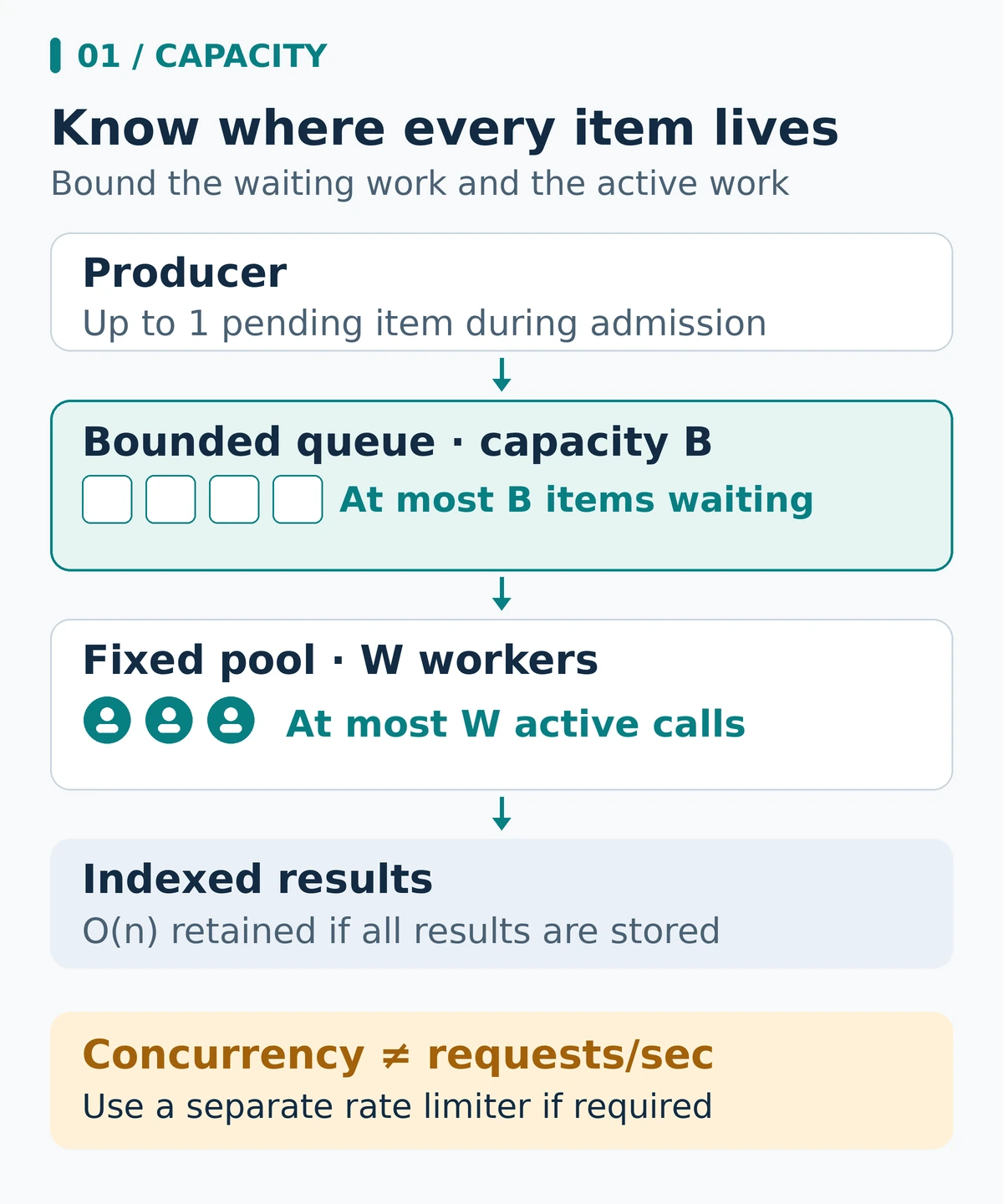
A worker count and a queue capacity answer different questions. With three workers and a queue capacity of six, up to three items can be inside the processing function while six other items wait to be taken by a worker. The producer may also be holding the next item while its enqueue operation waits. Those numbers describe this pipeline’s ownership, not every object in the process.
In particular, our input sequence and result list remain in memory. For a batch of a million identifiers, bounding the queue does not erase a million input objects or a million eventual outcomes. A useful review therefore records several budgets: active calls, queued entries, retained output, and the size of each payload. A queue of six small identifiers is very different from a queue of six decompressed documents.
This is why wrapping every operation in a semaphore is only a partial answer to an enormous batch. The protected operation can have a small concurrency limit while the program has already created a very large number of waiting tasks. A fixed worker pool lets the task count follow the worker budget rather than the number of input records. A semaphore remains useful when separately limiting a resource shared by several components; it simply solves a different part of the design.
Ask DeepSeek to draw an ownership inventory before suggesting an optimization. Who holds an item before enqueueing? Who owns it after dequeueing? Where is a result retained? Which structure can grow with batch size? If the answer only says that the application is bounded because it has a semaphore, the review is incomplete. This question often catches an architectural mistake before a stress test is necessary.
3. Give DeepSeek a small, auditable review packet
The most useful prompt contains the current function, its caller, the Python version, and the behavior contract. Include the code that creates and closes the network client if that lifecycle matters. Include a small synthetic case demonstrating the problem. Remove credentials, customer payloads, internal tokens, and unrelated application code before sharing anything with a hosted model.
Use a request that demands evidence rather than a sweeping rewrite. Ask the model to identify the exact await point where a producer can become blocked, the task that owns each worker, and the path taken when one operation fails. Require separate findings for confirmed behavior, plausible risks, and questions that cannot be answered from the supplied code. This keeps an attractive but unsupported explanation from becoming an accidental design decision.
Review this Python 3.11+ asyncio batch processor.
Use only the supplied code and contract.

Contract:
- At most W active processor calls and B queued entries.
- Return outcomes in input order.
- Our per-item execution deadline is a normal timeout outcome.
- Unexpected processor errors abort the batch.
- Caller cancellation propagates after worker cleanup.
- No network calls, retries, or detached background tasks in tests.

For each concern, give:
1. The exact code path and smallest reproducing scenario.
2. The contract clause affected.
3. A minimal patch, if justified.
4. A deterministic test that would fail before the patch.
5. Remaining assumptions and limits.

Do not claim to have run code. Do not broaden the contract.
Save the prompt beside the code version you reviewed. A later model answer should not silently replace the earlier contract. If it recommends a different policy, such as retrying every timeout or returning partial results after a crash, make that proposal explicit and decide whether it is appropriate before changing the implementation.
DeepSeek’s official documentation describes chat API access and compatible client formats, but this exercise does not depend on a particular model identifier or optional reasoning setting. Use the configuration supported by your account if you automate the review. Keep provider integration separate from the offline lab so an API outage cannot obscure a concurrency defect.
4. Start with a finite batch and a compact local lab
The downloadable lab keeps the processing callback injectable. That choice is important: a test can substitute a coroutine that waits for an event, deliberately raises an exception, or records when it enters and leaves. The scheduler is then tested against controlled behavior instead of a remote server whose latency and availability change between runs.
Each queued work entry carries an input index as well as its value. A successful worker writes its outcome into the matching result slot. This makes the output order an explicit property of the implementation. The method does not require worker zero to finish first, and it does not confuse a completion timestamp with the position in the original request.
Read the complete module and its tests before adapting it. The first example below shows the public usage pattern. The expandable source contains the complete scheduler; the download adds its tests and documentation. The constants in the demonstration are teaching choices, not recommended service limits.
Run the deterministic demonstration
"""Deterministic, offline examples: no provider, network, or randomness."""

import asyncio
from bounded_pipeline import bounded_map


async def main() -> None:
    # Events force completion order 2, 1, 0, independent of clock speed.
    gates = [asyncio.Event() for _ in range(3)]
    gates[2].set()
    completion_order: list[int] = []

    async def fake_process(number: int) -> str:
        await gates[number].wait()
        completion_order.append(number)
        if number:
            gates[number - 1].set()
        return f"result-{number}"

    ordered = await bounded_map(
        [0, 1, 2], fake_process, workers=3, queue_size=1, item_timeout=None
    )
    print("Completion order:", completion_order)
    print("Returned values:", [result.value for result in ordered])

    # A zero timeout expires on the next loop iteration. Immediate work can
    # finish; an unset Event cannot. This demonstrates policy, not a useful SLA.
    async def fake_timeout(number: int) -> str:
        if number == 1:
            await asyncio.Event().wait()
        return f"result-{number}"

    timed = await bounded_map(
        [0, 1, 2], fake_timeout, workers=1, queue_size=1, item_timeout=0
    )
    print("Timeout policy:", [result.status for result in timed])


if __name__ == "__main__":
    asyncio.run(main())
The first case deliberately completes items in reverse order. Its returned values remain in input order. The second uses a zero-second timeout only as a test device; it is not a production service-level target.
Completion order: [2, 1, 0]
Returned values: ['result-0', 'result-1', 'result-2']
Timeout policy: ['ok', 'timeout', 'ok']
Show the complete bounded_map scheduler
"""Offline teaching example: bounded asyncio workers, Python 3.11+."""

import asyncio
import math
from asyncio import Queue
from collections.abc import Awaitable, Callable
from dataclasses import dataclass
from typing import Generic, Literal, TypeVar, cast

T = TypeVar("T")
R = TypeVar("R")


@dataclass(frozen=True)
class Outcome(Generic[R]):
    status: Literal["ok", "timeout"]
    value: R | None = None


async def bounded_map(
    items: list[T],
    process: Callable[[T], Awaitable[R]],
    *,
    workers: int = 4,
    queue_size: int = 8,
    item_timeout: float | None = 10.0,
) -> list[Outcome[R]]:
    """Keep input order; return local timeouts; abort on other failures.

    The deadline starts when a worker starts process(), not at enqueue time.
    process() must cooperate with cancellation and must not detach background work.
    Do not mutate items while this coroutine is running.
    """
    if type(workers) is not int or workers < 1:
        raise ValueError("workers must be a positive integer")
    if type(queue_size) is not int or queue_size < 1:
        raise ValueError("queue_size must be a positive integer")
    if item_timeout is not None and (
        not math.isfinite(item_timeout) or item_timeout < 0
    ):
        raise ValueError("item_timeout must be finite and nonnegative, or None")

    queue: Queue[tuple[int, T] | None] = Queue(maxsize=queue_size)
    results: list[Outcome[R] | None] = [None] * len(items)
    owner = asyncio.current_task()
    assert owner is not None
    cancels_at_entry = owner.cancelling()

    async def worker() -> None:
        while True:
            job = await queue.get()
            try:
                if job is None:  # One stop marker per worker.
                    return
                index, item = job
                deadline = asyncio.timeout(item_timeout)
                processor_timeout = False
                try:
                    async with deadline:
                        try:
                            value = await process(item)
                        except TimeoutError:
                            processor_timeout = True
                            raise
                except TimeoutError:
                    if processor_timeout or not deadline.expired():
                        raise  # Includes TimeoutError from processor cleanup.
                    results[index] = Outcome("timeout")
                else:
                    results[index] = Outcome("ok", value)
            finally:
                queue.task_done()

    def worker_finished(task: asyncio.Task[None]) -> None:
        # TaskGroup does not abort siblings for a cancelled child. Observe the
        # task itself: cancellation can occur before worker() ever starts.
        if task.cancelled() and owner.cancelling() == cancels_at_entry:
            owner.cancel()

    async with asyncio.TaskGroup() as group:
        for number in range(workers):
            task = group.create_task(worker(), name=f"bounded-map-worker-{number}")
            task.add_done_callback(worker_finished)
        for index, item in enumerate(items):
            await queue.put((index, item))  # Backpressure on this producer.
        for _ in range(workers):
            await queue.put(None)
        # Exiting the group waits for every worker, so queue.join() is redundant.

    assert all(result is not None for result in results)
    return cast(list[Outcome[R]], results)
Download the complete offline asyncio lab. Unzip it into a new directory, read its README, and run the documented standard-library test command. Do not paste the example into a production service without adapting the callback, ownership rules, and error policy. A teaching implementation cannot know your framework’s request lifecycle or your client’s connection-pool behavior.
Do not mutate the input list while the batch is running. The example does not copy or synchronize access to that list, and every result index assumes the inputs stay stable. The finite-batch choice also defines the stopping condition. On success, every input position has one outcome and all workers have finished. On an abort, the caller receives the failure rather than a silently shortened result list. If your product needs a stream of partial results, design that as a separate interface with explicit acknowledgement and cancellation semantics. It is a substantial change, not a small return-type edit.
5. Follow one item through admission and processing
Trace item number seven through a hypothetical run with two workers and two waiting slots. If both workers are busy and both slots are occupied, the producer waits before placing item seven into the queue. That wait is intentional feedback to the producer. It prevents this stage from accepting unlimited waiting work merely because the source can enumerate identifiers quickly.
When a worker removes an entry, the waiting slot becomes available. The producer can admit another entry even while the earlier one is still being processed. Therefore queue depth alone cannot tell you how much work is outstanding. A dashboard showing an empty queue might coincide with every worker being busy. Record active operations and completed outcomes as separate measurements.
Our worker’s ownership starts after it has successfully retrieved an entry. Its cleanup is attached to that ownership interval. Do not acknowledge a queue entry that was never acquired, and do not acknowledge it twice. Where queue accounting is used, an acknowledgement means that this consumer has finished handling the entry according to its policy. It does not independently prove that a database committed a change or that an external service accepted a request.
There is a second boundary at the source. If a future version consumes from a message broker, removing a broker message and putting it in an in-memory queue may have delivery implications. The local queue cannot supply durability or recovery after process death. Preserve the broker’s acknowledgement contract, and test what happens if the process exits between acquisition and completion. Keep that operational problem visible instead of hiding it behind the word async.
6. Say exactly when each timeout starts
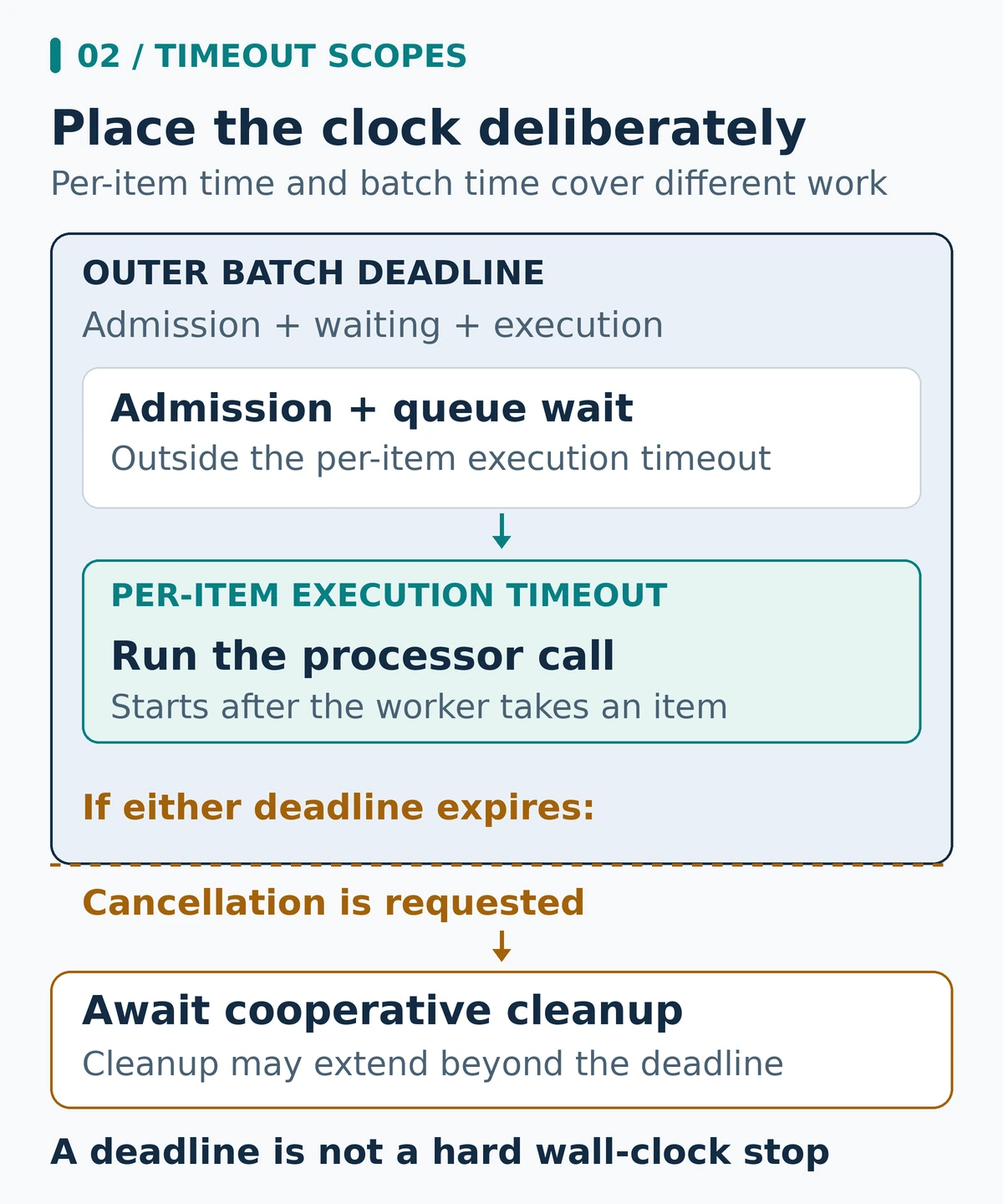
A timeout value without a starting point is an incomplete requirement. The per-item execution budget in this design begins when a worker starts its callback. It excludes time spent waiting for admission and time already spent in the queue. A record may therefore take longer to finish than the numeric execution timeout while still behaving exactly as designed.
For an interactive operation, you may also need a deadline for the entire batch. The lab does not install an overall deadline for you. If you need one, place it around the caller’s batch operation so it includes admission, queue waiting, and processing. It expresses a different promise: the user is no longer willing to wait for the whole operation. Decide how the interface distinguishes an individual timeout outcome from an interrupted batch.
Python’s timeout context works through cooperative cancellation. It cannot preempt arbitrary blocking Python code at an exact instant. Cleanup may also take time after cancellation is requested. Avoid describing the deadline as a hard wall-clock guarantee. A callback that blocks the event loop or suppresses cancellation violates the assumptions that make this design useful.
Another important distinction is the origin of a TimeoutError. The callback may raise its own timeout exception even when our outer execution budget has not expired. Relabeling that as our deadline would destroy diagnostic information. The lab marks TimeoutError raised inside the callback, including during its cancellation cleanup, and also checks whether the timeout context expired. That combination preserves callback failures instead of mislabeling them as our deadline. When you adapt the example to a client library, inspect that library’s exception hierarchy and document which failures are expected outcomes.
7. Make failure policy a decision tree
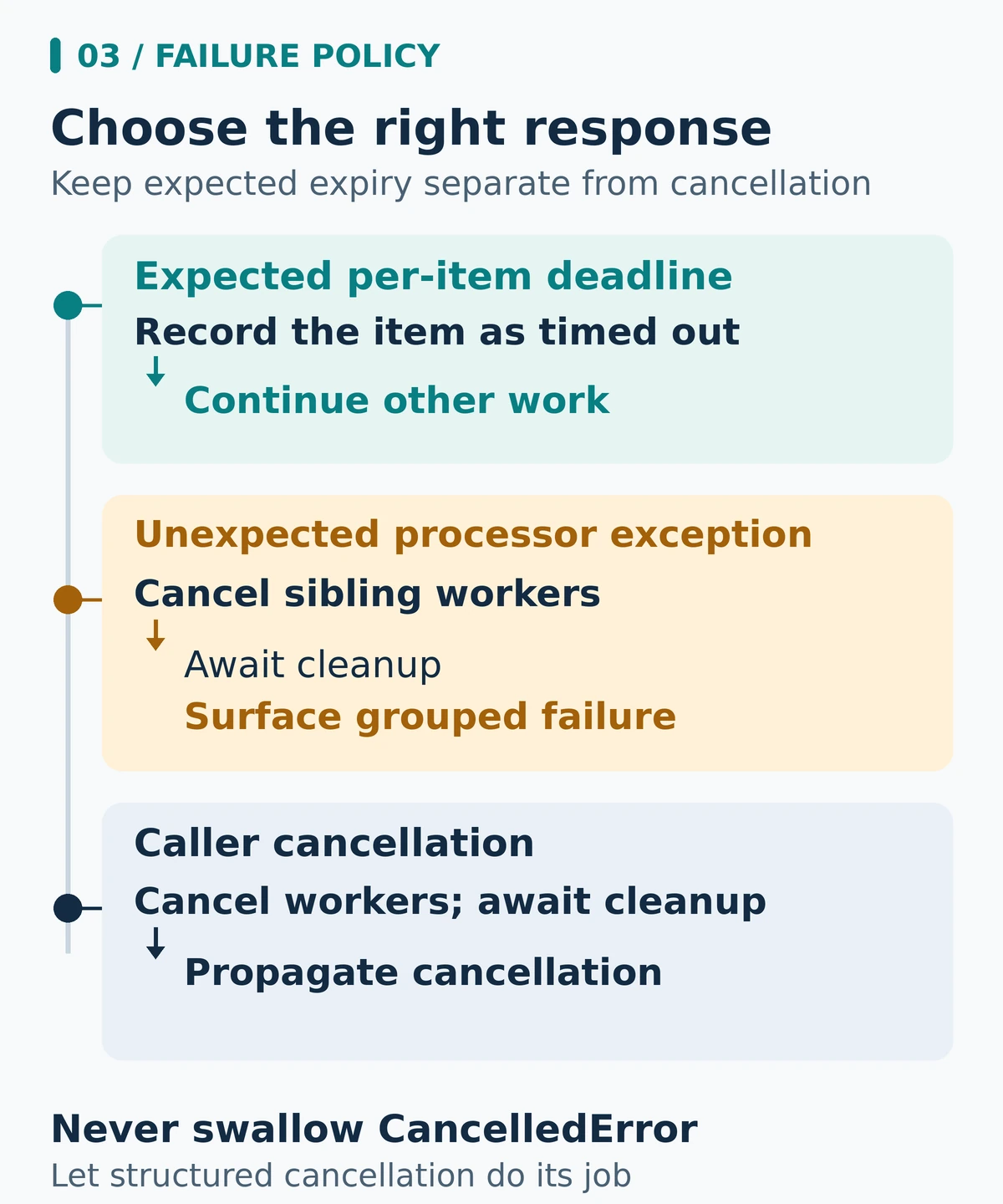
For a metadata import, a single slow lookup might be acceptable as a per-item timeout. A broken parser or an invalid assumption in the callback should usually stop this particular batch so that the developer sees a defect. Those choices explain why the lab converts only its own item deadline into a normal outcome and lets unexpected errors escape the worker.
The worker group owns related tasks as a unit. With TaskGroup, an unexpected child exception causes sibling cancellation and cleanup before the grouped failure is surfaced. That is the behavior this example needs. It prevents the caller from receiving a failed batch while sibling work continues without an obvious owner.
Do not add a broad catch simply to make a demonstration appear resilient. Returning an empty string for every exception can turn a programming mistake into apparently valid imported data. The loss is larger than the missing record: the application has erased the information needed to distinguish an unavailable upstream from a faulty transformation.
A reasonable alternative policy can still be explicit. Suppose malformed source records are expected and independently recoverable. Introduce a named domain exception or a typed outcome for that condition, then test it separately. Leave programmer errors and invariant failures visible. Ask DeepSeek to list every exception converted into data and explain why that conversion is part of the business contract. The list should be short enough for a human reviewer to challenge.
8. Preserve cancellation through cleanup
Cancellation is a control-flow signal. A user may close a request, a parent operation may reach its deadline, or a supervisor may stop a job. In each case, the code that owns the operation needs an honest result. A cancelled operation that quietly returns successful-looking data is difficult to reason about and difficult to operate safely.
Use cleanup paths to release resources that this operation owns. In a fake callback, that may mean decrementing an active-operation counter in a finally block. In a real adapter, it may mean exiting the response stream’s context manager. Do not close a client shared by unrelated requests merely because one batch ends. Ownership determines cleanup responsibility.
The common mistake is catching cancellation, logging it, and then continuing the worker loop. That worker may pick up more work after its owner has already asked it to stop. Another mistake is shielding the entire batch because cancellation looks inconvenient. Shielding changes the lifetime relationship; it does not remove the need for someone to own and await the surviving operation.
The lab’s contract includes the unusual case in which a processor independently raises cancellation. That should not silently remove one worker and leave an unfinished batch waiting forever. Review this path separately from caller cancellation, because task groups treat cancellation differently from ordinary child exceptions. The tests make the chosen behavior observable instead of relying on a vague assumption that all failures are equivalent.
9. Use events to test concurrency, not stopwatch guesses
A fragile test sleeps for a tiny interval and assumes every worker has reached a particular line. On a busy machine, the assumption can fail even if the application is correct. A stronger test gives the fake callback an event to signal that it has started and another event to wait on before it may finish. The test then controls the lifecycle directly.
To test the active-worker bound, hold the first set of callbacks open. Count entries into the callback and verify that the configured limit is reached without being exceeded. Release the callbacks and verify that every active count returns to zero. For queue pressure, observe how far the producer can advance while the workers remain blocked. These checks test resource ownership rather than a lucky scheduling order.
To test output ordering, deliberately release later input positions before earlier ones. The returned list should still line up with the original inputs. A test that makes every item complete in the same order it started would miss an implementation that accidentally appends completion-order results.
To test shutdown, arrange for one worker to fail while another is waiting. Assert that the waiting callback’s cleanup ran and that the batch failed. For caller cancellation, start the batch, wait until work is active, cancel the batch task, and await it. Assert the cancellation result as well as cleanup. A test that only checks an exception was raised may overlook surviving tasks.
Use generous watchdog timeouts around tests so a regression fails instead of hanging the suite indefinitely. The watchdog is a test safety mechanism, not the behavioral assertion. This distinction makes failures more informative: an exceeded active bound is a different defect from a pipeline that never shuts down.
10. Turn model feedback into a reproducible change
After running the baseline suite, give DeepSeek the smallest relevant failure report and the corresponding function. Ask it to explain why the assertion failed before proposing a patch. Include the exact Python version and command so the answer does not assume APIs introduced after the runtime you support.
Keep the patch narrow. If the defect is that a callback-originated timeout is mislabeled, change timeout classification and add its regression test. Do not simultaneously replace the queue, change output ordering, add retries, and introduce a third-party client. A small change makes it easier to attribute the new result to the intended fix.
Review the test itself as critically as the implementation. A model may “fix” a failing test by weakening an assertion, raising a limit, or removing the cancellation scenario. Compare the changed assertions to the original contract. A passing suite is only useful if it still tests the behavior you decided to require.
Save three artifacts for each accepted change: the defect scenario, the code diff, and the observed test result. If a reviewer cannot reproduce a concern, retain it as an open hypothesis instead of publishing it as a confirmed failure. The site’s evidence-based code review workflow covers this distinction in more detail.
The baseline test for caller cancellation fails.
Here is the exact command, Python version, test, and traceback.

Explain the ownership path first.
Propose the smallest correction that preserves all other clauses.
Do not delete or relax existing assertions.
Identify one regression test and one limitation that remains.
Separate observed evidence from your hypothesis.
Two failures found while checking this lab
The independent local review found a case that the first timeout test missed: the fake processor waited for cancellation and then raised TimeoutError from its finally block. The earlier implementation saw an expired deadline and returned a timeout outcome, hiding a cleanup failure. The corrected implementation marks exceptions raised inside the processor call before the outer timeout handler classifies them. A regression now requires that cleanup failure to remain visible.
A second test cancelled a worker task before its coroutine body first ran. A cancellation handler inside that body never executed, so the producer could remain blocked on a full queue with no worker available to consume it. The corrected scheduler observes the task’s completion and cancellation state through a callback registered when the worker is created. The regression verifies that this path cancels the owning batch rather than hanging until a watchdog intervenes.
These are observed failures of earlier local code, followed by tested corrections. They illustrate why a cancellation test should cover more than an already-running callback. They do not establish that every simultaneous failure and cancellation race has been covered, and they are not reported as DeepSeek-generated discoveries.
11. Separate concurrency from speed and rate limits
More workers are not automatically better. If the downstream service or local connection pool is already saturated, additional workers can spend their time waiting on another hidden queue. The result may be higher memory use and longer tail latency without improved throughput. Choose a starting budget conservatively and measure under a representative workload before increasing it.
The local lab makes no speedup claim. Its fake coroutines are designed to expose lifecycle behavior. A reduction in synthetic sleep time would not establish a production improvement. For meaningful measurements, record batch size, payload sizes, callback duration, client pool limits, timeout counts, and the distribution of completion times. Compare equivalent work and preserve the same correctness checks.
A concurrency cap also does not enforce requests per second. Three workers processing fast operations may begin many requests within a second. If an upstream contract has a rate budget, implement the corresponding admission policy separately and test it. Avoid inventing a universal DeepSeek request-rate limit from the worker count in an example.
Retries add another layer. Decide whether a retry occupies the same worker slot, how backoff affects the batch deadline, and which side effects are safe to repeat. The existing guide to API timeouts, retries, and backpressure addresses those integration concerns. Keep the present worker lab focused on lifecycle correctness so those policies can be added deliberately.
12. Find blocking work before adding workers
An async function can still contain blocking work. Declaring a function with async def does not convert a synchronous file read, CPU-heavy transformation, or blocking client call into cooperative I/O. If a callback monopolizes the event-loop thread, other callbacks and cancellation handlers cannot make progress as intended.
Ask DeepSeek to classify operations in the callback: genuine asynchronous I/O, small synchronous bookkeeping, potentially blocking library calls, and substantial CPU work. Then verify that classification against the relevant library documentation and a profile. Do not accept a suggestion to replace every operation with a task; additional tasks on the same blocked event loop do not solve the underlying problem.
Moving a blocking operation into a thread may be appropriate for some I/O workloads, but it introduces another lifetime boundary. Cancelling the coroutine awaiting a thread does not by itself establish that the underlying operation stopped or rolled back. Define how the thread’s work finishes and who owns any result or side effect after the async caller leaves.
For CPU-heavy transformations, investigate algorithmic work and a suitable execution model rather than using worker count as the only tuning knob. The site’s profile-first Python performance guide provides the measurement discipline. The key question is where time is actually spent, not whether the source code contains await often enough.
13. Adapt the lab at a single integration boundary
When you connect the pattern to a real service, keep the batch scheduler independent from the service-specific adapter. The adapter should own request formatting, response validation, and the conversion of explicitly expected service conditions into domain outcomes. The scheduler should continue to own admission, worker lifetime, ordering, and batch interruption.
Document the adapter’s cancellation behavior. Does it close a response body when interrupted? Does the client reuse connections safely after an aborted read? Can the remote operation complete even if the local request is cancelled? Those answers come from the client and service contracts, plus integration tests. The offline suite cannot establish them.
External side effects require particular care. A cancelled request does not mean an order, email, or write never happened. If the operation can change state, use the service’s appropriate idempotency and reconciliation mechanisms. Keep an operation identifier that allows an authorized follow-up check. Never equate a local timeout outcome with proof that the remote system did nothing.
Also decide what crosses the model boundary during development. A compact synthetic fixture can demonstrate queue pressure without exposing customer data. Logs can show item indexes, outcome categories, and elapsed durations without recording full payloads. Apply the data-minimization approach described in the site’s DeepSeek API privacy guide before sharing debugging context.
14. Make operational evidence useful without making it noisy
A useful batch record contains the configured worker and queue budgets, number of admitted items, number of completed outcomes, item-timeout count, and the final batch state. Where appropriate, include an opaque job identifier. These fields help an operator distinguish a slow upstream from a cancelled request or a defect in processing.
Track queue waiting and execution duration separately. If the waiting time rises while execution duration remains stable, the bottleneck may be admission capacity or excessive incoming load. If execution duration rises first, adding queued work may only make users wait longer. This is diagnostic evidence, not an automatic instruction to increase concurrency.
Keep observability lightweight in the hot path. A blocking log handler or a large serialized payload can itself change scheduling behavior. Aggregate routine metrics and reserve detailed traces for carefully bounded investigations. When reproducing a bug, preserve the test’s event order and outcome assertions rather than depending on the visual order of interleaved log lines.
For an interrupted batch, report what is known and what remains uncertain. The local scheduler can know that its workers finished cleanup. It may not know whether a remote side effect completed. That uncertainty should remain visible in the status or reconciliation record. A clean shutdown message should not imply stronger guarantees than the system actually provides.
15. Use a concrete acceptance checklist
Before merging an asyncio refactor, a reviewer should be able to answer the following questions from code and tests rather than from intent alone:
- How many processor calls can be active, and what test detects an excess?
- How many entries can wait locally, and which other structures grow with input size?
- Does the result preserve input order under deliberately reversed completion order?
- When does each timeout begin, and is its scope visible to callers?
- Can a callback’s own error be mistaken for the scheduler’s deadline?
- What happens to siblings when one callback unexpectedly fails?
- Does caller cancellation run cleanup and remain cancellation at the boundary?
- What evidence shows that no owned worker survives the finished batch?
- Which assumptions require integration tests against the real client?
A good DeepSeek-assisted review produces specific answers to those questions, or clearly identifies the missing evidence. It does not need to produce a large rewritten module. Sometimes the best result is a small regression test that proves the existing implementation already handles the difficult case.
Keep the checklist close to the component so the next maintainer can see why seemingly fussy details exist. Indexed result slots, explicit timeout classification, and cancellation tests are easy to remove during a cleanup if their purpose is undocumented. A short explanation tied to an executable test is more durable than a comment saying the implementation is robust.
Key takeaways
Use DeepSeek to challenge the lifecycle contract, locate concrete failure paths, and propose tests you can run. Keep execution evidence local and reproducible. The combination is useful because model-generated alternatives are cheap to explore, while ownership, bounds, and shutdown behavior remain subject to direct verification.
For this finite-batch design, the worker limit controls active processing, the queue capacity controls waiting entries, and the result list preserves input order at a memory cost proportional to batch size. Expected item deadlines become explicit outcomes. Unexpected errors and cancellation have separate paths. None of those mechanisms establishes provider rate compliance, remote rollback, or unlimited scalability.
Start with the offline tests, adapt one integration boundary at a time, and retain the difficult cases when the code changes. A dependable async workflow is one whose behavior stays understandable when the happy path ends.
Verification notes
The final local suite contains 26 tests, run successfully on Python 3.12.14 and 3.13.5. Python 3.11 grammar checks passed, but that runtime was unavailable for execution. The suite uses event-controlled fake processors and includes independent adversarial checks for cancellation and timeout cleanup. Python 3.13 changed some simultaneous-cancellation handling, so no identical behavior across every runtime race is claimed. The included examples are synthetic and do not report results from a DeepSeek model session or a live provider integration. The tests validate the local scheduler’s stated behavior, not every event ordering, operating system, client library, or production deployment. Re-run them on the Python versions your application supports.
Sources & References
Primary documentation consulted on October 4, 2026. The article’s prompts, scenarios, diagrams, and lab are original worked material. Python 3.11 documentation is used for the example’s minimum-version API contract.
- Python: coroutines, tasks, TaskGroup, cancellation, and timeout contexts
- Python: asyncio queues and queue accounting
- Python: synchronization primitives, events, and semaphores
- Python: developing with asyncio and identifying blocking behavior
- Python: isolated asynchronous unit tests
- Python: current TaskGroup documentation and Python 3.13 cancellation changes
- DeepSeek: official API documentation and first-call configuration
