


A Python dataclass can make a record easy to construct while leaving its most important promises undefined. An annotation can say that a retry count is an integer, yet construction can still accept a string. A frozen instance can contain a list that changes after validation. A hand-written update helper can look like a harmless convenience while bypassing checks that protect ordinary construction. These are small-looking differences with practical consequences when a record becomes a queue item, a configuration value, or a cache key.
This tutorial develops a precise way to use DeepSeek when designing that boundary. The worked example is a standard-library job specification with strict validation, an explicit ownership decision, and updates that return a new validated value. The Python code and accompanying tests were run locally on CPython 3.12.14 and 3.13.5, including optimized execution. The DeepSeek prompts below are unexecuted templates. They show how to request and review assistance; no model output or API behavior is presented as a tested result.
The central engineering question is simple: after a value has been accepted, which facts should remain true, and what can another part of the program still change? Answer that question before asking a model to write the decorator. The answer determines the constructor, the conversion boundary, the tests, and the update path.
Start with a contract that a test can disprove
Our synthetic object is called JobSpec. It describes a job identifier, a retry allowance, and an ordered collection of labels. The identifier must be an exact built-in string, must contain at least one character, and must equal the result of calling its own strip() method. In other words, the object rejects outer whitespace instead of quietly removing it. The retry allowance must be an exact built-in integer between zero and five, inclusive. A boolean is deliberately unacceptable even though Python treats bool as an integer subclass.
Inside the object, labels must be an exact built-in tuple whose members follow the same string rule as the identifier. An empty tuple is valid. Label order is meaningful to this example, and duplicate labels are permitted. The implementation will neither sort nor deduplicate them. The boundary factory accepts an exact built-in list or tuple and converts that outer container into a tuple before constructing the object. Direct construction has the narrower internal tuple requirement. These are two different interfaces with two different jobs.
Several apparently minor decisions deserve explicit attention. The string rule allows Unicode and internal whitespace. It does not define an ASCII identifier grammar, a maximum length, or a prohibition on internal line breaks. Python’s ordinary whitespace stripping behavior determines the outer-whitespace test; the code does not perform Unicode normalization. Accepting only built-in types also means rejecting user-defined subclasses of strings, integers, lists, and tuples. That is an intentionally narrow teaching contract, not a claim that subclasses are generally unsafe or unsuitable.
Write these decisions down as observable behavior before implementation. Otherwise, an assistant may interpret “clean identifier” as a request to strip input, “labels” as a set, or “integer” as an instruction to call int(). Each choice changes the interface. The same distinction matters in configuration validation with DeepSeek: recognizing an accepted value and converting an unaccepted value into something else are separate operations that need separate requirements.
Know what annotations and default factories actually provide
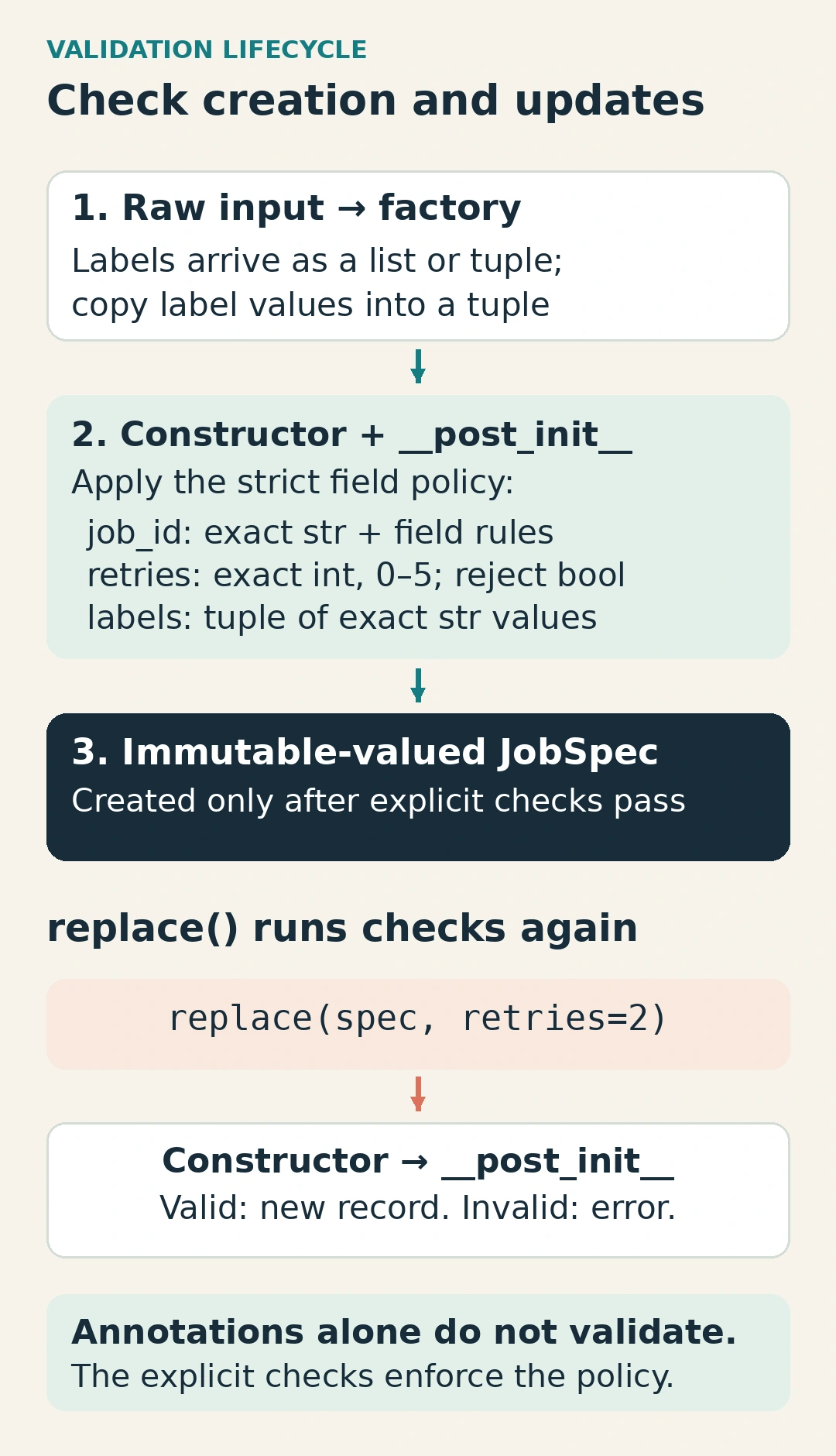
Type annotations describe intended types to readers and supporting tools. Ordinary dataclass construction does not turn those annotations into runtime checks. If a plain dataclass declares retries: int without validation, passing a string to that field can still construct an instance. Static checking may identify a mismatch in checked code, but data arriving from configuration, deserialization, or an unchecked caller still needs a runtime boundary if the program relies on the type being correct.
A default factory solves a different problem. A field declared with field(default_factory=list) receives a newly created list when the caller omits that argument. Two ordinary constructions with omitted labels therefore get separate lists. This is useful for genuinely mutable records. It is also easy to overgeneralize: when a caller supplies an existing list, the generated initializer stores that supplied object. The factory does not run for that argument, does not copy it, and does not establish exclusive ownership.
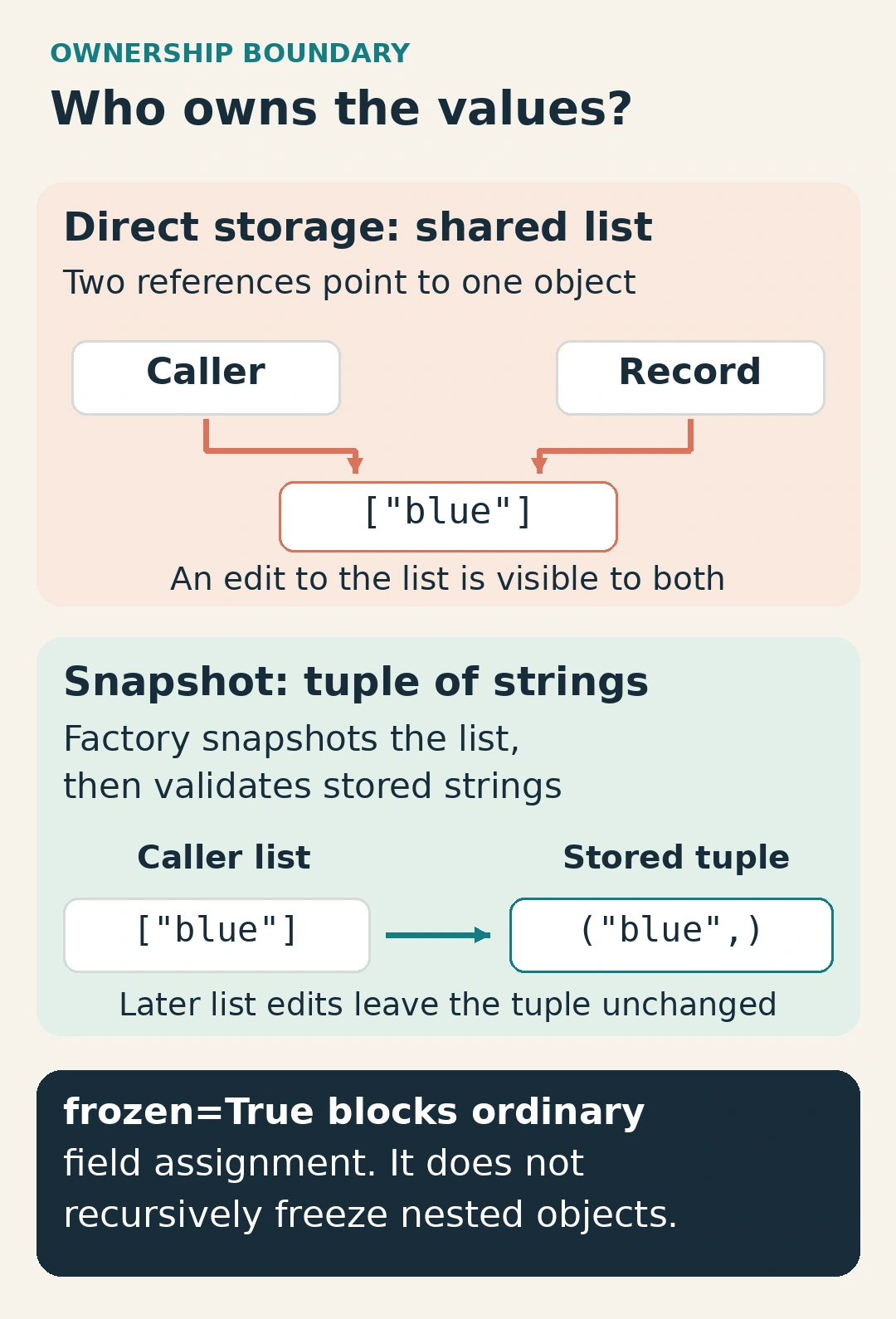
Imagine a caller creates a list containing a single label and passes it into a mutable dataclass. Later, the caller appends another label. Unless the constructor explicitly copied or converted the collection, the object sees that change because both names refer to the same list. Changing the declaration to use a default factory leaves this supplied-input case unchanged. A test that constructs only empty records can pass while the real ownership problem remains completely unexamined.
Our final design uses an empty tuple as the default because the stored collection is intended to be a value. Sharing the empty tuple is harmless under this contract: its membership cannot be changed, and there are no mutable elements within it. The lesson is not to add factories everywhere. Choose an appropriate stored representation, then test both omitted arguments and explicitly supplied arguments. The accompanying suite includes those two paths independently so that a later refactor cannot confuse default creation with input ownership.
A frozen dataclass still needs an ownership policy
The frozen=True option makes ordinary assignment to dataclass fields fail. For example, assigning a new retry count to an existing frozen instance raises FrozenInstanceError. This gives callers a useful signal: the normal update operation should create another value. It does not recursively freeze objects referenced by those fields. A frozen wrapper around a list can still expose that list, and calling the list’s append method mutates the list without rebinding the wrapper’s field.
There are two routes to the same surprise. The owner of the frozen object might directly append through its labels attribute, or a caller might retain the original input list and mutate it elsewhere. In either case, the wrapper’s field still refers to the same list, so the generated assignment guard has no field replacement to reject. Validating list contents once in __post_init__ does not prevent a later append from introducing a different type or an unacceptable label.
For this example, a tuple removes mutable membership from the stored collection, and strict string validation excludes mutable elements. Both parts matter. A tuple containing lists would still expose mutable state through its members. Conversely, a list of immutable strings would still allow its membership and order to change. A useful review therefore traces the whole stored structure rather than stopping at the outer decorator or the first immutable-looking container.
Even with these decisions, describe the result accurately. Frozen dataclasses emulate read-only fields for normal use; Python provides low-level mechanisms that can bypass ordinary attribute assignment rules. Slots constrain the usual instance layout but do not turn the object into a security boundary. This tutorial relies on cooperative application code using the public construction and replacement paths. It does not claim protection from deliberately hostile code running in the same process.
Separate the snapshot boundary from the internal invariant
The factory and the dataclass divide responsibility cleanly. make_job_spec handles the accepted external container shapes. It permits a built-in list or tuple, takes a tuple snapshot, and passes that result to JobSpec. The dataclass validates what it will actually store. It requires a tuple rather than accepting a list and hoping callers will remember not to mutate it. This keeps the internal representation consistent regardless of whether construction came through the factory or directly from trusted application code.
Snapshotting here means preserving the sequence of element references in a tuple at conversion time. It is a shallow operation. The string-only element rule makes that sufficient for this particular value object because accepted strings cannot be changed in place. If the domain later permits mutable label records, the same conversion would no longer establish the same ownership properties. That change would require a new representation or a clearly designed copying policy, together with tests for nested mutation.
A tuple input may already be suitable for reuse; the guarantee concerns the accepted contents and their future behavior, not a promise that every conversion creates a distinct object identity. Tests should inspect the preserved values and caller independence rather than require a fresh tuple for its own sake. For a list input, append, replacement, and clear operations after construction must leave the stored labels unchanged. Those operations are stronger ownership evidence than merely checking that the final attribute has tuple type.
This boundary also has a concurrency limit. The example does not establish an application-level atomic snapshot of a collection that another thread or task is concurrently changing. When that consistency matters, the caller needs an appropriate ownership or synchronization arrangement before conversion. Keep that concern separate from the ordinary case demonstrated here, where the caller changes its list only after construction has completed.
Implement the smallest code that preserves the contract
The complete implementation below uses a shared text validator, one dataclass, and one factory. The validator raises errors without returning a cleaned replacement. The generated initializer calls __post_init__, where the stored values are checked. Keyword-only construction makes calls easier to review because the job identifier, retry allowance, and labels are named at the call site. Slots are included as a layout choice; no speed or memory improvement is asserted without a workload-specific measurement.
"""Strict, standard-library value object with an explicit snapshot boundary."""
from dataclasses import dataclass


def _clean_text(value: object, field_name: str) -> None:
    """Validate without coercing, trimming, or otherwise changing input."""
    if type(value) is not str:
        raise TypeError(f"{field_name} must be a built-in str")
    if not value or value != value.strip():
        raise ValueError(f"{field_name} must be nonempty with no outer whitespace")


@dataclass(frozen=True, kw_only=True, slots=True)
class JobSpec:
    job_id: str
    retries: int = 0
    labels: tuple[str, ...] = ()

    def __post_init__(self) -> None:
        _clean_text(self.job_id, "job_id")
        if type(self.retries) is not int:
            raise TypeError("retries must be a built-in int")
        if not 0 <= self.retries <= 5:
            raise ValueError("retries must be between 0 and 5 inclusive")
        if type(self.labels) is not tuple:
            raise TypeError("labels must be a built-in tuple inside JobSpec")
        for index, label in enumerate(self.labels):
            _clean_text(label, f"labels[{index}]")


def make_job_spec(
    *, job_id: str, retries: int = 0,
    labels: list[str] | tuple[str, ...] = (),
) -> JobSpec:
    """Accept a built-in list or tuple, snapshot it, then validate the object."""
    if type(labels) not in (list, tuple):
        raise TypeError("labels input must be a built-in list or tuple")
    return JobSpec(job_id=job_id, retries=retries, labels=tuple(labels))
The sequence of checks is deliberate. A type check comes before a value operation, so the validator never tries to call strip() on an arbitrary object. Retries are checked with exact type identity before the range comparison, which rejects booleans and integer subclasses according to the stated contract. Labels are checked as a container before iteration, and each accepted container member is then checked independently. The error names the field or label position without interpolating the supplied value.
The factory contains only the boundary conversion that the constructor intentionally does not perform. It rejects arbitrary iterables, including generators, dictionaries, sets, and strings. This prevents a string from becoming a tuple of individual characters and avoids introducing generator consumption into a simple interface. Supporting those inputs could be reasonable in another application, but it would require decisions about order, consumption, exceptions, and resource limits. This example chooses a smaller accepted surface that is straightforward to explain and test.
All validation uses explicit conditional branches and exceptions. It does not rely on assert, because optimized Python execution can remove assert statements. There are no dependencies, network calls, environment variables, or hidden setup steps in the lab. The code is small enough to inspect alongside the contract, which is particularly valuable when reviewing a model-assisted proposal: every claimed rule should have an identifiable implementation location.
Keep rejection, normalization, and error reporting distinct
The implementation uses TypeError when a value has an unacceptable type and ValueError when an accepted type carries an unacceptable value. A string retry count is a type error; an integer retry count of six is a value error. A list passed directly into the dataclass is a type error even if all of its elements are acceptable strings. The same list can be accepted by the factory because that interface explicitly includes the snapshot operation.
This distinction gives tests and callers a stable conceptual boundary without making every word of every error message part of the public API. The tests check exception classes and observable state, rather than freezing the full wording of each message. If an application needs machine-readable validation errors, it can design structured error codes separately. Parsing human-readable exception text is fragile, especially when field paths or explanatory wording may improve during maintenance.
Rejecting an identifier with surrounding spaces may feel strict, but silent cleanup would conceal a different policy. A user interface could trim a field before submitting it, or an import layer could offer a clearly named normalization step. Either operation should be visible and independently tested. The value object can then continue to enforce its accepted representation. Avoid asking DeepSeek to “make validation friendlier” without saying whether that authorizes conversion, because friendliness can otherwise become an accidental change to stored data.
The example’s error messages avoid repeating inputs, but that is only one limited logging decision. Generated representations and exported dictionaries still contain the synthetic identifier and labels. Real systems should review what they log and export according to their data classification. A field being validated, frozen, or omitted from one particular representation does not make its contents private.
Use replace as a reconstruction and revalidation path
dataclasses.replace constructs another instance of the same dataclass using the requested changes and the other initialization fields. For this class, construction goes through the generated initializer and calls __post_init__ again. Increasing retries from zero to three is accepted. Replacing retries with a boolean is rejected. Replacing labels with a list is rejected because replacement addresses the internal dataclass interface, whose stored collection must be a tuple.
This distinction keeps the update API understandable. If an external update arrives as a mutable list, pass it through a deliberately chosen conversion boundary before using it as an internal value. Do not broaden direct construction just to make one update call shorter. In the demonstration, adding a label uses tuple concatenation, producing an acceptable candidate tuple. The replacement then validates the resulting object using the same rules that protect initial construction.
Unchanged fields are not automatically deep-copied by replacement. With this example’s built-in strings, integer, and tuple of strings, sharing unchanged values is consistent with the contract. For a different dataclass containing mutable objects, a replacement could retain aliases to those objects. This is another reason to inspect field types and ownership rather than assume that a new outer instance implies a fully independent graph of values.
Keep future extensions in mind. Fields declared with init=False, initialization-only inputs, custom initializers, inheritance, or side effects inside __post_init__ can complicate reconstruction. The lab avoids those features so that replacement remains a straightforward validation path. If they become necessary, revisit the update design and test its precise behavior on supported Python versions. Do not generalize this small class’s replacement guarantee to every dataclass solely because they share the same decorator.
Treat asdict as a conversion helper with visible limits
dataclasses.asdict returns a dictionary representation and recursively processes dataclasses and common containers, deep-copying other objects as documented. In this lab, its output contains the identifier, retry allowance, and a tuple of labels. The labels do not become a list merely because the outer value became a dictionary. The demonstration prints the exported container type, and a focused test checks it. When the target is JSON, encoding and any required schema mapping remain additional steps.
A dictionary export also does not establish an information-sharing policy. Fields excluded from generated representations with repr=False are not thereby excluded from asdict. Comparison options are likewise not an export allowlist. This example has only synthetic, nonsensitive fields, so showing the complete export is appropriate. A real application with private metadata should define explicit public fields and review the destination instead of treating a convenience serializer as a redaction mechanism.
Copying and validation are separate concerns here too. Calling asdict does not rerun the dataclass constructor to prove that every exported value is valid. Its behavior also does not make arbitrary object graphs inexpensive, safe to serialize, or suitable for a particular protocol. Avoid general performance or security claims based on the small successful example. Measure representative data if recursive conversion becomes part of a hot path.
If a specification crosses a process boundary, define a wire representation and a corresponding validated import operation. JSON, for example, commonly represents sequences as arrays, so decoding may provide a list where the internal dataclass expects a tuple. The factory is a suitable place for the allowed list-to-tuple boundary conversion. The signatures already reject a missing required job identifier and unexpected keyword arguments; broader wire-format validation and schema versioning require a separate policy.
Run the demonstration and inspect the actual results
Save the implementation as dataclass_contract.py and the following demonstration beside it as demo.py. Run the demo from that directory. It builds a specification from a caller-owned list, mutates the caller’s list, creates a valid replacement, and prints three intentionally rejected operations. Those rejected operations are caught so that the demonstration can show each result in one run. The original object remains available for inspection throughout.
"""Run with: python demo.py"""
from dataclasses import asdict, replace
from dataclass_contract import JobSpec, make_job_spec

caller_labels = ["batch", "nightly"]
original = make_job_spec(job_id="job-17", labels=caller_labels)
caller_labels.append("caller-only")
updated = replace(original, retries=3, labels=original.labels + ("reviewed",))

print("caller:", caller_labels)
print("original:", original)
print("updated:", updated)
print("export:", asdict(updated))
print("tuple export:", type(asdict(updated)["labels"]).__name__)

for description, operation in (
    ("boolean retry", lambda: replace(original, retries=True)),
    ("untrimmed id", lambda: JobSpec(job_id=" job-17")),
    ("mutable internal labels", lambda: replace(original, labels=["batch"])),
):
    try:
        operation()
    except (TypeError, ValueError) as error:
        print(f"{description}: {type(error).__name__}: {error}")
The output shows an extra label in the caller’s list while the original specification retains its two original labels. The updated specification has a retry allowance of three and one additional label. Its dictionary export preserves the tuple-shaped labels. A boolean retry count raises TypeError, an identifier with leading whitespace raises ValueError, and a list supplied as replacement labels raises TypeError. These outcomes follow the contract rather than a model-generated explanation.
The downloadable lab includes the full unittest suite and raw output from normal and optimized runs on both tested interpreters. Each run passed all thirty-eight test methods, including an independent valid-input matrix with ninety-six combinations. The demo also completed successfully in all four interpreter and optimization combinations. These are observations from CPython 3.12.14 and 3.13.5 on the verification date, October 6, 2026. They do not establish compatibility with every Python implementation, every later release, or unrelated dataclass designs.
Download the original Python dataclass lab, with the implementation, demonstration, test suites and a reader README. The lab uses only the standard library.
When reproducing the results, first run the tests unchanged. Then make one intentional fault, such as replacing the strict retry type check with a looser integer test or removing the factory’s tuple conversion, and observe which tests fail. Restore the implementation afterward. This small mutation exercise checks whether the tests are sensitive to the exact failure modes the article discusses. A suite that stays green after removing a claimed protection needs closer examination.
Use DeepSeek to turn the contract into a reviewable proposal
Begin a model-assisted session with the behavior you have chosen, the supported Python versions, and the allowed implementation scope. Give synthetic examples instead of production identifiers or private configuration. Ask for a small implementation plus tests, then review the proposed code locally. The following template is unexecuted. It is a starting point for a request you can adapt, not evidence that a particular DeepSeek model reliably follows every constraint.
Unexecuted DeepSeek prompt template:
Design a standard-library Python dataclass for CPython 3.12 and 3.13.
Use frozen=True, kw_only=True, and slots=True.
job_id: exact built-in str, nonempty, equal to value.strip().
retries: exact built-in int, 0 through 5 inclusive; reject bool.
Stored labels: exact built-in tuple of strings satisfying the job_id rule.
Keep order and duplicates. Allow empty labels and internal whitespace.
Do not coerce, trim, sort, normalize Unicode, or deduplicate.
A separate factory accepts exact built-in list or tuple labels and snapshots
that container into a tuple. Direct construction requires a tuple.
Use explicit exceptions, not assert, for runtime validation.
Return the contract, complete small implementation, and unittest tests.
Identify any requirement you cannot infer rather than inventing one.
Do not claim that frozen or slots provides a security boundary.
The best review unit is a behavior, not a line count. After receiving a proposal, locate where it rejects boolean retries, where it blocks a mutable internal container, and where it preserves caller-supplied ordering. Check whether the model moved normalization into __post_init__, accepted arbitrary iterables, or broadened types with isinstance. Those might be valid designs for another brief, but they would contradict this one unless the contract changed first.
Ask for uncertainty to be made visible. If the intended label semantics are unclear, a useful proposal should surface the question rather than silently choose a set. If a requested version does not support an API, the proposal should identify that boundary. In this lab, dataclasses.replace is the shared update API across both tested versions. There is no reason to broaden the tutorial into an inventory of every copying mechanism when one documented path satisfies the contract.
Keep the final code, prompt template, test output, and contract together. That record lets another engineer distinguish a design requirement from a generated suggestion and a locally observed result. It also makes future changes easier: you can update the contract and rerun focused tests instead of relying on a conversation transcript to remember why a suspicious-looking strict check exists.
Request a contract review before asking for stylistic cleanup
A second review pass should search for mismatches between promised behavior and possible construction paths. This is more useful than a general request to improve Python style. Give DeepSeek the contract and actual code together, then require each concern to identify the relevant operation and a concrete counterexample. A review that says “immutability could be improved” is less actionable than one that shows a retained list changing an already validated instance.
Unexecuted DeepSeek review template:
Review this implementation against the supplied contract.
Do not rewrite it yet. For each possible mismatch, provide:
1. The exact contract rule at risk.
2. A minimal construction or update that demonstrates the issue.
3. The expected behavior and the behavior predicted from the code.
4. A focused unittest test that would distinguish them.
Check direct construction, factory construction, retained input aliases,
bool-as-int, subclasses, default arguments, replace(), and asdict().
Separate confirmed language/library behavior from questions that need a run.
Do not describe unexecuted tests as passing.
Evaluate the review itself. A model can suggest a correct fact that is irrelevant to the chosen contract, or propose a defensive change that alters the accepted values. For example, deduplicating labels may be framed as cleanup even though duplicates are explicitly preserved. Adding a deep copy may complicate an object whose accepted members are already immutable strings. Ask whether each proposed change closes a demonstrated contract gap before accepting it.
A small evidence table in your working notes can help, even if it never appears in the published code. Record the requirement, the relevant function, the counterexample, and the test result. This makes disagreements concrete and keeps aesthetic preferences from being mistaken for correctness fixes. The broader DeepSeek code review workflow follows the same useful principle: treat generated review comments as claims to investigate, with source and execution evidence attached where possible.
Build tests around boundaries, aliases, and failed updates
Happy-path tests establish that the object can represent an intended value. Counterexample tests establish where that permission ends. Start with retry values immediately outside the accepted interval and values that resemble integers without satisfying the exact rule. Zero and five must succeed; negative one and six must fail. Both boolean values, a floating-point number, a numeric string, and an integer subclass must fail as type violations. Testing only a large out-of-range number would miss most of that boundary.
For strings, include empty input, whitespace-only input, leading whitespace, trailing whitespace, and valid internal whitespace. Include a string subclass because exact built-in type acceptance is part of this example. For labels, vary the outer container separately from the elements. A tuple containing an invalid member must fail even though its container type is right. A list of entirely valid strings must fail under direct construction but succeed through the factory. These two dimensions catch different implementation mistakes.
Ownership tests should involve actual mutations after construction. Begin with a caller-owned list, build the specification through the factory, then append, replace an element, and clear the original list. The stored tuple should preserve the original sequence throughout. Also demonstrate that an ordinary frozen dataclass containing a list does not have this property. That contrast is executable evidence for the design choice, rather than a claim inferred only from the presence of a tuple annotation.
Updates deserve both successful and unsuccessful cases. A valid replacement should create a different instance while preserving the original values. Invalid replacements should raise the expected exception and leave the original instance unchanged. Test each validated field through replacement, because otherwise a future custom update helper could bypass one rule while ordinary construction continues to look correct. Run the same suite with optimization enabled so that validation accidentally written as assertions cannot hide behind the default interpreter mode.
The included suite has thirty-eight test methods across the main and independent test files, several containing multiple subtests. That count describes the lab; it is not a coverage guarantee. When the input space becomes richer, property-based testing with DeepSeek can help generate more combinations around an independently defined invariant. Generated cases still need an oracle grounded in the contract. Repeating the implementation’s condition inside the test can reproduce the same mistake on both sides.
Understand the guarantees this value object does not make
The record deliberately omits several production policies. It has no label-count limit, string-length limit, job identifier grammar, scheduling logic, authorization check, or persistence layer. Accepting a value does not mean the caller is permitted to submit a job with that identifier. It means only that the value satisfies this local shape and content contract. Adding domain or operational checks is legitimate, but their purpose and failure behavior should remain distinguishable from basic type validation.
Equality and hashing are also domain decisions. With the fields used here, equal specifications have the same field values, and the frozen dataclass can support value-based use in a set. That does not mean a job identifier alone defines equality, nor does it make the generated hash a persistent identifier. If a system considers two jobs identical whenever their identifiers match, even when their labels differ, it needs a separately specified identity rule rather than an accidental reliance on the default field comparison.
Ordering is not enabled on this dataclass. If a display or scheduler needs sorted specifications, choose the sort key explicitly and decide how to handle ties. The Python sorting workflow with DeepSeek is relevant at that layer. It would be a mistake to sort stored labels during validation merely because sorted output looks tidy: this contract preserves the caller’s order, and presentation requirements should not quietly rewrite stored meaning.
Finally, a concise class can still be the wrong abstraction for a changing domain. Nested heterogeneous data, detailed field-error aggregation, complex schema migrations, or multiple external formats may justify additional tooling. Evaluate that need from requirements and maintenance cost. The standard-library lab is useful because its assumptions are small and visible, not because dataclasses replace every validation or serialization library.
Maintain the contract when fields and requirements change
Treat each new field as a small design review. Ask which exact values are accepted, whether the stored value can change through an alias, what its default means, and whether it belongs in equality, representation, and export. Then examine replacement behavior. A mutable mapping added with a default factory could reintroduce shared-input aliasing even while every existing test about labels continues to pass. Extend the ownership tests to the new field instead of assuming the established decorator settings will cover it.
Changing accepted types also deserves migration thought. Broadening labels from strings to rich objects changes the meaning of the shallow tuple snapshot. Broadening retries to integer-like third-party values changes the exact-type policy. Introducing automatic trimming changes which input is accepted and what callers observe afterward. A model can help enumerate affected call sites and propose tests, but the decision about intended behavior belongs in the contract and review record.
Keep version-specific observations separate from portable promises. When upgrading Python, run the complete lab and your application’s own cases under the new interpreter. Consult the relevant standard-library documentation for behavior your design actually uses. Focus review on observable changes in construction, replacement, comparison, and export rather than assuming that all generated dataclass methods are implementation-independent in every edge case. This lab’s deliberately narrow built-in values reduce the number of unusual interactions it needs to rely on.
For a maintenance prompt, supply the existing contract and ask DeepSeek to identify which guarantees a proposed field or feature would invalidate before requesting a patch. Review the explanation, add regression tests for the new boundary, and then inspect the implementation change. This sequence keeps the assistant’s useful ability to propose alternatives while ensuring that a plausible refactor does not silently become a different API.
A practical decision guide for your next dataclass
Choose a mutable dataclass when the domain genuinely needs an editable record and its ownership rules are clear. Use default factories for independently created mutable defaults, and decide separately what to do with supplied mutable inputs. Choose a value-oriented design when callers should receive a stable description and updates should create a new description. Then inspect every stored member, because the outer class being frozen is only one part of the design.
For the value-oriented case demonstrated here, the crucial choices reinforce one another. Runtime checks establish the accepted values. The factory snapshots the external collection into the intended internal representation. The tuple and strict string members remove the ordinary mutable aliases relevant to that collection. Replacement reconstructs and revalidates. Focused tests exercise construction, ownership, update failures, and export behavior on the supported interpreter versions.
DeepSeek fits best as a proposal and review aid within that process. Give it a precise contract, ask for counterexamples, and require runnable tests. Keep unexecuted suggestions separate from measured results. The outcome to seek is a small object whose behavior another engineer can predict from its contract and verify locally, without needing to trust a reassuring explanation from either the model or the original author.
Sources and References
Primary Python documentation, checked October 6, 2026. The local verification described above used CPython 3.12.14 and 3.13.5; the links below document the library and language behavior behind the example.
- Python 3.12 dataclasses documentation: generated methods, frozen instances, default factories, post-initialization, asdict, and replace.
- Python 3.13 dataclasses documentation: supported dataclass behavior on the second tested interpreter series.
- Python typing documentation: type annotations are not enforced by the Python runtime.
- Python built-in types documentation: boolean and integer relationships, tuple and string behavior, and string stripping.
- Python assert statement reference: optimized execution and assertion removal.
- Python unittest documentation: test cases, subtests, and exception assertions used in the executable lab.
- Python JSON encoder and decoder documentation: sequence encoding and the separate wire-format boundary.
- Python data model and hashing: hash requirements and why process-local hashes are not persistent identifiers.

[…] passes the same consistency rules as direct construction. This keeps validation in one place. The dataclass validation guide explores ownership and replacement in more detail; the concern here is how those snapshots move […]
[…] not a security barrier against code deliberately bypassing normal attribute access. The guide on Python dataclass validation and ownership explores that distinction in more […]
[…] accepted types creates new questions about validation, ownership and user-defined behavior. The dataclass ownership guide is a useful companion when making that […]
[…] can still contain a list that changes. Review that extension as an ownership decision; the related dataclasses guide covers that broader […]