


A lazy Python pipeline can return the right values and still have the wrong behavior. It may consume an extra record, delay a configuration error until work has started, silently lose the last few items, or leave a file open when a caller stops early. These mistakes often survive tests that compare only a final list. A useful review needs to inspect when the source is touched, how far it advances, and what happens when execution ends unexpectedly.
This guide uses DeepSeek as an optional review partner for that work. You will build a small synchronous batching adapter, make its contract explicit, and test it with observable sources. The implementation supports three final-batch policies and a configurable batch size capped at 4,096 items. That is an item-count limit for this adapter, not a guarantee about the memory, running time, or security of an entire pipeline.
Verification note: The standard-library-only helper, demonstration, and 44-test author suite were run locally on Python 3.12.14 and Python 3.13.5. A separate independent suite adds 34 tests. The combined 78-test suite passed on both versions in normal and optimized execution. The DeepSeek prompt templates below are unexecuted examples. No live model or API calls were made, and the displayed Python results are local execution output rather than model responses.
Download the original Python iterator lab, including the implementation, demonstration, all 78 tests and a reader README. Standard library only; tested under Python 3.12 and 3.13.
Start with a consumption contract
Before choosing an iterator tool, write down what the consumer is allowed to do to its input. “Make batches of three” leaves several questions unanswered. Should constructing the adapter call the source’s iteration method? Must a request for one batch read exactly three available items? Is a smaller final group acceptable? Does an exception in the source invalidate earlier groups, or only the unfinished group? Who is responsible for closing the source when processing stops?
These are observable decisions. A source might retrieve records from an external system, update a counter, or advance a cursor every time it is asked for another item. Reading one extra item can therefore matter even when that item never appears in the result. Conversely, a source can return one logical item only after doing substantial internal work. A promise about calls to an immediate iterator should not be presented as a promise about every operation underneath it.
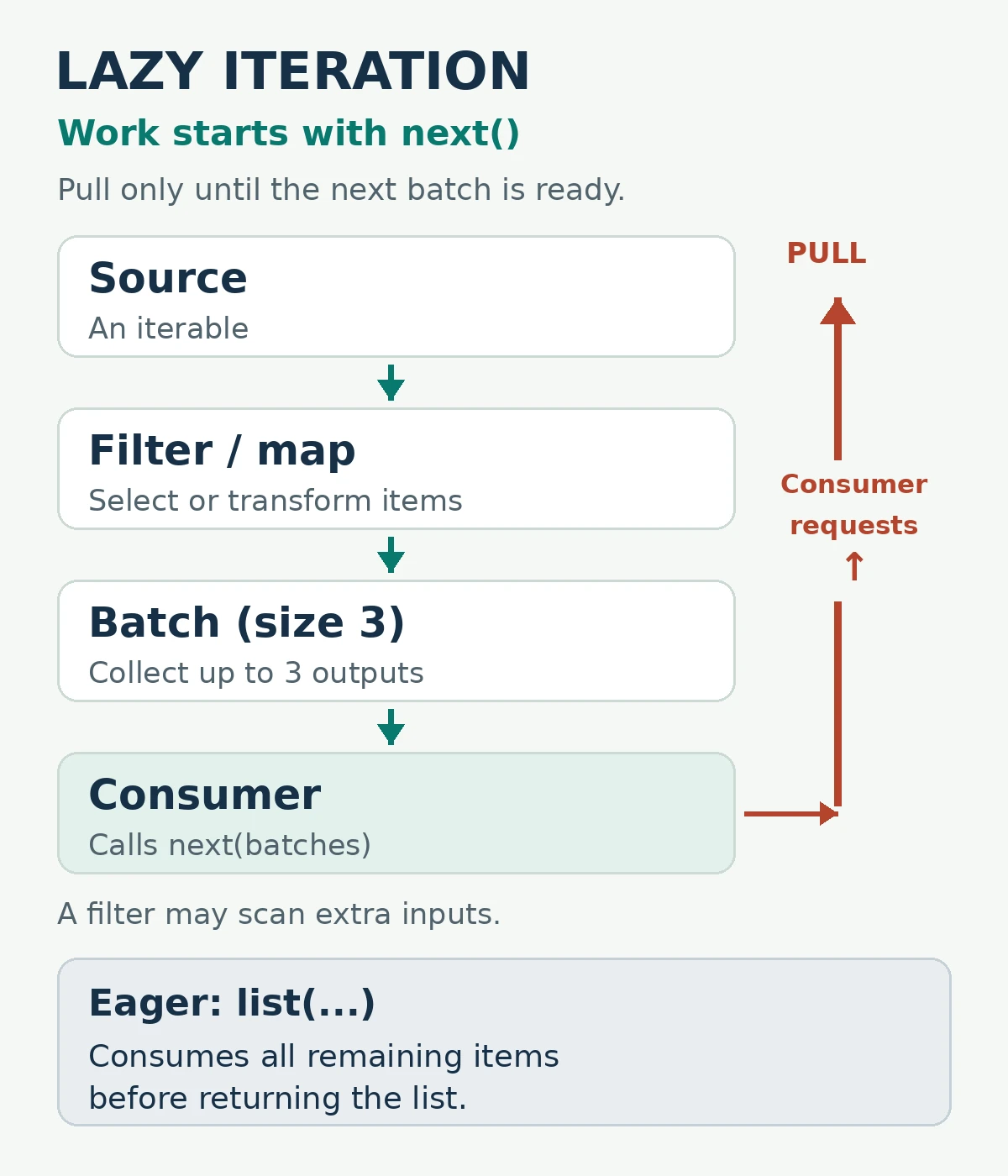
For this tutorial, configuration validation happens immediately. Source acquisition and source advancement happen only when the returned iterator is advanced. A full batch causes exactly the requested number of successful calls to the immediate source, with no speculative request for the next item. Normal exhaustion is the only event that activates the final-batch policy. Other source exceptions propagate, and the adapter stops rather than trying to repair or resume the stream.
That contract deliberately excludes asynchronous iteration, time-based flushing, padding, retries, parallel processing, and transaction management. Each feature introduces its own timing and ownership decisions. Keeping the helper small makes its behavior possible to explain completely. If a project later needs one of those features, introduce a separate contract and tests instead of quietly stretching the meaning of an existing argument.
Treat an iterator as a moving position
An iterable is something from which Python can obtain an iterator. An iterator supplies successive items and records its progress. A list can usually supply a fresh iterator for another pass; an already-created generator represents one advancing execution. Confusing these roles produces common bugs in validation code: one function loops over a source to inspect it, then another function receives the same exhausted iterator and sees no records.
Our helper returns a single-pass iterator even when its input is a reusable list. Consuming that returned object twice does not rebuild its batches. Creating a new helper around the original list can start a new pass. Creating a new helper around the already-consumed source iterator cannot rewind it. The distinction belongs in tests because both inputs often produce identical results on their first successful run.
Sharing the same source iterator also shares its position. If a batch adapter reads two items and another part of the program calls next on that source, the adapter’s next group starts after the item taken elsewhere. Nothing is copied or isolated. The test suite demonstrates this explicitly with a range iterator so that the consequence is visible without files, network access, or concurrency.
Once our adapter has finished, advancing it again remains harmlessly exhausted and does not revisit its source. Python’s iterator protocol requires exhaustion to remain exhaustion. A custom iterator that starts producing values again after announcing its end breaks that expectation; this helper is not designed to compensate for it. The practical rule is to create a new source when a genuinely new pass is needed and make that source’s creation cost and side effects explicit.
Build a deliberately narrow batching helper
Save the following implementation as bounded_batches.py. Its public arguments are the source, a batch size, and the keyword-only final policy. Size must be an exact built-in integer from one through 4,096. Boolean values, integer subclasses, floating-point values, and numeric strings are rejected. The policy must be an exact built-in string equal to keep, drop, or error. These restrictions are application choices, not requirements imposed by the iterator protocol.
Rejecting booleans is useful because a setting accidentally loaded as true should not silently become a batch size of one. Rejecting subclasses keeps the teaching contract narrow and avoids implying support for custom numeric conversion behavior. A production application may reasonably choose a broader integer-like interface, but that should be a deliberate API change with additional tests. Do not add implicit coercion merely to make a failing input appear convenient.
"""Small synchronous batch adapter; caller retains source ownership."""
from collections.abc import Iterable, Iterator
from typing import TypeVar

T = TypeVar("T")
MAX_BATCH_SIZE = 4096


def bounded_batches(
    source: Iterable[T], size: int, *, final: str = "keep"
) -> Iterator[tuple[T, ...]]:
    """Validate immediately; acquire and advance source on first next().

    size must be a built-in int in 1..4096 (bool is rejected).
    final must be a built-in str: 'keep', 'drop', or 'error'.
    No prefetch, retry, copying of elements, or source closing is performed.
    A non-StopIteration source exception ends this adapter and is propagated;
    any pending partial batch is not yielded.
    """
    if type(size) is not int:
        raise TypeError("size must be a built-in int")
    if not 1 <= size <= MAX_BATCH_SIZE:
        raise ValueError(f"size must be between 1 and {MAX_BATCH_SIZE}")
    if type(final) is not str:
        raise TypeError("final must be a built-in str")
    if final not in ("keep", "drop", "error"):
        raise ValueError("final must be 'keep', 'drop', or 'error'")

    def generate() -> Iterator[tuple[T, ...]]:
        iterator = iter(source)
        while True:
            pending: list[T] = []
            for _ in range(size):
                try:
                    item = next(iterator)
                except StopIteration:
                    if pending and final == "keep":
                        yield tuple(pending)
                    elif pending and final == "error":
                        raise ValueError(
                            f"incomplete final batch: expected {size}, got {len(pending)}"
                        ) from None
                    return
                pending.append(item)
            yield tuple(pending)

    return generate()
The outer function contains no yield statement. It performs the checks immediately and then returns a separate generator object. The inner function acquires the source iterator once, builds a pending list, and yields an immutable tuple container for each completed group. The elements themselves are not copied. If an element is a dictionary, the tuple contains the same dictionary object that the source supplied.
The only protected operation in the inner loop is the call that requests the next source item. This placement is important: the handler identifies normal iterator exhaustion rather than swallowing unrelated work. There is no broad exception catch, no fallback value, and no hidden conversion to a list of the whole source. The implementation is short enough that each promise in its docstring can be paired with a concrete test.
Validate before touching the source
A generator function does not execute its body merely because it has been called. Putting argument checks at the top of a function that later yields can therefore postpone those checks until the first request for an item. That can be surprising when an application expects configuration errors to surface during setup. This helper’s ordinary outer function avoids that ambiguity: an invalid size or policy raises at the original call site.
The tests use a source whose iteration method increments a counter. For invalid configuration, both its iteration counter and its next-item counter must remain zero. This is stronger than checking that no values were returned. It establishes that even acquiring an iterator has not occurred. That matters for custom sources whose iteration method allocates a cursor or performs another observable action before supplying any data.
For valid configuration, the source remains untouched at construction as well. Passing a non-iterable with a valid size therefore returns an adapter successfully, then raises a type error when the adapter is first advanced. Passing that same non-iterable with an invalid size raises the size error immediately. This ordering is intentional. Configuration validity is checked now; whether the source can actually be iterated is checked when use begins.
This promise starts at the helper’s boundary. Python evaluates arguments before calling a function. If the caller writes a source-producing expression that opens a file or performs work, that expression may run before our validation code gets control. Likewise, a generator expression evaluates its leftmost iterable expression when the generator expression is created. Deferring the helper’s own call to iter cannot undo work that already happened in its caller.
Choose what the final partial batch means
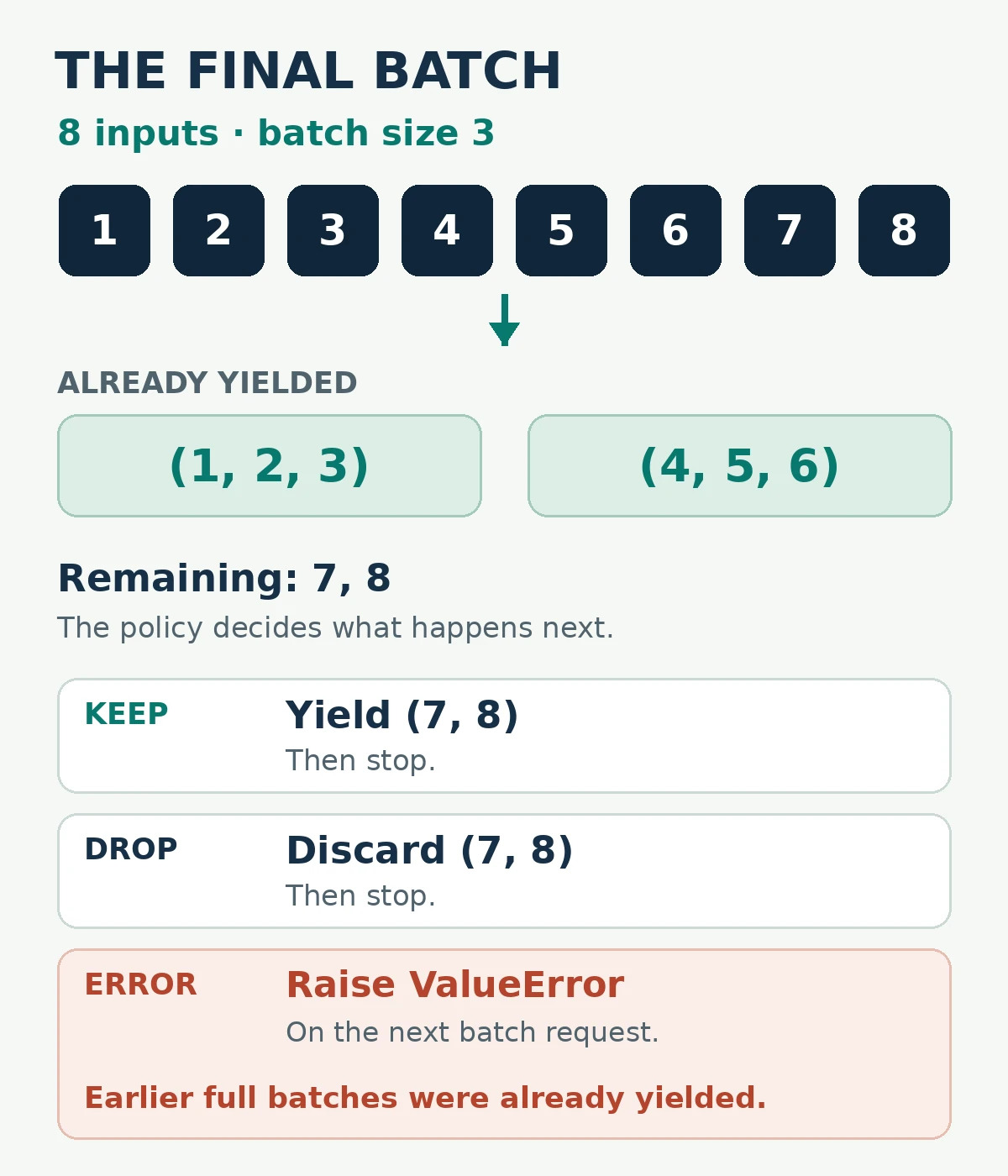
The keep policy preserves every item from a normally exhausted finite source. With seven values and a batch size of three, the result contains two groups of three and a final group of one. This is a suitable default when batching is only a transport or scheduling convenience and downstream processing accepts smaller groups. An empty source produces no groups; the helper never invents an empty final tuple.
The drop policy returns only complete groups. Its name describes what is returned, not what is read. The helper must consume the remaining values and observe exhaustion before it knows the group is incomplete. Those values have left the source even though no final tuple is delivered. A caller cannot recover them by asking the original iterator for its next item afterward. Use this policy only when discarding the tail is a deliberate part of the application.
The error policy raises a value error when normal exhaustion reveals a nonempty short group. Complete groups may already have been yielded. Therefore, an error at the tail does not imply that no work has happened. A downstream process might already have logged records, updated an in-memory accumulator, or committed earlier groups. The helper cannot reverse those effects, and the policy should never be described as making the entire operation atomic.
All three policies accept empty input and exact multiples of the size. A source with exactly six items at size three yields two complete groups under every policy. Detecting that there is no seventh item requires a later request to advance the adapter; the helper does not peek ahead while returning the second group. A consumer that stops after that second group has not asked the helper to confirm exhaustion.
The diagram below should be read as a policy decision at normal end-of-input. It does not describe what happens after an operating-system error, a parsing error, or another exceptional failure in the source. Those events follow a separate path and never become a short successful batch.
Run the demonstration and inspect exact output
Save this companion as demo.py next to the helper and run it with Python. The counted source distinguishes attempts to retrieve an item from successful deliveries. That distinction explains the final counter: seven values require eight next-item attempts when the adapter is fully exhausted, because one additional attempt receives the end-of-input signal. Counting only the delivered values would hide that final observation.
"""Deterministic local demonstration: no files, network, or model calls."""
from bounded_batches import bounded_batches


class Counted:
    def __init__(self, values):
        self.values = iter(values)
        self.iter_calls = 0
        self.next_calls = 0
        self.delivered = 0

    def __iter__(self):
        self.iter_calls += 1
        return self

    def __next__(self):
        self.next_calls += 1
        value = next(self.values)
        self.delivered += 1
        return value


def main():
    source = Counted(range(7))
    batches = bounded_batches(source, 3)
    print(f"created: iter={source.iter_calls}, next={source.next_calls}")
    print("first:", next(batches))
    print(f"after first: next={source.next_calls}, delivered={source.delivered}")
    print("rest:", list(batches))
    print(f"finished: next={source.next_calls}, delivered={source.delivered}")
    print("exhausted again:", list(batches))
    print("drop:", list(bounded_batches(range(7), 3, final="drop")))
    strict = bounded_batches(range(7), 3, final="error")
    print("error first:", next(strict))
    print("error second:", next(strict))
    try:
        next(strict)
    except ValueError as exc:
        print("error tail:", exc)
    rows = (value * value for value in range(10) if value % 2 == 0)
    print("pipeline:", list(bounded_batches(rows, 2)))
    print("pipeline reused:", list(rows))


if __name__ == "__main__":
    main()
The locally captured output was identical on the two tested Python versions:
created: iter=0, next=0
first: (0, 1, 2)
after first: next=3, delivered=3
rest: [(3, 4, 5), (6,)]
finished: next=8, delivered=7
exhausted again: []
drop: [(0, 1, 2), (3, 4, 5)]
error first: (0, 1, 2)
error second: (3, 4, 5)
error tail: incomplete final batch: expected 3, got 1
pipeline: [(0, 4), (16, 36), (64,)]
pipeline reused: []
The first line confirms that constructing the adapter did not acquire or advance the source. The first group then consumes exactly three values. Materializing the remaining batches drives the source to completion, which exposes the final short group. Reusing the same finished adapter produces an empty list. The final two lines repeat the single-pass lesson with a generator expression that filters even numbers and squares them.
The calls to list are intentional here because the examples are finite and tiny, and displaying a complete result makes the behavior easy to inspect. They are not a recommendation to materialize a large production stream. In a real consumer, process each group inside a loop and retain only the results that the application actually needs. Tests can safely use small materialized fixtures while still checking that the implementation itself stays incremental.
Test consumption rather than guessing from syntax
A comprehension, a generator, and a chain of iterator tools can all look compact while doing different amounts of work. The most direct test is an instrumented source. Our test probe records how often its iteration method is called, how many next-item attempts occur, and how many values are delivered. It can also fail at a chosen attempt and record whether anyone explicitly asks it to close.
These counters let a test state a precise boundary. Requesting one full group of three from ten available values must deliver exactly three and make exactly three next-item attempts. Requesting two groups from an infinite counter through a two-item islice must stop after six deliveries. An implementation that secretly prefetches a seventh value would return the same visible groups but fail the consumption assertion.
Boundary tests also distinguish complete groups from exhaustion checks. After yielding an exact final group, the source has not yet signaled its end. The next request for a group performs one additional attempt and then finishes. For a short final group, the unsuccessful attempt occurs before that smaller tuple can be yielded. These expectations are specific enough to catch off-by-one behavior without requiring timing measurements or implementation-dependent memory inspection.
Keep probe instrumentation focused on the property under test. Avoid giving it unnecessary behaviors such as automatic retries or hidden buffering, because those can make a helper bug look like a source feature. Separately test a source that raises during iterator acquisition. That covers an earlier stage than next-item failures and confirms that deferred acquisition is part of the contract, rather than an accidental result of one friendly input type.
Preserve source failures and discard the unfinished group
Suppose a source delivers two items and then raises an operating-system error while the requested group size is four. The helper does not have a valid short final group: the source failed instead of announcing normal exhaustion. The error propagates to the consumer, and neither of the two pending items is yielded. The adapter’s generator then terminates. A subsequent request on that same adapter is exhausted rather than a retry.
This behavior preserves a useful distinction between “there are no more records” and “we could not retrieve the next record.” Turning every source exception into a partial tuple would blur that distinction and could let corrupted or interrupted processing appear successful. Dropping all exceptions would be worse because a caller could not tell a complete stream from one that silently stopped in the middle.
The tests check the identity of a deliberately raised exception object. This verifies that the helper propagates the source failure rather than substituting a generic message. They also cover a source value error under the error tail policy. Both failures use the same exception class, but their origins differ: one comes from source execution and the other from the helper’s final-group rule. In a larger public library, distinct custom exception types may be worthwhile; this narrow example retains ordinary Python exceptions and documents the distinction.
A failed attempt may leave the source in an application-specific state. The helper makes no promise that requesting another item directly from that source is safe or meaningful. A custom iterator might recover, a generator might be closed, and an external cursor might be unusable. Any retry should be designed at a layer that understands source recreation, duplicate work, and already-delivered batches. Rewrapping the same iterator is not a general recovery strategy.
There is also no rollback for values already pulled into the discarded group. They may have triggered source-side effects even though the consumer never received them. That is why the contract describes pending data loss explicitly rather than calling failures harmless. When losing such progress is unacceptable, the application needs a replayable input or a durable acknowledgment design beyond a batching adapter.
Keep resource ownership with the caller
The helper does not open, close, enter, or exit the source. It borrows the iterable supplied by its caller. Exhausting the adapter, closing its returned generator, or encountering a source error does not cause the helper to call a close method on the source. Tests verify those explicit non-actions with a retained source object that exposes an observable close method.
This policy prevents a small adapter from taking ownership it was never given. The same source could belong to an outer file context, a larger workflow, or another component that still needs it. Automatically closing every object that happens to have a close attribute would be an unreliable substitute for an ownership agreement. A file opened by the caller should normally remain governed by the caller’s with block.
For a file-processing workflow, keep opening, iteration, and batch consumption inside one clearly bounded resource scope. If the loop breaks early, the outer context still exits and closes the file. If parsing raises, the same context handles cleanup. The batch adapter is responsible for grouping values, while the owning scope is responsible for the resource lifetime. The related Python resource cleanup guide develops that separation further.
Explicit cleanup must not be confused with every possible finalization effect. A generator source may run its own cleanup when it exhausts, fails, is explicitly closed by its owner, or is finalized. Dropping references can also affect lifetime. Our promise is that the adapter does not explicitly close the source; it is not a promise that no source cleanup can ever happen. Retain and manage the resource at the layer that actually owns it.
A stopped adapter can retain references while it remains alive. Closing the adapter can release its suspended frame, but that still does not transfer source ownership. Avoid storing abandoned adapters indefinitely, especially when their sources hold substantial state. The clean design is to make both the data-consumption lifetime and the resource lifetime apparent in the calling code.
A batch cap is only a batch cap
The maximum size of 4,096 limits the number of elements in one group constructed by this helper. It does not limit the size of any element. A single value can contain a large byte string, a nested object graph, or a reference to another large structure. Counting records is useful, but it cannot establish a byte-level memory budget without additional assumptions about the records themselves.
The implementation also uses a pending list and creates a tuple from it. During conversion and suspension, multiple references to the same elements can exist. The elements are not deep-copied, yet container overhead and reference retention remain real. This article makes no measured peak-memory claim. If precise memory behavior matters, measure the complete application under representative data and account for allocator behavior, source state, and consumers.
Upstream operations can retain far more than one group. A source may buffer input internally or have already materialized an entire dataset. Forking a stream with tee can retain values while its consumers advance at different speeds. Sorting all incoming values creates a global operation whose requirements are not reduced by adding batching afterward. Review those stages separately; the Python sorting guide is relevant when ordering is part of the pipeline.
Downstream behavior matters just as much. Converting all yielded groups into a list retains the whole result. Appending processed records to an ever-growing accumulator does the same in another form. A consumer that stores every submitted task can create an unbounded backlog even though every individual task contains only a small tuple. Batching alone provides neither a queue limit nor a concurrency limit.
Finally, this helper is not a security boundary. It does not enforce input byte limits, nesting limits, timeouts, safe parsing, or trust rules for executable objects. A malicious or simply expensive iterator can do arbitrary work during its iteration methods. The cap is a local API choice intended to prevent accidentally enormous group counts. Broader limits belong in the components that read, parse, schedule, and retain data.
Count at the correct point in a composed pipeline
Consider a pipeline that filters a stream before batching it. To collect three even values from the sequence zero through nine, the filter reads zero, one, two, three, and four. The batching helper receives three values while the original source delivers five. Both components are behaving correctly. A statement that “one batch reads at most three source records” would be false unless “source” clearly meant the immediate filtered iterator.
The test suite includes exactly this case. It checks that the first group is zero, two, and four, and that the original source has delivered five values. That test guards the explanation as well as the code: it makes the distinction between output count and upstream work concrete. A highly selective filter can read a very large prefix before returning a single value, and a filter that never matches can fail to produce a group indefinitely.
The order of operations also changes semantics. Filtering before grouping produces batches of accepted values. Grouping before filtering preserves the original chunk boundaries and can leave each processed chunk with different numbers of accepted values. Neither order is universally correct. Choose the one that matches downstream requirements, then include rejected records in a small test fixture so the difference cannot be overlooked.
Parsing raises a related question. If a parsing function fails while building a group, that failure reaches this helper as a source exception and discards the current pending group. If records should instead be collected as success-or-error results, the parser needs an explicit representation for those outcomes before batching. The JSON Lines validation guide provides related context for record-level validation choices.
Pipeline diagrams should therefore label the count being bounded. “Three accepted records per batch” is meaningful. “Three reads total” may be wrong. When asking DeepSeek to review a composition, include a source with rejected values and ask for the expected counters at each boundary. A plausible explanation becomes much more useful when it comes with an assertion that can be executed locally.
Separate bounded consumption from bounded latency
The helper can work with an infinite iterator when the consumer requests a finite prefix of batches. The infinite-counter test takes exactly two groups and verifies six deliveries at size three. It does not attempt to exhaust the counter, and it does not use a timeout to hide an unbounded operation. The consumer’s finite request is what makes this particular experiment terminate.
However, any individual next-item operation may block or take a long time. A group of three slow values can take a long time to appear even though only three values are collected. This synchronous helper has no deadline, cancellation protocol, or time-based flush. A partial group is emitted only after normal exhaustion under the keep policy, not because a period of inactivity has elapsed.
These limits matter for systems that read from sockets, event streams, or interactive input. An application that needs “up to one hundred records or two seconds, whichever comes first” needs a different design. It must decide how timing is measured, how a blocked read can be interrupted, and who owns any background work. Adding a clock check between blocking calls does not by itself make the calls interruptible.
For the same reason, do not claim that this helper supplies complete backpressure for a system. It requests data synchronously in response to consumer advancement and performs no prefetch of its own. Other components may already have queues, worker pools, or buffered reads. Those components require their own capacity limits and tests. Local pull behavior is useful evidence, but it is only one part of an end-to-end flow-control design.
Use DeepSeek to propose checks, then execute them yourself
A productive DeepSeek session starts with the contract, the implementation, and a small failing example if one exists. Ask for observable defects and candidate tests. Avoid asking whether a pipeline is simply “efficient” or “safe,” because those adjectives hide the exact boundaries that need review. A useful response should identify a concrete input, the expected behavior, and the assertion that would distinguish correct code from a plausible mistake.
All templates in this section are unexecuted. They demonstrate requests a developer could make; they are not a transcript, an evaluation of DeepSeek, or evidence that a particular model found the listed issues. The official DeepSeek documentation describes its supported interaction options, including thinking mode. No API integration is required for the local Python lab, and this article deliberately avoids depending on a particular model identifier or changing request parameter.
For the first pass, ask for a contract audit without implementation changes. This separates disagreements about intended behavior from actual defects. If a reviewer believes an integer subclass should be accepted, that is a proposed API expansion, not proof that the existing exact-type contract is implemented incorrectly. The same distinction applies to automatically closing borrowed sources or attempting to recover from failures.
Unexecuted DeepSeek prompt template: contract review
Review the supplied bounded_batches implementation against its stated contract.
Check immediate configuration validation, deferred iter(source), full-batch
lookahead, keep/drop/error tails, source exception identity, single-pass
exhaustion, and borrowed-source ownership. Give concrete counterexamples
and unittest assertions. Separate contract violations from optional API
changes. Do not claim to have executed code. Do not make whole-pipeline
memory, latency, or security claims from the batch-size cap.
For a second pass, request tests designed to fail a specific incorrect implementation. A test that only recreates the current code’s happy path is weaker than one that distinguishes it from eager materialization, speculative reads, broad exception handling, or automatic source closure. Give the reviewer the current tests so it can suggest gaps rather than repeating the same cases in different wording.
Unexecuted DeepSeek prompt template: adversarial tests
Propose additional standard-library unittest cases for this helper.
Prioritize bugs that preserve the final values but change source consumption.
Use a custom source with iter, next, delivered, and close counters.
For each test, name the incorrect implementation it rejects. Include failure
before the first value, after a complete batch, and within an incomplete
batch. Use tiny finite fixtures or a strictly bounded infinite prefix.
Finally, ask for integration review using a complete but sanitized caller. Remove credentials, private records, and unrelated production details before sharing code with any hosted service. A synthetic source that preserves the relevant behavior is often enough. Run proposed tests locally, read failures yourself, and record what was actually verified. The separate Python performance guide is useful when the next question is how to measure a complete workload.
Unexecuted DeepSeek prompt template: pipeline integration
Review this caller and the helper together. Identify who owns each resource,
which stages may consume multiple upstream records per output, where data
is retained, and whether a late error can follow earlier side effects.
Suggest small local tests. Treat all benchmark or execution claims as
unverified unless I provide actual output. Do not introduce retries,
parallelism, external dependencies, or API calls.
Run the downloadable test lab
The downloadable lab uses unittest and contains 44 authored test methods plus 34 independent test methods, with additional subtests over finite cases. Extract the archive and run python3 -m unittest discover -v inside its python_iterator_lab directory. To repeat the cross-version check, run the command with each interpreter available in your environment; executable names may differ. Run the same command with python3 -O to check optimized execution.
The author suite passed on Python 3.12.14 and Python 3.13.5. The combined 78-test suite, including the independent tests, also passed on both versions in normal and optimized execution using the -O flag. These are correctness checks, not performance benchmarks. Test method totals also differ from the number of individual cases exercised inside subtests. The useful evidence is the assertions and captured results, rather than a large-looking headline count.
Coverage includes empty inputs under every tail policy, exact multiples, short tails, size boundaries, rejected configuration types, deferred source acquisition, no speculative reads, repeated exhaustion, shared source state, finite consumption of an infinite source, propagated exception identity, and explicit source ownership. A small matrix also compares the helper’s finite results with a straightforward slicing reference over several lengths and sizes.
That reference intentionally uses a small materialized list because it is a test oracle, not the implementation under review. Its purpose is to make expected grouping easy to inspect. Separate probe tests establish incrementality. Keeping these concerns separate prevents a common testing mistake: replacing every expected result with another clever iterator expression that could repeat the same bug as the code being tested.
Download the original Python iterator lab, including the implementation, demonstration, all 78 tests and a reader README. Standard library only; tested under Python 3.12 and 3.13.
A passing suite is evidence about these cases and this contract. It is not a proof for every possible user-defined iterator, nor an assurance about file systems, remote services, or downstream side effects. When integrating the helper, add tests for the actual source and consumer behavior that matters to your application. Keep those integration claims separate from the standard-library lab results presented here.
Plan for downstream failures separately
A batch can be yielded successfully and then fail during downstream processing. At that point, the source has already advanced past every value in the group. Asking the adapter for another group moves onward; it does not repeat the failed group. Retrying work requires the consumer to retain the current tuple or recreate the relevant input through a replay mechanism that the application understands.
Even retaining the tuple does not make a retry safe. If processing changed an external system before failing, repeating the group could duplicate effects. The batching helper has no knowledge of transaction boundaries, record identifiers, or acknowledgments. Those decisions belong in the consumer. Test a failure after processing part of a group and decide what the application should do before introducing automated retries.
The final error policy introduces another late-failure scenario: earlier complete groups may have been processed before a short tail is discovered. If an application must reject the entire input before performing any effects, it needs prior validation or a staging design. Fully scanning a single-pass source to validate its length consumes it, so that design also needs replay, storage, or an independent source. There is no free rewind hidden in a strict batching option.
For diagnostic logging, record the last completed group and the failure stage without pretending to know more than the program observed. Avoid logging entire sensitive records simply because a group failed. Operational visibility should help distinguish source acquisition, source advancement, tail validation, and consumer processing. Those stages suggest different recovery actions and should not all be collapsed into a message that says only “batch failed.”
When the standard library is already enough
Python added itertools.batched in version 3.12. Python 3.13 added its strict option, which rejects an incomplete final batch. If the built-in behavior matches the application and its supported Python versions, prefer that smaller dependency on custom code. A bespoke adapter should earn its place by providing an explicit contract that the application actually needs.
This example adds a named keep/drop/error policy, a maximum accepted batch size, exact-type configuration checks, and immediate validation with deferred source acquisition. These are intentional differences. It is not presented as a faster replacement, a drop-in clone of every built-in behavior, or a broadly reusable streaming framework. Its value is that the choices are visible and tested.
When considering a refactor to the built-in, run the contract tests against the proposed wrapper and review differences rather than assuming that equivalent happy-path tuples mean equivalent behavior. Construction-time errors, accepted argument types, and ownership assumptions can matter to callers. Some differences may be worth accepting, but they should become documented changes rather than surprises discovered after deployment.
The same restraint applies to expanding this helper. Padding, byte budgets, asynchronous iteration, and timed batches are reasonable features for other designs. Adding all of them here would make the API harder to explain and the tests less focused. Keep the adapter responsible for its small synchronous task, and compose it with components whose own contracts are equally explicit.
A practical final review
Before adopting the helper, choose the tail policy deliberately and confirm that the caller accepts late failures after earlier groups have been delivered. Test at least one source that fails during acquisition and another that fails midway through a group. Verify that invalid configuration leaves the supplied iterable untouched. Keep an observable source in the suite so an eager refactor or accidental lookahead cannot pass unnoticed.
Then review the complete pipeline around it. Identify resource owners, upstream buffering, selective filters, global ordering operations, and downstream collections. Determine whether the consumer can stop early and how the owning scope cleans up in that case. If latency, bytes, concurrency, or external effects matter, write separate limits and tests for those concerns instead of assigning them to the batch size.
DeepSeek can help propose counterexamples and sharpen these questions, but executable evidence remains local. Keep the prompt templates, proposed changes, actual test output, and any performance measurements conceptually separate. The goal is a pipeline whose behavior can be explained at every boundary: when work starts, how much immediate input a request consumes, what happens to the tail, and who remains responsible when processing stops.
Sources and References
Primary documentation consulted on October 6, 2026. The local helper, examples, tests, and analysis of their behavior are original to this guide. Documentation describes language and library contracts; the test logs establish only the local executions reported above.
- Python 3.12 documentation: itertools.batched — the built-in batching facility introduced in Python 3.12
- Python 3.13 documentation: itertools — strict batching, iterator composition, and tee storage considerations
- Python documentation: iterator types — iteration methods and persistent exhaustion
- Python language reference: generator expressions and generator methods — evaluation timing and generator execution
- Python documentation: contextlib — explicit resource-cleanup scopes
- Python documentation: unittest — assertions, exception checks, and subtests
- Official DeepSeek documentation: thinking mode — current interaction documentation; no model or API execution was performed for this guide
