


A priority queue looks simple until two tasks have the same priority, a task changes its position, or a cancellation leaves an old heap entry behind. A short implementation may appear to work while returning a replaced task, comparing payload objects that cannot be ordered, or accumulating obsolete records after repeated updates. These are contract questions as much as algorithm questions.
This guide builds an original Python priority queue with explicit rules for stable ties, replacement, cancellation and storage cleanup. It uses a heap for physical ordering and a separate map for the currently pending submissions. We will trace concrete examples, test operation sequences against an independent reference model and use DeepSeek prompts to ask for reproducible counterexamples. The queue is a single-owner, non-reentrant, in-memory teaching component. It does not run jobs, schedule wall-clock deadlines or coordinate concurrent workers.
The central recommendation is to test the history of operations, not only the final sorted output. A queue can return the right order after one batch of inserts and still mishandle a key that is canceled and reused. Write the replacement and cancellation rules first, then exercise the transitions that can leave obsolete entries in storage. The DeepSeek prompts below are unexecuted templates; all reported code checks concern the local Python lab, not measured model performance.
Define what one pending task means
Every task has a key, an integer priority and an optional payload. A key identifies one currently pending submission. Submitting the same key again replaces that submission; it does not add a second live task. Lower priority numbers are returned first. When priorities match, the queue returns tasks in the order of their current submissions. A replacement counts as a new submission and joins the back of its new priority tie.
That last rule is a policy choice worth stating prominently. Suppose A and B both have priority one, with A submitted first. Replacing A with another priority-one task makes the order B, then A. A system that preserves A’s original waiting position would need a different update operation and different tests. Neither interpretation should be left to a model, a variable name or an accidental implementation detail.
The key must be a nonempty exact Python string. The priority must be an exact Python integer, so booleans and integer subclasses are rejected. Negative priorities are valid. The queue does not strip whitespace, change case or normalize Unicode in keys. Those transformations can collapse distinct application identifiers; perform them at a separately specified boundary if your domain requires them.
The public methods are deliberately small. put inserts or replaces a task. cancel returns whether a live submission was removed. peek returns the next task without removing its live entry. pop removes and returns that task. Both lookup methods raise IndexError when the queue is empty. compact removes obsolete physical records and reports how many it discarded. The queue’s length always means the number of live submissions.
These rules separate the application answer from its storage representation. A canceled task must stop appearing in results immediately, even if a small obsolete record remains inside the heap. Conversely, counting physical records would overstate pending work. Naming both quantities makes that distinction visible during testing and prevents an internal cleanup detail from becoming a misleading dashboard number.
Make equal priorities predictable
The first example submits A with priority two, then B and C with priority one. The expected removal order is B, C, A. B and C share a priority, so their submission order breaks the tie. Their keys do not decide the order. If the keys had been Z and A instead, the first submitted task would still come first under this contract.
The heap record contains three fields: priority, a unique submission sequence and the key. The sequence establishes a total order between successful submissions at the same priority. Because each sequence value is unique within this queue, a comparison between distinct records is settled before reaching the key. Payloads are not stored in these heap records and never participate in ordering.
This matters when payloads are dictionaries, application objects or values whose comparison has side effects. Adding an arbitrary payload to an ordering tuple can appear harmless until a tie reaches that field. The lab includes payload objects that raise if their comparison methods are called. Successful removal of tied tasks then checks a concrete behavioral promise rather than merely assuming that payloads are “probably comparable.”
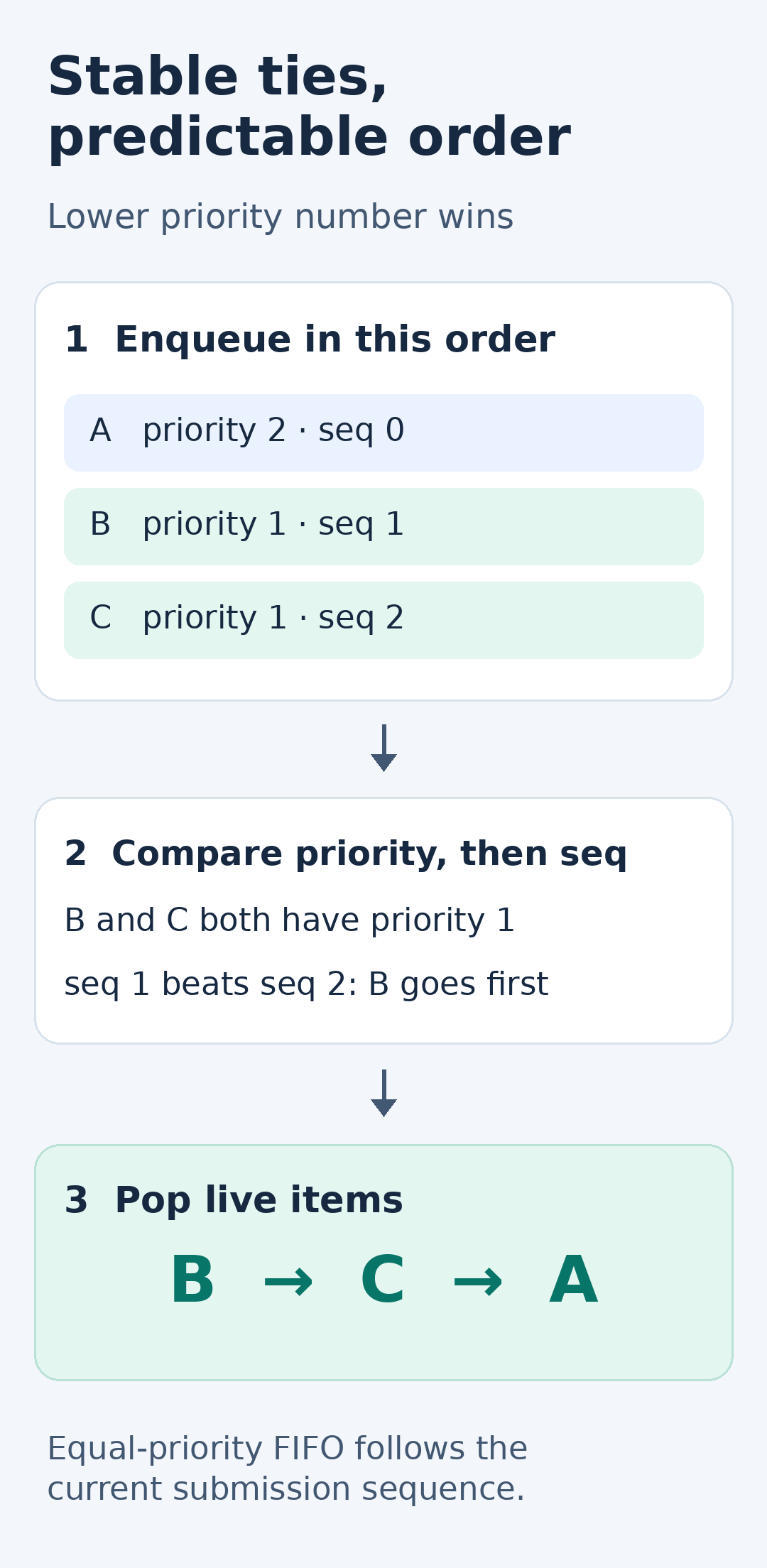
Stable ordering here is defined by the wrapper’s submission sequence. It is not a promise that a raw heap preserves insertion order on its own. Python’s heap documentation describes a smallest-first heap and discusses tie-breaking records. Our additional contract determines which events receive a new sequence and how obsolete versions are ignored. The guide to stable sorting and deterministic keys provides useful background for specifying tie policies clearly.
Separate current submissions from heap records
The live map associates each key with its current sequence and task object. The heap contains ordering records from current and possibly older submissions. An entry is current only when the map still contains its key and the recorded sequence matches the map’s sequence. Testing key existence alone is insufficient because a key may have been replaced or canceled and submitted again.
Consider A submitted at priority four with sequence zero, followed by B at priority two with sequence one. Replacing A at priority one receives sequence two. The live map now points A to sequence two and B to sequence one. The old A record remains physically present for the moment, but it no longer represents pending work. The queue must return the new A, then B, and never return the obsolete A.
A reused key makes the need for version checking even clearer. Cancel A while another task remains, then submit a new A. The old record’s key exists again, but its sequence still differs from the current submission. If a stale-entry check accepts any matching key, an old priority can incorrectly control when the new payload is returned. This is a small operation history with a large effect on correctness.
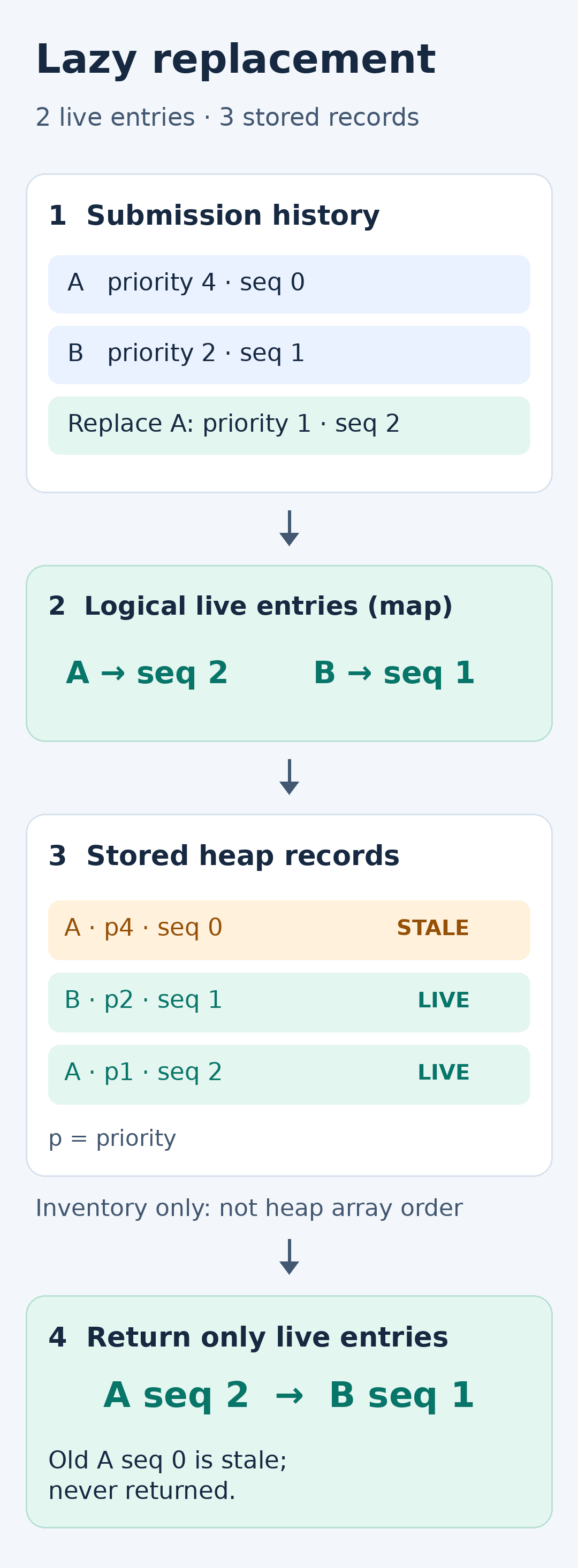
The diagram shows logical records and ordering relationships, rather than claiming that a heap’s entire backing array is globally sorted. Only the heap invariant and its root-selection behavior are relevant to this wrapper. Tests should avoid depending on one incidental arrangement of internal records, since multiple valid heaps can represent the same priority order.
Keeping payloads solely in the live map also limits what obsolete records retain. After replacement or cancellation, an obsolete heap record still contains its key and numbers, but no payload reference. Other callers may still hold the old task or payload, of course. This queue’s reference policy cannot force those external owners to release memory.
Read the complete implementation
The implementation uses ordinary standard-library building blocks. A frozen dataclass holds each task, a counter supplies submission sequences, a dictionary identifies current entries and heapq maintains the ordering records. Validation happens before a submission consumes a sequence. Invalid task types therefore fail without changing the queue’s logical contents or tie order.
Task construction rejects invalid scheduling fields explicitly instead of relying on assertions. The frozen setting prevents ordinary reassignment of the key and priority after insertion. It does not make an arbitrary payload deeply immutable, and it is not a security boundary against code deliberately bypassing normal field access. The lab assumes ordinary valid task objects and excludes such hostile object manipulation.
"""Single-owner, non-reentrant, in-memory min-priority queue with stable current submissions.

Heap records contain priority, submission sequence and key, never payloads.
Replacing a key is a new submission and takes a new tie position.
"""
from dataclasses import dataclass
import heapq
from itertools import count


def _require_key(key: object) -> None:
    if type(key) is not str:
        raise TypeError("key must be an exact str")
    if not key:
        raise ValueError("key must not be empty")


@dataclass(frozen=True)
class Task:
    key: str
    priority: int
    payload: object = None

    def __post_init__(self) -> None:
        _require_key(self.key)
        if type(self.priority) is not int:
            raise TypeError("priority must be an exact int")


class PriorityQueue:
    def __init__(self) -> None:
        self._heap: list[tuple[int, int, str]] = []
        self._live: dict[str, tuple[int, Task]] = {}
        self._sequence = count()

    def __len__(self) -> int:
        return len(self._live)

    @property
    def stored_count(self) -> int:
        """Physical heap records, including obsolete submissions."""
        return len(self._heap)

    def put(self, task: Task) -> None:
        """Insert or replace one key; replacement joins the back of its tie."""
        if type(task) is not Task:
            raise TypeError("expected an exact Task")
        sequence = next(self._sequence)
        heapq.heappush(self._heap, (task.priority, sequence, task.key))
        self._live[task.key] = (sequence, task)
        self._maybe_compact()

    def cancel(self, key: str) -> bool:
        """Remove the current submission if present; absence returns False."""
        _require_key(key)
        removed = self._live.pop(key, None) is not None
        self._maybe_compact()
        return removed

    def peek(self) -> Task:
        """Return the next current task without removing its live entry."""
        self._discard_stale_roots()
        if not self._heap:
            raise IndexError("peek from an empty queue")
        return self._live[self._heap[0][2]][1]

    def pop(self) -> Task:
        """Remove and return the next current task, or raise IndexError."""
        self._discard_stale_roots()
        if not self._heap:
            raise IndexError("pop from an empty queue")
        _, _, key = heapq.heappop(self._heap)
        task = self._live.pop(key)[1]
        self._maybe_compact()
        return task

    def compact(self) -> int:
        """Rebuild from live submissions; return discarded record count."""
        before = len(self._heap)
        self._heap = [
            (task.priority, sequence, key)
            for key, (sequence, task) in self._live.items()
        ]
        heapq.heapify(self._heap)
        return before - len(self._heap)

    def _discard_stale_roots(self) -> None:
        while self._heap:
            _, sequence, key = self._heap[0]
            current = self._live.get(key)
            if current is not None and current[0] == sequence:
                break
            heapq.heappop(self._heap)

    def _maybe_compact(self) -> None:
        live = len(self._live)
        if not live:
            self._heap.clear()
        elif len(self._heap) > 2 * live + 32:
            self.compact()
The code accepts an exact Task rather than subclasses or objects that happen to expose similarly named attributes. That policy keeps the comparison fields predictable for this example. A production interface may need a more flexible data model, but expanding accepted types creates new questions about validation, ownership and user-defined behavior. The dataclass ownership guide is a useful companion when making that decision.
The implementation intentionally does not catch every possible exception and pretend the operation was transactional. Ordinary validation errors have a defined behavior. Process termination, asynchronous interruption, allocation failure and deliberate mutation of private state are outside the guarantee. Making those limits explicit is preferable to claiming that a few lines of dictionary and heap manipulation are an all-or-nothing storage system.
Trace peek and pop through stale roots
Both peek and pop first discard obsolete records from the heap root. A stale record cannot be returned simply because it currently has the smallest numeric priority. The queue keeps removing such roots until it finds a record whose key and sequence match the live map, or until the heap is empty.
For example, submit A at priority zero, replace it at priority five, and submit B at priority two. The physical heap may still place the old priority-zero A at its root. Peeking removes that obsolete record and returns B. The logical queue still contains two tasks. A useful test checks both facts: the returned object is B, and the live length is unchanged, even though physical storage may shrink.
This means that “peek does not modify the queue” needs precise wording. It preserves logical pending work, but it can perform storage cleanup. Code observing stored_count may see that number decrease after a peek. That is allowed and documented here. If you expose diagnostic properties, account for this distinction instead of assuming that every read-shaped method is physically mutation-free.
After finding a current root, pop removes its ordering record and corresponding live-map entry, then applies the cleanup policy. The returned object is the exact task object associated with that submission. The queue does not create a fresh payload, call a task callback or acknowledge successful execution. Removal establishes that the item left this in-memory pending set, and nothing more.
When the last live task leaves, the queue clears remaining obsolete records. Otherwise, an empty logical queue could retain a long history of canceled or replaced keys. The empty case is particularly easy to test and is worth keeping as an explicit invariant rather than waiting for a later insertion to trigger cleanup.
Cancellation applies to pending work only
Canceling an existing key removes its current live entry and returns true. Canceling an absent key returns false. Repeating the same cancellation therefore has an observable, predictable result. This can simplify callers that receive duplicate cancellation requests, although it does not by itself make an entire external cancellation workflow idempotent.
A task that has already been popped is no longer in this queue. Calling cancel on its key returns false unless that key was submitted again. The queue cannot stop a worker that already holds the task, undo an external request or revoke a completed result. Applications needing those behaviors require an explicit execution state and a cancellation protocol outside this component.
Likewise, a replacement affects the currently pending submission. If an older task with that key has already been popped, inserting a new task creates a new pending item without changing the older object. This distinction is important when keys are reused for retries. A key can identify current queue membership, while an application-level attempt identifier tracks work that may already be running.
The state-machine guide helps specify transitions such as pending, running, succeeded and canceled. This queue implements ordering and pending membership only. Keeping those responsibilities explicit prevents a queue method name from being mistaken for a complete job-management guarantee.
Bound obsolete records with a visible cleanup policy
Lazy replacement avoids searching through the heap to remove an arbitrary older record immediately. The tradeoff is that obsolete records can accumulate. Repeatedly replacing one key illustrates the issue: the live length stays one, but the stored count rises unless cleanup intervenes. Watching only len(queue) would hide that growth.
This lab rebuilds the heap when its physical record count exceeds twice the live count plus thirty-two. When no live entries remain, it clears storage immediately. The constant is an educational policy parameter chosen for observable tests, not a claim that thirty-two is optimal for real workloads. After successful public operations, a nonempty queue therefore has at most 2 * live + 32 physical heap records.
The comparison is strictly greater than the threshold. With one live task, thirty-four stored records are allowed. A thirty-fifth stored record triggers rebuilding and leaves one current record. The exact-boundary test makes the chosen policy reviewable and protects against an accidental change from “exceeds” to “reaches.” Either policy could be valid, but documentation and tests should describe the same one.
Canceling or popping tasks can also make the threshold tighter by reducing the live count. Cleanup therefore runs after those operations as well as after insertion. Checking the bound only on new submissions would allow a once-large queue to retain disproportionate obsolete storage after most of its live tasks disappear.
Manual compaction rebuilds directly from the live map while preserving each current sequence. Reassigning new sequences during rebuilding could change equal-priority order, depending on how entries are traversed. Physical maintenance should preserve the logical result. The lab verifies that compaction can be inserted into an operation history without changing which task should come next.
The record-count bound is not a byte-level memory limit. Keys and payloads can be large, current tasks still retain their payloads, and temporary allocation during rebuilding needs additional space. Nor is this an admission limit: callers can submit arbitrarily many distinct live keys until the process runs out of resources. A real application needs a separate capacity and backpressure policy.
Choose who owns the payload
The payload is stored and returned by reference. If a caller inserts a dictionary and later changes it, the task’s payload reflects that change. This can be useful when reference identity is intentional, but it is a poor choice for an audit record that must preserve the exact submission contents. The queue makes no silent copy and does not serialize the payload.
One way to obtain snapshot semantics is to construct an immutable application value before submission. Another is to make a deliberate copy with a defined policy for nested objects. Copying arbitrary object graphs can be expensive or have surprising behavior, so it should not be hidden inside a priority-queue wrapper without discussion. Test the chosen boundary with a mutable nested example.
The lab’s payload-retention tests use weak references to check the queue’s own ownership after cancellation and replacement. They deliberately remove other local references first. An old payload that remains reachable through a caller variable should not be reported as a queue leak. A useful memory test identifies which object is expected to release which reference.
Scheduling fields have different ownership needs from payload contents. Changing a priority in place would leave the old ordering record in the heap. This interface instead requires a fresh task submission, which gets a new sequence and makes the prior record obsolete. That single update path keeps the live map and heap interpretation aligned.
Use a reference model with a different representation
A good oracle for this queue does not need a heap. For a small test corpus, maintain a simple ordered list of current tasks. On replacement, remove any task with the same key and append the new submission. To determine the next task, use stable sorting by priority. Equal-priority tasks then retain their current submission order in the list.
This reference is deliberately slower and structurally simpler than the implementation. It has no obsolete records, no root-pruning loop and no compaction threshold. Comparing its public results with the heap wrapper is more valuable than writing a second heap wrapper in the test. Independent representations make it less likely that the same stale-entry mistake appears on both sides of an assertion.
Check results after every operation rather than draining the queue only once at the end. Compare cancellation booleans, expected empty-operation exceptions, peeked and popped object identity, live length and storage bounds. A mistake can be temporarily hidden by a later replacement or cancellation; checking each step preserves the first point where behavior diverged.
The author suite includes 200 seeded traces of 200 operations each, for 40,000 operation steps. Operations include insertion, cancellation, peek, pop and explicit compaction. Small key and priority domains make replacements and ties frequent. The seed is fixed for reproducibility, but it is not evidence that every possible operation history was explored.
The downloadable package also includes an independent review suite with its own bounded histories and adversarial examples. Its exact corpus and executed results are recorded alongside the lab. Distinguish operation counts from test-method counts: one unittest method may run thousands of generated steps. Neither count proves correctness for all possible programs or failure conditions.
Executed result: all 48 unittest methods passed under CPython 3.12.14 and 3.13.5, normally and with -O. Independent tests include all 66,430 histories of length zero through five over a nine-operation alphabet, plus 30,000 seeded operation steps. Fifteen deliberately faulty variants were detected in every configuration. These are bounded test results, not a universal correctness proof or benchmark.
Keep small histories for the important failures
A named regression test should tell a story short enough to inspect manually. For stable ties, submit two keys in an order that differs from alphabetical order. For replacement, submit A and B at the same priority, then replace A without changing its priority. If the expected order is B then A, the test directly encodes the new-submission policy.
For key reuse, leave another task live, submit A with a very good priority, cancel A and submit a new A with a worse priority. The surviving old record must not bring the new task forward. Leaving another task in the queue matters because the empty-queue cleanup would otherwise remove the stale record and make the test less discriminating.
For compaction, build a mix of live and obsolete records, record the expected drain order, compact and compare again. Also test the exact threshold, a shrinking live set and the last-task removal. These cases check why cleanup runs when it does, rather than merely showing that a method named compact can be called without raising.
For validation, try booleans, floats, empty keys and subclasses, then verify that an existing next task remains unchanged. For ownership, use distinct objects and identity assertions. A test using only strings and integer payloads may pass even when the implementation accidentally begins comparing or copying payloads.
Deliberate faulty variants can expose weak tests. Examples include accepting stale entries whenever a key exists, reusing an old sequence on replacement, omitting cleanup after cancellation or retaining the old payload in each heap record. Only report a mutant as detected after running the changed implementation against the suite. A plausible description of a test failure is not an executed result.
Give DeepSeek the policy before the code
When requesting a review, include the replacement semantics and the logical-versus-physical distinction. Without those rules, a reviewer might suggest preserving the first submission’s tie position, treating repeated cancellation as an error or demanding that peek never remove obsolete storage. Those are possible alternative designs, but they are not automatically defects under this contract.
The prompt below asks for evidence that can be verified locally. Paste only code and synthetic task data that you are allowed to share. You do not need real customer names, confidential job contents or production payloads to reproduce a tie or stale-version problem. Keep the review focused on the smallest history that separates the intended result from the implementation.
Review this Python priority queue against the stated contract.
Lower integer priorities win. Exact Task objects contain a nonempty
exact str key, an exact int priority, and a referenced payload.
Only one current submission exists per key.
Replacing a key is a new submission, including for equal priorities.
Equal priorities use FIFO order of current submissions.
Cancel returns False for absent keys; pop and peek raise IndexError
when empty. Peek preserves live membership but may prune stale records.
Heap records must not retain payloads.
After each successful operation: stored <= 2 * live + 32 if live > 0;
stored == 0 if live == 0. Compaction preserves current sequences.
This is single-owner, non-reentrant and in-memory; it does not execute jobs.

For each suspected defect, give the shortest operation history,
expected results, actual results derived from code, and a unittest.
Separate contract violations from proposed policy changes.
Check replaced priorities, reused canceled keys, ties, payload identity,
empty state, exact storage thresholds and compaction after removals.
Do not claim execution unless the tests were actually run.

Implementation:
[paste priority_queue.py here]
Ask a separate question about the tests: which faulty implementations could still pass, and what minimal history would distinguish them? That encourages the reviewer to investigate the evidence rather than only restating the code. The evidence-based code review guide describes how to turn a finding into a reproducible check.
If a finding is unclear, ask for a table or plain-text trace containing the operation, current live keys, current sequences and expected next task. Keep the physical heap representation separate. A reviewer who sorts the entire internal heap and calls that the maintained structure may be reasoning about a different invariant from the one the code actually needs.
Finally, run accepted regression tests yourself and preserve their results. The model can help propose a counterexample, but a confident explanation should not replace executable evidence. The linked primary DeepSeek documentation is a reference for an optional chat-completion integration; no special queue-review endpoint or measured success rate is implied.
Explain latency and concurrency honestly
The underlying heap operations make dynamic smallest-first selection practical, but this wrapper does more than one heap operation per public call. A pop may discard several obsolete roots. A cancellation may trigger a rebuild. It would therefore be misleading to describe every public operation as having the same simple worst-case logarithmic cost.
The relevant sizes are live tasks and stored records. Heap maintenance depends on the physical heap size, while rebuilding uses the current live map. The cleanup policy controls obsolete-record growth relative to live entries but does not remove occasional cleanup work. Measure the distribution of operation latency under realistic replacement and cancellation patterns before choosing a production threshold.
Arbitrary-precision integer priorities introduce another qualification: comparing huge integers has a cost related to their representation. Payload size and key size affect memory even though payloads never enter the ordering comparison. The lab includes very large priorities as correctness cases; it does not present those tests as a throughput benchmark or a resource ceiling.
Payload destruction or weak-reference callbacks must not call back into this queue while an operation is in progress. Releasing an old payload can invoke such a callback synchronously, so single-owner access alone does not prevent reentrancy. The wrapper is not designed to preserve an outer operation’s intended result if callback code changes the queue partway through it.
This class is not thread-safe and does not provide an asynchronous waiting interface. Wrapping only one of its internal structures in a lock would not protect the relationship between the map and heap. If several producers and consumers need coordination, choose an interface and synchronization design for that setting, then preserve its documented behavior. The asyncio guide covers a different layer of concurrency and cancellation responsibilities.
Priority order also does not guarantee fairness. A continuing stream of better-priority tasks can delay worse-priority work indefinitely. Aging, per-resource limits, deadlines and weighted scheduling require additional policy. Before adding them, define how they interact with replacement and ties; otherwise a well-tested basic queue can become an ambiguous scheduler.
Run the example and preserve the tested version
Download the lab and open a terminal in its extracted lab directory, alongside priority_queue.py. The package uses only Python’s standard library and makes no network calls. Run the demonstration to inspect the worked ordering examples, then run the complete suite both normally and with optimization enabled.
from priority_queue import PriorityQueue, Task

queue = PriorityQueue()
for task in (Task("A", 2), Task("B", 1), Task("C", 1)):
    queue.put(task)
print("stable order:", [queue.pop().key for _ in range(len(queue))])
queue = PriorityQueue()
queue.put(Task("A", 4, {"attempt": "old"}))
queue.put(Task("B", 2))
queue.put(Task("A", 1, {"attempt": "new"}))
print("live and stored:", len(queue), queue.stored_count)
print("replacement order:", [queue.pop().key for _ in range(len(queue))])
queue.put(Task("D", 3))
print("cancel existing:", queue.cancel("D"))
print("cancel absent:", queue.cancel("D"))
print("empty storage:", queue.stored_count)
python3 demo.py
python3 -m unittest discover -v
python3 -O -m unittest discover -v
Download the original Python priority queue lab, including the implementation, demonstration, authored and independent tests, and full reader instructions.
The optimized run helps detect accidental reliance on ordinary assert statements for required validation. The implementation uses explicit exceptions, while unittest checks remain method calls. Passing both modes is useful evidence about the delivered code, but it cannot compensate for a missing scenario or an oracle that encodes the wrong replacement policy.
If you copy the implementation into a document or application, test the copied file rather than assuming it stayed identical. Preserve the source, tests, interpreter versions and demonstration output together. A later refactor that changes cleanup timing may still preserve public results, while a seemingly smaller change to sequence handling can alter fairness within a tie.
The property-based testing guide explains how to broaden generated inputs and reduce failures. For this queue, the important extension is a generator of operation histories, not just a generator of individual task values. Keep short named histories after a generated failure so the discovered rule remains understandable.
Practical questions about queue policy
Why does replacement move a task behind equal-priority peers?
Because this interface treats replacement as a new submission. That policy is simple to explain and makes the current submission time the tie-breaker. If a task should keep its original waiting age, define a separate update policy and test it explicitly. Preserving age while replacing payloads is a different decision from preserving an obsolete heap record.
Why not remove every canceled record immediately?
Immediate arbitrary removal needs a way to locate and repair the affected heap position. This lab instead removes logical membership immediately and lets stale records be pruned or compacted later. The choice reduces bookkeeping but creates cleanup costs that must be documented. A workload with strict latency requirements may justify a different data structure.
Does the storage bound protect the process from running out of memory?
No. It bounds physical record count relative to current live count under the stated ordinary-operation assumptions. It does not cap live tasks, payload bytes, key lengths, temporary rebuild space or interpreter overhead. Admission control and resource budgeting remain application responsibilities.
What should an AI-assisted review produce?
It should produce an explicit rule, a minimal sequence of operations, expected outputs and a runnable regression test. It should also say which evidence was executed and which remains a suggestion. Those artifacts make the review useful even when the reviewer’s first proposed explanation turns out to be wrong.
Sources & References
Primary documentation checked October 7, 2026. The sources support standard-library behavior and the optional DeepSeek request interface. The wrapper’s policy, examples, diagrams, tests and verification results are specific to this original lab. Versioned Python documentation may show a newer patch release than the exact interpreters used for testing.
- Python heapq documentation: heap operations and priority-queue implementation considerations
- Python itertools count documentation: sequential counter values
- Python dataclasses documentation: generated methods, validation hooks and frozen fields
- Python synchronized queue documentation: a separate standard-library interface for coordinated queue access
- Python unittest documentation: discovery and assertions
- Python optimization options: optimized execution and ordinary assert statements
- DeepSeek chat completion API reference: optional messages-based review integration
