


A background job can have only a handful of status labels and still behave unpredictably. A second start arrives while the first worker is running. A retry resets the counter by accident. A cancellation request is treated as proof that external work stopped. These problems become easier to reason about when the application describes allowed transitions explicitly instead of scattering status assignments across callbacks.
This guide shows how to use DeepSeek to review a small Python state machine with a precise contract. We will build an in-memory job lifecycle, separate event parsing from transition policy, make retry limits visible, and test both permitted and rejected paths. The implementation is original teaching code. It uses only the Python standard library and does not start workers, contact a model, or send network requests.
The accompanying code was executed locally on CPython 3.12.14 and 3.13.5, in normal and optimized modes. DeepSeek prompts in this article are unexecuted templates, not transcripts of successful model runs. Their purpose is to help you ask better questions and evaluate proposed changes against evidence. A passing local lab establishes the behavior of this example; it does not establish the reliability of a deployed queue or distributed system.
Define the job workflow before choosing a Python pattern
Our fictional application prepares a report. A newly accepted job waits in a queue, a worker may begin an attempt, and that attempt either succeeds or fails. A failed job can return to the queue if its attempt budget has room. Cancellation is allowed while a job is queued, running, or failed. Success and cancellation end this particular lifecycle. Those decisions are the application contract, not rules that Python or DeepSeek can infer for every product.
The state names are queued, running, succeeded, failed, and cancelled. The event names are start, succeed, fail, retry, and cancel. A state answers what the application currently records. An event asks the policy to consider a change. Keeping those vocabularies separate prevents a caller from treating any desired status as an acceptable update. A worker should submit a completion event to the policy, rather than assigning a status field wherever convenient.
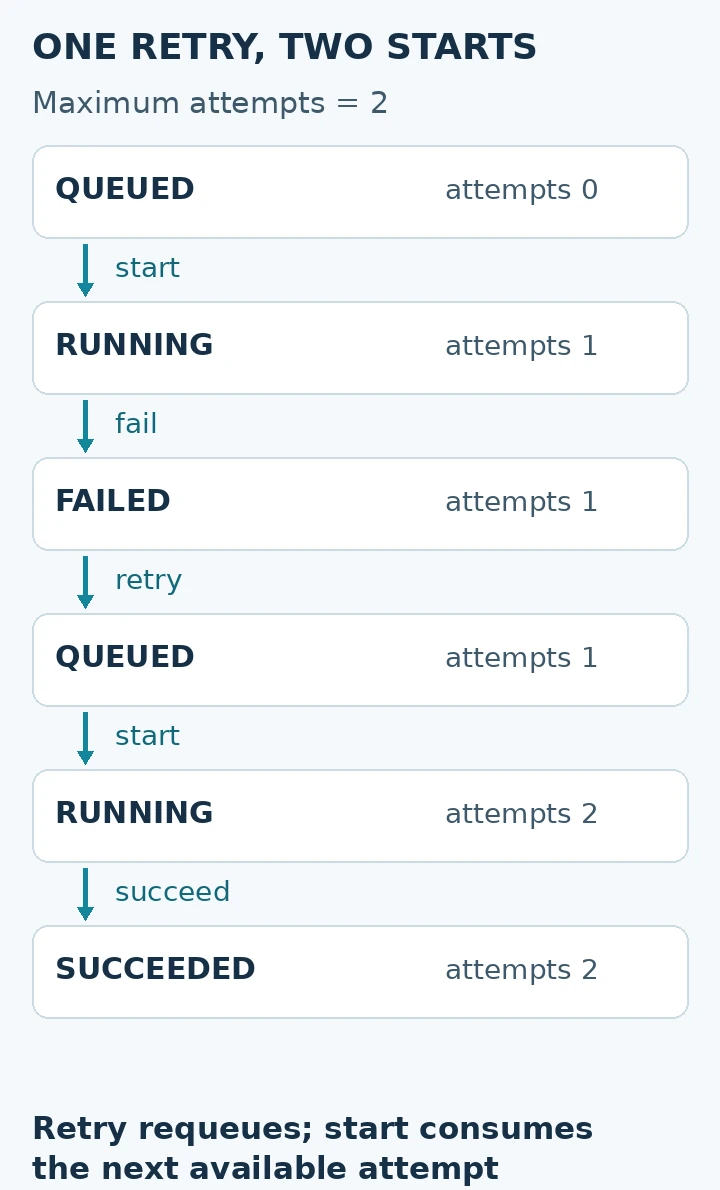
We also record the number of attempts already started and the maximum permitted attempts. Starting consumes one attempt. Failure does not consume another one, and retry merely returns the job to the queue. This convention removes an ambiguity that often hides inside a variable named retries. A maximum of two means at most two starts in total, including the first attempt. It does not mean one initial attempt plus two additional retries.
The example accepts maximum budgets from one through ten. That small upper bound makes complete snapshot enumeration inexpensive and keeps the teaching contract easy to inspect. It is a deliberate product policy for this lab, not a recommended universal queue limit. If your application needs a different range, change the constructor contract and its boundary tests together rather than quietly accepting whatever an incoming payload contains.
Start with a written list of accepted events for each state, then write examples that would falsify that list. For instance, success before the first start must fail; retry after success must fail; cancelling a never-started job must succeed without increasing its counter. If those outcomes are still disputed, ask the product owner or operator first. The requirements-analysis workflow can help turn ambiguous statements into reviewable acceptance criteria.
Use enums to make vocabulary explicit, not to invent policy
Python enums give the states and events distinct, named members. In this implementation, each member has an explicit lowercase string value that can appear in a payload. The Python enum documentation distinguishes lookup by value from lookup by member name. Our parser uses the former: the lowercase external value identifies an event. An uppercase Python constant name belongs to the implementation and is not automatically accepted as the wire format.
We use plain enums instead of string-derived enums because the internal policy should receive an event object, not an arbitrary string that happens to compare conveniently. Conversion happens at one named boundary. This choice is not a criticism of string enums; they can suit interfaces that intentionally interoperate with strings. Here, rejecting accidental mixing makes a useful teaching property visible and gives the tests a clear failure to detect.
The uniqueness decorator rejects accidental aliases in these definitions. If two event names were assigned the same value, a reviewer could mistakenly read them as separate operations while the enum treated them as aliases. Preventing that is helpful for this vocabulary. It still says nothing about whether a start from a failed job is legal. Vocabulary validation and transition validation are different jobs, and both need to be present.
Do not model mutually exclusive lifecycle states as independent booleans unless combinations really have domain meaning. Three flags for running, failed, and cancelled permit contradictory combinations unless additional rules prevent them. A single state field makes exclusivity straightforward. Conversely, do not force unrelated dimensions into one enormous enum. An independently tracked delivery status and review status may deserve separate models with explicitly stated coordination rules.
Make the allowed transitions easy to inspect
The transition map has seven accepted state-event combinations before applying the retry guard. A queued job accepts start or cancel. A running job accepts succeed, fail, or cancel. A failed job accepts retry or cancel. A succeeded or cancelled job accepts none of these events. Every omitted pair is rejected. The omission policy matters: a missing branch does not silently preserve the current state and pretend that the request worked.
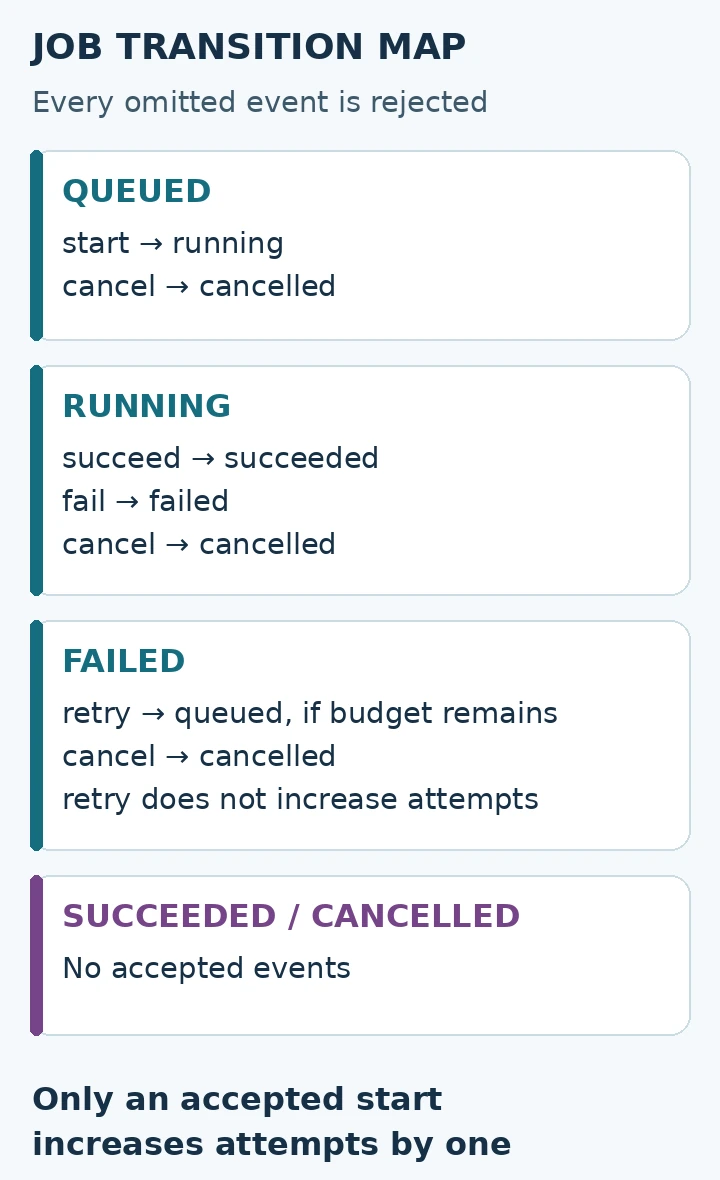
A transition also defines what happens to associated data. Most accepted events preserve the attempt count. Start increments it by exactly one, and every event preserves the maximum budget. This is why testing only the target state is insufficient. A function can return the right label while losing the counter, replacing the budget, or mutating the caller’s original snapshot. The state and data changes form one result.
The W3C statechart specification describes transitions triggered by events and conditioned by guards. Our example uses that vocabulary, but it is not an SCXML implementation and does not claim conformance. It has no hierarchical states, parallel regions, automatic entry actions, or internal event queue. A short collection of branches is appropriate because the policy is small enough to understand without building a framework around it.
For larger policies, a transition table can separate data from execution, but tables do not remove the need to define conditions and effects. A table entry that points to an arbitrary callback can hide more behavior than a direct branch. Choose the representation your reviewers can audit accurately. Ask DeepSeek to explain the transition matrix before requesting a pattern such as the State design pattern, which may add classes without resolving the original ambiguity.
Treat the retry budget as a guard over validated data
A guard is an additional condition that must hold before an otherwise recognized transition can proceed. Retry is recognized in the failed state, but a retry is accepted only when the number of started attempts is below the maximum. An exhausted failed job remains failed after rejection. It may still be cancelled under this contract, so failure is not universally terminal even when no further attempt is available.
Constructor validation prevents snapshots that contradict the meaning of their state. Running, succeeded, and failed require at least one previous start. A queued job requires at least one unused attempt. A cancelled job may have zero starts because cancellation can happen before execution. All snapshots keep their counters within the declared range. These are consistency checks on one snapshot, not proof that a particular historical event sequence actually occurred.
That distinction is important when loading data. A caller can directly construct a succeeded snapshot with one attempt, and the constructor accepts it because it is internally consistent. It does not verify an audit trail or authorize the caller to report success. In a real application, trusted storage, event ownership, and authorization must determine who can submit a completion. A value object’s constructor cannot replace those responsibilities.
The implementation deliberately accepts exact built-in integers for counters and rejects booleans, floating-point values, numeric strings, and integer subclasses. This is a narrow tutorial boundary, not a claim that every reusable Python library should reject subclasses. The benefit is predictable validation without coercion. If the external interface accepts text numbers, parse them before construction under a separate documented rule and test that parser independently.
Implement one pure transition function
The complete module below returns a new snapshot for every accepted event. It neither mutates the input nor performs the report-generation work. That separation lets tests exercise policy without creating files, sleeping for a worker, or connecting to a broker. It also makes a rejected event easy to describe: the function raises a domain-specific error and the caller still has the original snapshot.
"""Pure, in-memory transition policy for a small teaching job workflow."""
from dataclasses import dataclass, replace
from enum import Enum, unique


@unique
class State(Enum):
    QUEUED = "queued"
    RUNNING = "running"
    SUCCEEDED = "succeeded"
    FAILED = "failed"
    CANCELLED = "cancelled"


@unique
class Event(Enum):
    START = "start"
    SUCCEED = "succeed"
    FAIL = "fail"
    RETRY = "retry"
    CANCEL = "cancel"


class TransitionError(ValueError):
    """A recognized event is not allowed for this valid job snapshot."""


@dataclass(frozen=True)
class Job:
    state: State = State.QUEUED
    attempts: int = 0
    max_attempts: int = 3

    def __post_init__(self):
        if type(self.state) is not State:
            raise TypeError("state must be a State member")
        if type(self.attempts) is not int:
            raise TypeError("attempts must be a built-in int, not bool")
        if type(self.max_attempts) is not int:
            raise TypeError("max_attempts must be a built-in int, not bool")
        if not 1 <= self.max_attempts <= 10:
            raise ValueError("max_attempts must be between 1 and 10")
        if not 0 <= self.attempts <= self.max_attempts:
            raise ValueError("attempts must be between 0 and max_attempts")
        if self.state in (State.RUNNING, State.SUCCEEDED, State.FAILED):
            if self.attempts == 0:
                raise ValueError("this state requires at least one start")
        if self.state is State.QUEUED and self.attempts == self.max_attempts:
            raise ValueError("a queued job needs an unused attempt")


def parse_event(raw: str) -> Event:
    """Parse exact, lowercase wire values; do not normalize or guess."""
    if type(raw) is not str:
        raise TypeError("event value must be a built-in str")
    return Event(raw)


def transition(job: Job, event: Event) -> Job:
    """Return a new valid snapshot, or reject without modifying the input."""
    if type(job) is not Job:
        raise TypeError("job must be a Job snapshot")
    if type(event) is not Event:
        raise TypeError("event must be an Event member")

    state = job.state
    if event is Event.CANCEL and state in (
        State.QUEUED, State.RUNNING, State.FAILED
    ):
        return replace(job, state=State.CANCELLED)
    if state is State.QUEUED and event is Event.START:
        return replace(job, state=State.RUNNING, attempts=job.attempts + 1)
    if state is State.RUNNING and event is Event.SUCCEED:
        return replace(job, state=State.SUCCEEDED)
    if state is State.RUNNING and event is Event.FAIL:
        return replace(job, state=State.FAILED)
    if state is State.FAILED and event is Event.RETRY:
        if job.attempts < job.max_attempts:
            return replace(job, state=State.QUEUED)
        raise TransitionError("retry budget exhausted")
    raise TransitionError(f"{event.value} is not allowed from {state.value}")


def to_payload(job: Job) -> dict:
    """Export a new plain dictionary; this is not persistent storage."""
    if type(job) is not Job:
        raise TypeError("job must be a Job snapshot")
    return {
        "state": job.state.value,
        "attempts": job.attempts,
        "max_attempts": job.max_attempts,
    }
The frozen dataclass supports ordinary value-style use. Python’s dataclass replacement function constructs another instance and runs the post-initialization checks in this design, so each returned snapshot passes the same consistency rules as direct construction. This keeps validation in one place. The dataclass validation guide explores ownership and replacement in more detail; the concern here is how those snapshots move through a lifecycle.
Frozen does not mean a security boundary against code deliberately bypassing normal assignment. The module assumes ordinary cooperative Python callers and valid objects created through its public constructor. It does not sandbox plugins, prevent process-memory manipulation, or verify a forged object. Avoid describing a frozen snapshot as tamper-proof. Its practical role here is to discourage accidental in-place edits and preserve earlier values during review and testing.
The domain error inherits from the standard value-error family so callers can distinguish an invalid transition from a wrong argument type. A recognized retry from an exhausted failed job reports a budget error; a start from a running job reports that the event is not allowed. Applications can translate those outcomes into their own response format. They should not catch every exception and claim success, because that would conceal programming defects as ordinary rejections.
There is no fallback assignment and no use of assertions to enforce the runtime contract. Invalid data and events are rejected through explicit exceptions in optimized execution as well. The final branch is intentionally strict: extending the enum alone does not enable a new operation. Any added event needs an approved rule, tests for its accepted cases, and tests showing where it remains forbidden.
Keep event parsing outside transition policy
The parser accepts only exact lowercase event values. It rejects surrounding whitespace and alternative capitalization instead of guessing the sender’s intent. That is a protocol choice. A human-facing command box might deliberately normalize input before calling it, while a machine-to-machine endpoint might reject malformed values so a broken client becomes visible. Either decision can be reasonable, but it should live at a documented boundary.
Separating parsing lets the policy remain small. It receives a recognized event, not a dictionary with optional keys, an HTTP request object, or a partially validated payload. A malformed event fails before the state machine considers business rules. A well-formed event can still be illegal for the current state. Keeping those errors distinct improves tests and prevents confusing an unknown operation with an exhausted retry budget.
The demonstration below follows a failed first attempt, a successful second attempt, and a rejected retry after success. Its printed dictionaries are fresh exported values. Exporting is useful for a log or response, but it is not durable storage and does not make state changes atomic. Changing the exported dictionary does not change the snapshot. No serialized value is automatically trusted when it returns from another process.
"""Run with: python demo.py. This sends no requests and performs no job work."""
from job_machine import Job, TransitionError, parse_event, to_payload, transition

job = Job(max_attempts=2)
for raw in ("start", "fail", "retry", "start", "succeed"):
    job = transition(job, parse_event(raw))
    print(to_payload(job))

try:
    transition(job, parse_event("retry"))
except TransitionError as exc:
    print(type(exc).__name__ + ": " + str(exc))
python demo.py
python -m unittest -v
python -O -m unittest -v
Run these commands from the extracted lab directory. The final demonstration error is expected and caught: retry is not allowed after success. If an edited implementation instead restarts the job, the output has revealed a contract regression even if the script exits normally. Treat successful process exit, expected domain rejection, and successful job completion as separate observations.
Test rejection as carefully as the happy path
The authored suite has twenty-three test methods. Among them are constructor boundaries, parser behavior, successful execution, retry exhaustion, cancellation before the first start, terminal-state rejection, repeated-event rejection, input preservation, and payload export. Counting methods alone does not describe coverage: two methods enumerate many cases. Keep method counts separate from the number of parameter combinations so a report does not imply thousands of independently designed tests.
The complete snapshot-event check visits every valid snapshot under each maximum budget from one through ten and tries all five events. There are 1,425 such combinations. For each, it compares the result with an explicit contract table or requires rejection. A successful result must have the expected state, counter, and unchanged budget, and must be a new object. The original snapshot is checked again after the attempt.
This matrix can expose missing branches, overly broad acceptance, and unintended data changes. It cannot establish the correctness of the written requirements by itself, because an incorrect expectation can be encoded in both the implementation and the test. Review the matrix as a product artifact. Trace each accepted pair back to a requirement, and ask whether each rejected pair reflects a real decision rather than an overlooked case.
Boundary tests intentionally include booleans, strings, invalid budgets, impossible zero-attempt states, and a queued snapshot with no remaining capacity. Testing only normal integers would miss important constructor behavior. Parser tests similarly distinguish a recognized value from a value that merely looks close. These fixtures provide a concrete contract for future refactoring, when a convenience conversion could silently change which inputs are accepted.
All twenty-three authored methods passed on both locally available Python versions in normal and optimized execution. These are real local results for the included implementation. They are not measurements of DeepSeek’s coding quality or evidence of live API compatibility. The evidence-based code review guide explains why a review should report exactly what was executed and retain uncertainty where testing stopped.
Download the original Python state-machine lab, including the complete implementation, demonstration, test suite and reader README. The download requires no third-party packages or credentials.
Check histories without claiming a distributed proof
The suite also enumerates all length-six event sequences from initial jobs with budgets one, two, and three. Five possible events across six positions and three starting budgets produce 46,875 sequences. Invalid events are rejected and the sequence then continues from the unchanged snapshot. This models a caller that can submit more requests after a rejection; it does not model a program crash or a stopped test at the first error.
After every accepted event, the checks require attempts never to decrease, never to exceed the budget, and to increase exactly when start is accepted. The maximum remains constant. These properties test histories that a single-step matrix does not present as an ordered story. A sequence such as start, fail, retry, start, fail, retry makes the distinction between requeueing and consuming a new attempt especially clear.
The enumeration is bounded evidence, not an exhaustive proof about every possible system. It covers histories of the stated length, this implementation, these starting budgets, and cooperative in-memory execution. It excludes concurrent workers, process restarts, external side effects, network reordering, and storage failures. For larger input spaces, the property-based testing guide offers a complementary way to explore examples and preserve discovered counterexamples.
A cancelled label does not stop external work
Cancellation is one of the easiest places to overstate what a state machine does. In this lab, cancel changes the recorded lifecycle state. There is no worker to interrupt, no subprocess to terminate, and no remote request to recall. A production service that marks a running job cancelled while work continues must explain what that status means to users. The label alone cannot guarantee that a report was never generated or delivered.
Some products need a cancellation-requested state followed by a separate acknowledgement. Others permit work to finish but discard its result. Still others cannot cancel after an irreversible step begins. Each policy produces a different transition map. Do not let a model pick one merely because the name sounds familiar. Give it the observable product requirements, especially what happens when completion and cancellation arrive almost simultaneously.
Under the present contract, whichever event is applied to a single snapshot first determines the next snapshot in that sequential calculation. A subsequent completion after cancellation is rejected, and a subsequent cancellation after success is rejected. This describes the pure function’s behavior only. It says nothing about which request wins in shared storage, because this lab contains no lock, transaction, version comparison, or authoritative ordering service.
Decide how to handle duplicate and stale events
The example rejects a repeated start, repeated success, and repeated cancellation once the relevant transition has occurred. That is an explicit strict policy. A user interface or delivery service may instead need a repeated request to return the original outcome. Such behavior requires a definition of request identity and a place to remember the outcome. Reusing a status string as a substitute for an event identifier is usually too ambiguous to explain safely.
Consider a delayed failure from attempt one that arrives while attempt two is running. Our small event enum has no attempt identifier, so the function cannot recognize that completion as stale. A production design would need to carry and validate an attempt token, generation number, or equivalent identity. This limitation is material: validating the current state is necessary for the lab’s contract, but it is insufficient for correlating asynchronous work across attempts.
Do not describe the function as an idempotent queue consumer or an exactly-once processor. Those claims depend on storage and effect handling beyond a pure transition rule. A retry policy for a remote request has related but different responsibilities, discussed in the API reliability guide. Keep transport retries, business retries, and duplicate event delivery distinct when designing the surrounding service.
Use DeepSeek to challenge the contract before rewriting code
A productive review starts with the transition map, counter semantics, and known exclusions. Ask DeepSeek to find a contradiction or an omitted case before asking it to generate a larger abstraction. This focuses the conversation on behavior. A polished class hierarchy is not useful if it silently turns the maximum number of attempts into the maximum number of extra retries.
Unexecuted DeepSeek review template
Review this job-state contract before proposing code.
States: queued, running, succeeded, failed, cancelled.
Events: start, succeed, fail, retry, cancel.
Start consumes one attempt. Retry only requeues.
Success and cancellation reject every later event.
Retry from failed requires attempts below max_attempts.
Cancellation is a recorded state change, not proof that external work stopped.
Identify ambiguous requirements, then give minimal counterexample sequences.
Separate contract defects from production concerns outside the lab.
Do not claim you ran tests. Do not invent benchmark results.
[Paste the transition map and implementation here.]
Ask for a compact counterexample that includes the starting snapshot, the event sequence, the expected outcome, and the violated rule. That format is easier to convert into a regression test than a general statement that the code needs better error handling. Evaluate the proposed example locally. If the implementation already rejects it correctly, keep that evidence instead of accepting the model’s diagnosis because its explanation sounds confident.
Unexecuted DeepSeek test-review template
Review these tests against the stated contract.
List accepted transitions with no direct assertion.
List rejected transitions with no rejection assertion.
Check attempt counting, exhausted retries, terminal states, and invalid input types.
Propose three small mutations that the suite should catch.
For each mutation, name the test or new test that should fail.
Treat concurrency, persistence, stale attempts, and external cancellation as unimplemented.
Return a review, not a claim that the code has been executed.
[Paste the tests and contract here.]
Useful mutations include resetting attempts during retry, allowing start from failed without requeueing, and accepting a completion from a terminal state. A mutation is a deliberately wrong variation used to test whether checks notice the change. Run it in an isolated copy, preserve the expected failure, and restore the original code before release. Merely asking a model whether a mutation would fail does not replace executing the relevant test.
Keep the review input minimal and fictional where possible. The lab does not require customer records, internal credentials, production payloads, or proprietary job content. Share only the code and requirements you are authorized to send. Current DeepSeek interface details can be checked in its official documentation, but this workflow does not require a particular model name or a paid API run. All prompts here remain templates until you actually execute them and record the result.
Draw the boundary around what still needs engineering
Persistence is the first major missing layer. Two callers can read the same old snapshot and each compute a valid next value. The pure function cannot decide which one is committed. A real service needs a storage-level mechanism that checks the authoritative version and applies the accepted update under its chosen consistency rules. Describe the conflict response and retry behavior before integrating the policy with a database.
External effects create another boundary. Computing a running snapshot and submitting work are separate operations unless the system coordinates them. A crash between those operations can leave a record and the actual work out of agreement. The appropriate design depends on the broker and storage system. This tutorial deliberately avoids presenting a generic transaction wrapper as a solution to every delivery problem.
Authorization must be checked by the surrounding application. A valid succeed event does not establish that the sender is the worker assigned to the job. Likewise, accepting cancel in a state does not establish that a user owns the job or can stop it. State policy answers whether an operation fits a lifecycle. Identity and permission policy answer whether this actor may request that operation on this resource.
Observability should preserve enough context to explain rejections without exposing sensitive report contents. Useful fields may include a public-safe job identifier, previous state, requested event, attempt identity, policy version, and a stable rejection category. Decide retention and access according to the actual application. The lab’s error strings are teaching diagnostics, not a complete monitoring schema or a promise of stable public API error codes.
Versioning also matters when the policy changes. Adding a paused state is not just adding another enum member: existing stored snapshots, consumers, dashboards, and old events may need compatibility decisions. Review reachability, permitted exits, and the meaning of terminal states. A migration plan should explain what old values mean under the new policy rather than defaulting unrecognized values to queued and risking an unintended restart.
Practice changes that force explicit decisions
First, propose a pause and resume feature without implementing it immediately. Decide whether pausing is allowed before a start, during execution, or after failure. Decide whether the counter changes and whether external work actually pauses. Write the expanded matrix and three rejection examples. If the answers depend on a worker acknowledgement, acknowledge that the current two-argument transition interface may need more event information.
Second, add attempt identity on paper. A completion should identify which start it belongs to. Specify how a delayed completion from an earlier attempt is rejected even when the current state is running. Then write a test sequence that starts, fails, retries, starts again, and receives the old completion. This exercise reveals why state labels and counters alone are not enough for a production asynchronous worker protocol.
Third, compare strict duplicate rejection with recorded-outcome replay. Define whether the same event identifier with different data is a conflict and how long outcomes remain available. Do not modify the pure lab to hide duplicate requests until the expected behavior is written down. The important deliverable is the policy and its test cases; a dictionary of remembered identifiers is only one possible local demonstration, not a durable deduplication service.
Finally, deliberately alter the retry branch in a disposable copy so it resets attempts to zero. Predict which matrix case fails, run the suite, and compare your prediction with the actual report. This is a small way to practice evidence-based review. Preserve the original lab and keep deliberate defects out of any release artifact. A useful test suite should make the wrong behavior observable, not merely produce a reassuring green summary.
Common questions about this Python state machine
Is a library necessary for five states?
No additional library is needed for this lab. A short pure function and a clear contract are enough to express the behavior being taught. A dedicated state-machine library may become useful for visualization, hierarchy, integrations, or other requirements. Evaluate those needs directly, including the library’s semantics and maintenance, rather than adding a dependency solely because the workflow has a formal name.
Why keep failed separate from cancelled?
They represent different outcomes under this contract. Failure records an unsuccessful attempt and may allow another attempt; cancellation ends this lifecycle without making a claim about successful report generation. Combining them would erase a distinction that affects permitted events. Your product might use other names or additional terminal states, but the difference should remain explicit wherever it changes behavior or user expectations.
Can a model choose the correct transition policy?
A model can propose alternatives and point out contradictions, but it cannot know unstated business decisions. It may assume that repeated cancellation succeeds, that failure is terminal, or that retries reset a counter. Give it the contract, test its suggestions, and resolve ambiguous behavior with the people responsible for the system. The most useful output is often a missing question rather than another implementation.
What should a release review actually approve?
Approve a named version of the contract and the exact implementation tested against it. Confirm accepted transitions, rejected transitions, counter semantics, boundary validation, and known production exclusions. For a deployed service, add the evidence from storage, authorization, concurrency, stale-event, and effect-handling tests. Keep those layers visible so passing the small deterministic core is not mistaken for validating the entire operational system.
The central lesson is to make every accepted change earn its place in the transition map. Enums clarify the vocabulary, snapshots carry validated data, guards express conditional permission, and tests challenge both progress and rejection. DeepSeek can help review those choices when given a precise brief. The final authority is the agreed behavior and the evidence produced by the exact code you plan to use.
Sources and References
Primary references checked October 6, 2026. The job policy, code, examples, prompts, and test cases are original to this tutorial. Python documentation establishes library behavior; the W3C reference supplies broader statechart terminology. This lab does not implement SCXML or claim that a state-machine policy alone provides distributed execution guarantees.
- Python: enum reference, member lookup, plain enums and uniqueness
- Python: dataclasses, frozen instances, post-initialization and replacement
- Python: unittest assertions, exception checks and subtests
- Python tutorial: handling errors and defining exception classes
- W3C SCXML: events, transitions and guard conditions
- DeepSeek: official API documentation and current interface examples
