


A requirements document can look complete while leaving the hardest product decisions unanswered. “Prevent overbooking” does not explain what happens when two people claim the final seat. “Allow cancellations until the day before” leaves room for several incompatible implementations. A fluent set of AI-generated acceptance criteria can conceal those gaps just as easily as it can reveal them.
Use DeepSeek for requirements analysis as a controlled drafting and challenge process: preserve the original evidence, derive small requirements, expose unresolved choices, and connect each proposed acceptance criterion to its source. The useful output is a reviewable decision package. Product owners can see what needs agreement, engineers can identify invariants, and testers can distinguish an agreed outcome from a plausible suggestion.
This guide develops that process through one fictional community workshop booking product. It includes prompt templates, a miniature requirements artifact, boundary and concurrency examples, and a local traceability check. The examples are editorial illustrations, not transcripts of a DeepSeek session or evidence that a booking system passed tests. The workflow can be tried with a small approved excerpt before anyone considers automating it.
1. Freeze a useful source packet
Start with the material people actually use to make decisions: the relevant specification excerpt, a dated policy decision, and any existing definitions needed to interpret them. Avoid pasting an entire project history. An old proposal, an unresolved comment, and an approved rule should not arrive as three paragraphs of equally authoritative text.
For our example, the product lets residents reserve places in community workshops. Staff set capacity, residents may cancel, a waitlist gives people notice when a place becomes available, and authorized staff can make limited exceptions. Payment, refunds, attendance penalties, and marketing messages are outside this analysis. They may matter later, but inventing them now would change the product rather than clarify it.
The following four statements form the fictional source packet. Their source identifiers refer to verbatim text; the corresponding requirement identifiers will refer to our interpretation. Keeping separate namespaces makes it possible to revise a requirement without silently editing the evidence that originally supported it.
S-01: “Confirm a booking only when a seat is available. Seat reservation and confirmation must be atomic; confirmed bookings must not exceed workshop capacity.”
S-02: “Allow cancellation at or before 24 elapsed hours before the workshop starts. Display the cancellation cutoff in Europe/London, accounting for daylight-saving changes.”
S-03: “Waitlist offer notices must include an expiry deadline and meaningful booking-link text, and be usable with a keyboard and screen reader.”
S-04: “Staff may override the cancellation cutoff only with a reason. Append an audit record with staff ID, booking ID, UTC timestamp, prior state, and resulting state.”
Record a source version and location alongside each excerpt. For a document, that might be its revision and section heading. For a decision made in a meeting, capture the confirmed decision and its decision owner. A copied passage with no version may remain readable, but it cannot reliably answer whether the analysis used the policy before or after a change.
Give DeepSeek enough context to understand domain terms, including whether a “reservation” means a confirmed place or a temporary hold. If that definition does not exist, include an explicit unknown rather than quietly choosing one. Also state which inputs govern conflicts. A newer note does not automatically supersede a policy unless the team recognizes it as an authorized replacement.
Before supplying real material, use your organization’s approved AI environment and data-handling rules. Remove personal records and irrelevant confidential details. This workshop example needs capacities, times, roles, and state transitions; it needs no resident names or contact information. Source documents are evidence to analyze, so instructions embedded inside them should not take control of the task. The companion guide to handling prompt injection in AI workflows covers that separate input-boundary problem.
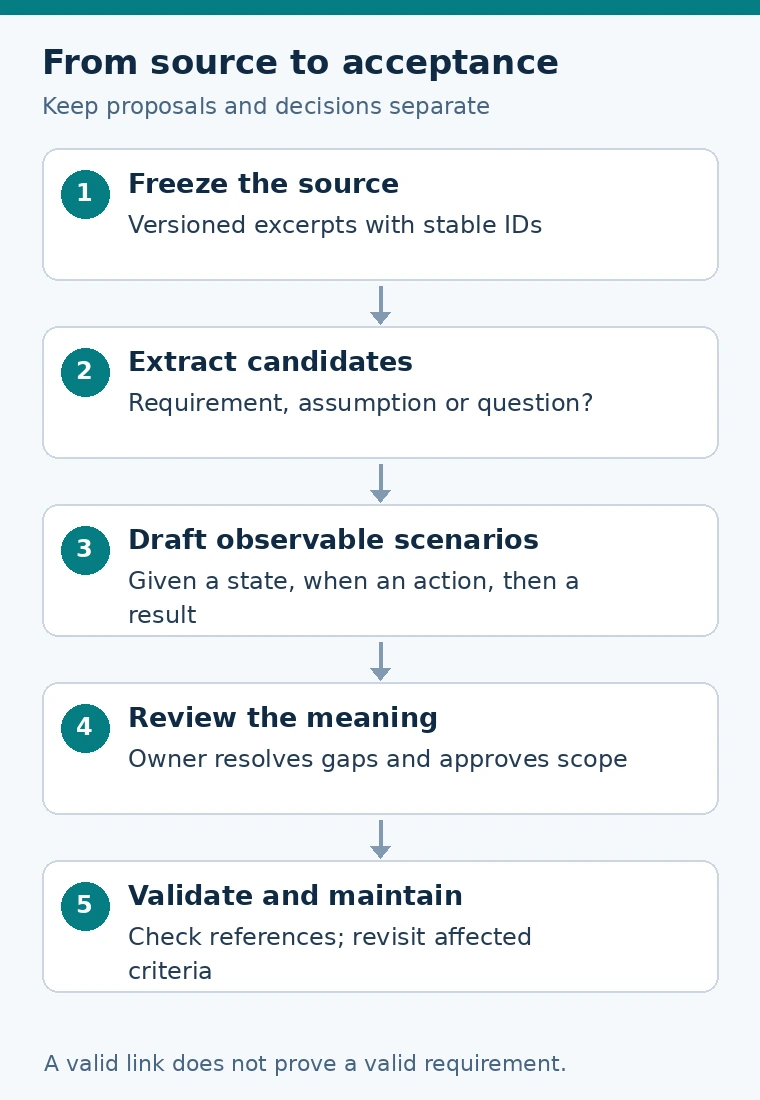
2. Separate evidence from interpretation
Require four distinct record types. A source excerpt preserves the original wording. A derived requirement states one behavior or constraint the team believes follows from that wording. An assumption records a provisional belief used to make progress. An open question records a decision that remains unresolved. These labels should survive every export and review.
Consider capacity. The source may establish that confirmed reservations must never exceed a workshop’s capacity. The derived requirement expresses that invariant. “Each booking is for one person” would be an assumption unless the source says so. “May staff increase capacity after booking opens?” is a question. Putting all four statements in a single list of requirements gives unsupported choices the same visual authority as the real policy.
Do not treat a source reference as a proof stamp. A proposed rule could cite the capacity passage while adding an unsupported fifteen-minute hold. The citation is syntactically valid, yet the relationship is wrong. Ask the model to explain the derivation in a short rationale and identify any added meaning. Reviewers need that explanation beside the candidate requirement, not hidden in a long conversational answer.
NASA’s requirements-definition guidance provides a useful general discipline here: document rationale and assumptions, and validate requirements for stakeholder fit, technical correctness, feasibility, and verifiability. This article adapts those principles to a small product team; it does not claim that the workflow implements NASA’s full engineering process.
Status needs the same care as record type. “Draft” describes proposed wording. “Open” marks a requirement whose interpretation still needs a decision. “Approved” requires an accountable human decision for a particular version. The model may recommend a status transition, but generating a polished paragraph cannot perform that transition. Keep an approval record outside the model’s editable output if your workflow could otherwise accept a self-declared approval.
Finally, preserve disagreement. If operations interprets the cutoff differently from product, create one question with the competing interpretations and affected records. Do not ask DeepSeek to choose whichever sounds more reasonable. The disagreement is part of the work, and making it visible is a useful result.
3. Extract requirements before writing scenarios
Use the first pass to inventory meaning. Ask for small candidate requirements, explicit source links, ambiguous terms, contradictions, and missing decisions. Defer acceptance scenarios until this inventory is reviewed. Otherwise, an early assumption gets repeated in several elegant scenarios and starts looking like established policy through repetition.
DeepSeek’s Chat Completions documentation describes a conversation as a list of role-tagged messages. If you use the API, that provides a straightforward place to separate task instructions from supplied source text. A chat interface can use the same logical separation in clearly labeled sections. Neither arrangement guarantees that the interpretation is correct; it makes the task and evidence easier to inspect.
Here is a first-pass prompt. Replace the bracketed inputs with the frozen packet and your actual scope. The output should stay small enough that a reviewer can compare every derivation with its source.
You are helping analyze requirements for a community workshop booking product.
Use only the supplied source packet as product authority.
Scope: capacity, cancellations, waitlist notices, staff overrides.

Produce four separate lists:
1. Verbatim source excerpts with the existing source IDs unchanged.
2. Candidate requirements: id, description, source_ids, rationale,
   added interpretation, and status="draft" or "open".
3. Assumptions: id, statement, affected requirement IDs, validation owner.
4. Open questions: id, exact ambiguity, competing interpretations,
   affected requirement IDs, and who should decide.

Do not invent policies, time limits, role permissions, or numeric targets.
Do not mark any generated requirement approved.
If a requirement cannot be derived without a choice, label it open.
Keep source text separate from your analysis.

SOURCE PACKET:
[paste versioned S-01 through S-04]

KNOWN DEFINITIONS AND SCOPE:
[paste reviewed definitions; label unknowns explicitly]
Review the inventory for missing meaning before improving its wording. For capacity, did it preserve both the limit and the concurrent-request case? For cancellation, did it retain the exact time zone and the equality condition? For accessibility, did it narrow “notices” to one interface without justification? For staff actions, did it distinguish permission to override a rule from the obligation to record the override?
Split compound requirements when their decisions or verification methods differ. A staff override can have an authorization rule and an audit requirement even if one source supports both. For this miniature example we keep four top-level requirement IDs and discuss additional distinctions around their candidate criteria. A larger project should introduce child requirements when that makes ownership and change impact clearer.
Retain the reviewed inventory as an artifact. A chat history alone is awkward to diff and easy to misread after several rounds of edits. Use a versioned document or structured file, and record the prompt version and source version with it. If you need a machine-readable format, the guide to structured output with DeepSeek explains the formatting layer. Here the central problem is deciding what each field is allowed to mean.
4. Resolve decisions with the right people
A good question tells a decision owner exactly what would change. “Clarify cancellations” is weak. “At the specified cutoff instant, is self-service cancellation still allowed, and which clock determines receipt?” identifies two choices with direct implementation consequences. Add the affected requirement, an example on each side of the boundary, and the result each interpretation would produce.
Keep a compact decision ledger beside the requirements. Each entry needs the question ID, proposed options, decision owner, status, decision text when available, and affected requirement or criterion IDs. An unanswered question should have an owner rather than a model-generated answer. Where the excerpt already provides a decision, record that fact and avoid asking the team to decide it again.
Some questions block acceptance; others block only a particular scenario. If the exact cutoff is established but request-receipt timing is not, the team can review the arithmetic while leaving a slow-network scenario open. This prevents an all-or-nothing approval meeting and makes the remaining uncertainty more precise. A requirement can also be split so an approved part does not inherit the ambiguity of an unrelated part.
For the workshop product, useful follow-up questions include how long a waitlist offer lasts, whether it promises a reserved place, what happens when audit storage is unavailable, and how duplicate submissions should be recognized. The source packet may answer some of them. Anything it does not answer stays outside the approved contract until an authorized decision supplies the missing evidence.
The audit source contains a useful subtlety: it requires a reason for the override, but its explicit audit-field list does not include that reason. Requiring a reason to be supplied and requiring it to be retained are separate decisions. Ask whether the audit record must preserve the reason, identify R-04 as affected, and wait for a source-backed answer before adding a retention criterion. This is exactly the kind of gap that polished paraphrasing can hide.
Ask DeepSeek to rank questions by the consequence of leaving them unresolved, not by how confidently it can guess an answer. Capacity exceptions and a lost audit record can change architecture. Button copy can often wait. The ranking is a discussion aid: the team still decides priority using its risks, release plan, and operational knowledge.
5. Develop meaningful acceptance scenarios
Only after the interpretation is stable should you request acceptance criteria. Each criterion needs a known starting state, an event, and an observable outcome. Cucumber’s Gherkin reference gives those roles to Given, When, and Then. You can use the structure without committing to Cucumber automation; plain-language examples remain review artifacts until someone implements and executes the relevant tests.
Using the reviewed requirements below, propose acceptance criteria.
For each criterion include:
- id and requirement_ids
- given, when, then

In separate review notes, label the scenario type and unresolved dependencies.
Treat every generated criterion as a draft candidate. Source references resolve
through requirement_ids; do not insert extra fields into the minimal fixture.

Cover successful behavior, rejected behavior, exact boundaries,
concurrent events where relevant, and observable quality constraints.
Preserve approved wording and source IDs.
If the expected result needs a new policy, propose an open question instead.
Do not add implementation mechanisms unless an approved source requires them.
Do not claim that criteria have been tested or approved.

REVIEWED REQUIREMENTS AND DECISIONS:
[paste the current artifact]
Capacity requires an invariant across competing requests
A positive example starts with capacity ten and nine confirmed reservations. One eligible request succeeds, leaving ten confirmed reservations. A negative example starts with all ten places occupied and checks that another request cannot create an eleventh confirmation. Neither scenario alone establishes the concurrent behavior that caused the original concern.
For the concurrency example, start with one remaining place and two distinct eligible residents. Both requests attempt to reserve that place during overlapping execution. The expected result is exactly one new confirmation, no overcapacity state, and a definite unsuccessful outcome for the other request. The source may require that outcome without prescribing which resident wins or which database mechanism implements it.
“Both click at the same time” is a story, not a reproducible concurrency setup. The eventual test must arrange overlapping processing at the decision point and observe the resulting bookings through an appropriate interface. Requirements analysis should identify the invariant and the competing operations; engineering and testing then choose a controlled way to exercise them. A serial test with fast requests does not establish atomicity.
Also separate duplicate submission from competing submission. Two different residents contesting a place is one case. A single resident retrying after a lost response is another. If the specification is silent about request identity or duplicate bookings, raise a question. Do not smuggle an idempotency policy into a criterion merely because it would be a sensible design.
Cancellation requires a precise boundary
Write examples immediately before the cutoff, exactly at it, and immediately after it. Use a named time zone and a concrete workshop date so reviewers can inspect the policy rather than mentally fill in “local time.” State which event is compared with the cutoff: clicking a button, receiving the request, or committing the change can yield different answers during a slow connection.
If the source has already chosen one of those events, carry it through unchanged. If it has not, make that choice visible. The same discipline applies to inclusive and exclusive comparisons. Our source explicitly includes the instant exactly twenty-four elapsed hours before the workshop. A rewritten criterion that accepts only earlier requests would change that policy. One small word can change the user-visible result of a boundary test.
For dates near a daylight-saving transition, use the location’s calendar and zone rules rather than substituting a fixed offset for the entire year. Our source uses twenty-four elapsed hours, so subtract that duration from the workshop instant and then display the result in Europe/London. Subtracting a local calendar day can produce a different instant across a clock change.
For a workshop starting at 10:00 UTC on 25 October 2026, the cutoff is 10:00 UTC on 24 October. London displays that cutoff as 11:00 BST, while the workshop starts at 10:00 GMT the next day. The clocks change between those instants. The exact-cutoff request is accepted; a request one second later is outside the ordinary cancellation window. This example tests both elapsed-time arithmetic and local display without treating them as the same operation.
Notices and overrides need observable consequences
A waitlist notice criterion should preserve the required expiry deadline, meaningful booking-link text, and keyboard and screen-reader usability. Record any unresolved trigger or expiry duration separately. It should not quietly promise that a place is held. Notification, eligibility, reservation, and confirmation are different states, and a source author may have intended only the first.
For staff overrides, successful execution and rejected execution deserve separate examples. A staff cancellation override with a reason should produce the specified business change and its audit evidence. A resident attempting the same operation must not gain staff authority simply by reaching the endpoint. Missing reasons, expired roles, and concurrent edits are candidate cases whose expected outcomes must be grounded in the source or a new decision.
6. Make quality requirements observable
Requirements analysis should ask how the product must behave as well as what it must do. “Accessible,” “fast,” and “auditable” are useful intentions but incomplete acceptance criteria. Each needs an observable result, a verification method, and a defined context. If the source contains no target, the model should propose a question or an explicitly unapproved candidate rather than manufacture a service commitment.
For an in-page waitlist status message, W3C’s explanation of WCAG 2.2 Success Criterion 4.1.3 is relevant: status information presented without a focus change must be programmatically available to assistive technology. That is a specific accessibility consideration, not a complete accessibility assessment. The W3C document also distinguishes status messages from changes of context, so a dialog and an inline update should not be treated as the same interaction.
Turn that consideration into a reviewable product example. With keyboard focus remaining on the control used to join the waitlist, the inline result appears and exposes the full meaningful message to assistive technology. Verify the announced context, not merely the presence of an accessibility attribute. The team’s supported browser and assistive-technology combinations belong in its verification plan. An email notice needs its own content and interaction checks.
For reliability, ask what the user sees if a booking succeeds but the response is lost. For auditability, ask whether an override can succeed when its required audit record cannot be persisted. For performance, ask who will define the acceptable response threshold, workload, observation window, and measurement point. “Under two seconds” with none of those conditions creates an argument rather than a usable contract.
These questions should remain connected to the relevant requirement instead of gathering in an abandoned “nonfunctional” appendix. A booking’s atomicity, a notice’s accessibility, and an override’s audit evidence influence the same user journeys as the main functional behavior. Assign a reviewer for each quality concern, and record a deliberate exclusion if the current release will not address it.
7. Read a miniature review package
The miniature package below shows the shape of a handoff, using our four source passages and four top-level requirements. Treat it as a worked illustration. R-01, R-02, and R-04 remain draft; R-03 remains open because the source does not establish an offer duration. All four criteria are draft candidates by the package’s review status. Approval appears only in validator test cases that deliberately exercise the coverage rule, not as a claim about this product.
{
  "requirements": [
    {
      "id": "R-01",
      "source_ids": ["S-01"],
      "status": "draft",
      "description": "Reserve a seat and confirm its booking atomically, without exceeding workshop capacity."
    },
    {
      "id": "R-02",
      "source_ids": ["S-02"],
      "status": "draft",
      "description": "Accept cancellation through the inclusive cutoff 24 elapsed hours before the workshop start; display the cutoff in Europe/London."
    },
    {
      "id": "R-03",
      "source_ids": ["S-03"],
      "status": "open",
      "description": "Provide accessible waitlist offer notices with an explicit expiry deadline. The expiry duration remains an owner decision."
    },
    {
      "id": "R-04",
      "source_ids": ["S-04"],
      "status": "draft",
      "description": "Require a reason for staff cancellation-cutoff overrides and append an audit record with the specified actor, booking, timestamp, and states."
    }
  ],
  "criteria": [
    {
      "id": "AC-01",
      "requirement_ids": ["R-01"],
      "given": "A workshop has one seat remaining and two distinct booking requests arrive concurrently.",
      "when": "Both requests try to reserve the final seat and confirm their bookings.",
      "then": "Exactly one booking is confirmed; confirmed bookings do not exceed capacity and no seat reservation is committed without its confirmation."
    },
    {
      "id": "AC-02",
      "requirement_ids": ["R-02"],
      "given": "A workshop starts at 2026-10-25T10:00:00+00:00, after the London daylight-saving change.",
      "when": "A cancellation is requested exactly at 2026-10-24T10:00:00+00:00.",
      "then": "The request is accepted; the displayed cutoff is 24 October 2026 at 11:00 BST (Europe/London)."
    },
    {
      "id": "AC-03",
      "requirement_ids": ["R-03"],
      "given": "A waitlist offer already has an expiry deadline supplied by an owner-approved policy.",
      "when": "The participant reads and navigates the offer notice using a keyboard and screen reader.",
      "then": "The expiry deadline is available as text, the booking link has meaningful text, and the participant can focus and activate that link."
    },
    {
      "id": "AC-04",
      "requirement_ids": ["R-04"],
      "given": "A staff member supplies a reason to cancel a booking after its cancellation cutoff.",
      "when": "The staff member completes the cutoff override.",
      "then": "An audit record is appended with staff ID, booking ID, UTC timestamp, prior state, and resulting state."
    }
  ]
}
The runnable miniature deliberately has two top-level lists. Requirements carry source references and status; criteria carry requirement references and their Given, When, and Then text. The surrounding decision ledger holds assumptions, questions, review notes, and approval evidence. The checker does not validate that separate ledger. This shape can express a requirement with no criterion yet without inventing coverage. It can also express several criteria for one requirement because successful behavior, rejection, and boundary behavior answer different questions.
An assumption record might say that all example reservation requests concern distinct eligible residents. That assumption defines the fixture; it does not establish the product’s eligibility rules. If a reviewer wants to examine household limits or resident verification, add the relevant source and requirement first. Otherwise the examples will appear to authorize a policy the team never discussed.
AC-03 assumes that an owner-approved policy has supplied an actual expiry deadline. That precondition makes the accessibility example discussable; it does not resolve R-03 or invent an offer duration. AC-04 similarly illustrates the successful audit path while leaving failure handling for a decision.
An open question about audit failure should identify the override requirement and any criterion whose expected result depends on the answer. Record the candidate outcomes clearly: reject the override before changing the booking, or support another approved recovery design. The model can describe the trade-off, but the review package should not select one by accident through a confident Then clause.
Keep the package small enough to read end to end. A hundred near-duplicate scenarios may make coverage look impressive while hiding the only unresolved decision. Prefer a few examples that distinguish competing implementations. For cancellation, the equality boundary is more informative than ten arbitrary times that all fall comfortably before the deadline.
Do not confuse an artifact example with a release checklist. A real workshop service would require additional work on identity, privacy, operations, and whatever other features it actually provides. Those topics are not silently satisfied by this package. Its purpose is to show a controlled requirements-analysis slice with traceable decisions and a clear route to expansion.
8. Maintain traceability in both directions
Forward traceability asks what each source statement produced. Reverse traceability asks why each requirement and criterion exists. Keep both views. A forward-only list can hide a criterion with no authority. A reverse-only list can make every criterion look justified while leaving half of a source passage unanalyzed.
Use stable identifiers for the logical record and explicit revisions for changed content. Do not renumber all criteria when one is inserted. If a criterion is replaced, retain its history and record the replacement. Review comments, test references, and implementation notes often use those identifiers; reusing an old ID for unrelated behavior makes their evidence misleading.
The minimal chain is source to requirement to criterion. Extend it to decision records when interpretation required a choice, and to test cases when verification work begins. A criterion that cites two requirements should explain their interaction. For example, a staff cancellation override might depend on the cancellation rule and the audit rule. A long list of every requirement ID is not stronger traceability.
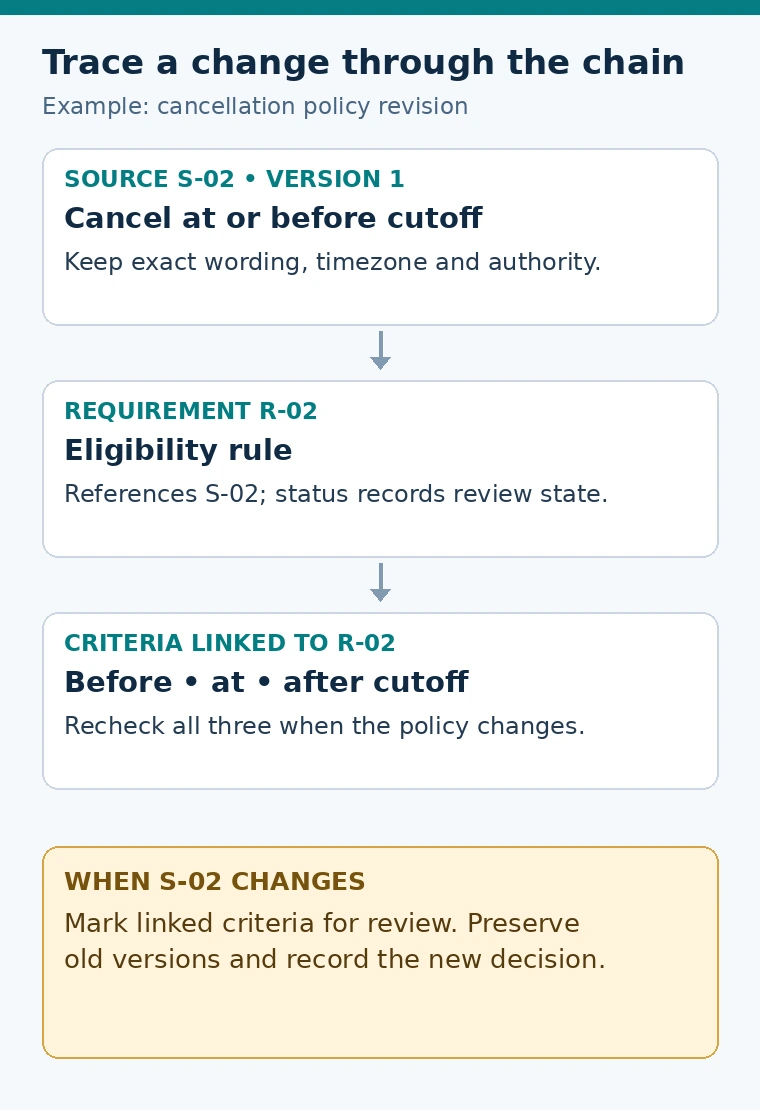
For each approved requirement, inspect at least one example that could fail if an important interpretation were wrong. Then inspect the uncovered parts of its source. A capacity criterion may cover the limit but omit concurrent reservation. A cancellation criterion may cover time comparison while omitting the specified zone. A binary “covered” flag cannot tell those stories.
Separate structural coverage from behavioral adequacy in your reporting. “All approved requirement IDs are referenced” is a useful, limited statement. “All requirements are fully tested” is a much larger claim that would require reviewed criteria, implemented tests, execution evidence, and an agreed scope. Do not let the shorter check inherit the meaning of the larger one.
9. Validate the artifact locally
A small local validator can catch mechanical mistakes before a reviewer spends time on the prose. It can reject duplicate identifiers, unknown source references, criteria pointing to missing requirements, and approved requirements with no criterion reference. Only approved requirements are subject to the checker’s missing-criterion gate. Reviewers must inspect coverage gaps for draft and open requirements separately; the script does not enumerate those gaps.
The following example operates on local illustrative data. It needs no model account or paid inference call. Its purpose is to make a few structural rules executable so that a renamed source or broken reference does not pass unnoticed during editing.
Complete Python validator
Save the following as traceability.py, and save the complete JSON miniature above as example.json. The fixed SOURCES catalog is maintained outside the model-editable JSON. The script rejects additional fields rather than letting assumptions create new evidence records. Keep the richer question and decision ledger separately.
"""Offline structural checks, not semantic review or approval. Python 3.9+."""
import json
import sys

# Human-owned evidence, outside the model's editable JSON. Keep IDs stable.
SOURCES = {
    "S-01": "Confirm a booking only when a seat is available. Seat reservation and confirmation must be atomic; confirmed bookings must not exceed workshop capacity.",
    "S-02": "Allow cancellation at or before 24 elapsed hours before the workshop starts. Display the cancellation cutoff in Europe/London, accounting for daylight-saving changes.",
    "S-03": "Waitlist offer notices must include an expiry deadline and meaningful booking-link text, and be usable with a keyboard and screen reader.",
    "S-04": "Staff may override the cancellation cutoff only with a reason. Append an audit record with staff ID, booking ID, UTC timestamp, prior state, and resulting state.",
}


def validate(document):
    """Return errors and approved requirements lacking valid linked criteria."""
    errors = []
    report = {"errors": errors, "missing_criteria": [],
              "coverage_kind": "structural only; not semantic approval"}
    if not isinstance(document, dict):
        errors.append("root must be an object")
        return report
    if set(document) != {"requirements", "criteria"}:
        errors.append("root must contain exactly requirements and criteria")

    def text(value):
        return isinstance(value, str) and bool(value.strip())

    def records(name, fields, ref_field, known_ids, statuses=False):
        items = document.get(name)
        if not isinstance(items, list):
            errors.append(f"{name} must be an array")
            return {}
        valid, seen = {}, set()
        expected = {"id", ref_field, *fields}
        if statuses:
            expected.add("status")
        for index, item in enumerate(items):
            label, before = f"{name}[{index}]", len(errors)
            if not isinstance(item, dict):
                errors.append(f"{label} must be an object")
                continue
            if set(item) != expected:
                errors.append(f"{label} must contain exactly {sorted(expected)}")
            ident = item.get("id")
            if not text(ident):
                errors.append(f"{label}.id must be a nonempty string")
            elif ident in seen:
                errors.append(f"duplicate ID: {ident}")
                valid.pop(ident, None)
            else:
                seen.add(ident)
            for field in fields:
                if not text(item.get(field)):
                    errors.append(f"{label}.{field} must be a nonempty string")
            refs = item.get(ref_field)
            if not isinstance(refs, list) or not refs:
                errors.append(f"{label}.{ref_field} must be a nonempty array")
            else:
                for ref in refs:
                    if not text(ref) or ref not in known_ids:
                        errors.append(f"{label}.{ref_field}: unknown or invalid reference {ref!r}")
                if all(isinstance(ref, str) for ref in refs) and len(set(refs)) != len(refs):
                    errors.append(f"{label}.{ref_field} contains duplicate references")
            if statuses and item.get("status") not in ("draft", "approved", "open"):
                errors.append(f"{label}.status must be draft, approved, or open")
            if len(errors) == before:
                valid[ident] = item
        return valid

    requirements = records("requirements", ("description",), "source_ids", SOURCES, True)
    criteria = records("criteria", ("given", "when", "then"), "requirement_ids", requirements)
    for ident in requirements.keys() & criteria.keys():
        errors.append(f"ID reused across requirements and criteria: {ident}")
        criteria.pop(ident)
    covered = {ref for criterion in criteria.values() for ref in criterion["requirement_ids"]}
    report["missing_criteria"] = sorted(
        ident for ident, item in requirements.items()
        if item["status"] == "approved" and ident not in covered
    )
    return report


def unique_object(pairs):
    result = {}
    for key, value in pairs:
        if key in result:
            raise ValueError(f"duplicate JSON key: {key}")
        result[key] = value
    return result


def main():
    if len(sys.argv) != 2:
        print("Usage: python traceability.py example.json", file=sys.stderr)
        return 2
    try:
        with open(sys.argv[1], encoding="utf-8") as handle:
            document = json.load(handle, object_pairs_hook=unique_object)
    except (OSError, ValueError) as exc:
        print(f"Cannot read JSON: {exc}", file=sys.stderr)
        return 2
    report = validate(document)
    print(json.dumps(report, indent=2))
    return 1 if report["errors"] or report["missing_criteria"] else 0


if __name__ == "__main__":
    sys.exit(main())
Run the local example
python traceability.py example.jsonThe actual offline output for the supplied fixture was:
{
  "errors": [],
  "missing_criteria": [],
  "coverage_kind": "structural only; not semantic approval"
}
The accompanying validator suite passed 40 offline tests on Python 3.12.14, including malformed values, duplicate identifiers and JSON keys, unknown references, approved-only coverage, command-line failures, and the example’s London daylight-saving arithmetic. These checks exercised the validator and the illustrative time calculation. No DeepSeek API call or booking-system test was made.
This fixture has no approved requirements. An empty missing_criteria list therefore does not establish approval or complete behavioral coverage. The command exits with code 1 if either structural errors or missing approved coverage exist, and code 2 for a file, JSON, or invocation error. The script cannot authenticate whoever sets a requirement’s status: import approval only from a separate accountable review process.
Read the output literally. A successful check establishes only the rules implemented by the checker for that input. Inspect both errors and missing_criteria; an empty missing-criterion list alone is not a pass. Our fixture has no approved requirements, so that list cannot demonstrate approved coverage. Syntax and traceability validation do not verify semantics. A criterion could reference the correct cutoff source while reversing the comparison, and an identifier checker would still accept it. Likewise, one superficial criterion can technically reference a requirement without covering its important cases.
The checker cannot authenticate who set a requirement to approved or prevent a model from downgrading it to draft to escape the coverage gate. Compare statuses with the separately controlled approval record before accepting generated updates. Structural validation is one check within that review process.
Keep negative fixtures with the validator. An unknown source, duplicate criterion ID, and uncovered approved requirement should each trigger the intended error. Those fixtures check the checking tool’s behavior; they do not test the booking product or benchmark DeepSeek. When the schema changes, update the fixtures and review what the checker now guarantees.
10. Challenge the proposed criteria
Use a separate review pass to look for mistakes in the artifact, with the frozen sources available again. Ask for concrete counterexamples and unsupported additions, not a general quality score. A score such as nine out of ten offers little help when the remaining defect allows an eleventh booking.
Review this requirements package against the frozen source packet.
Do not rewrite it yet. Report only actionable findings.
For each finding provide:
- affected source, requirement, and criterion IDs
- the exact unsupported, ambiguous, missing, or contradictory statement
- a concrete input or event sequence that exposes the problem
- whether correction needs editorial repair or an owner decision

Look especially for:
capacity races; inclusive/exclusive cutoff changes; timezone drift;
notice wording that promises a held place; invented staff permissions;
audit outcomes not established by a source; and quality targets without authority.
Distinguish a confirmed conflict from a question the source does not answer.
Do not change approval statuses.
Have a human examine the findings against the original wording. A model reviewing another model’s text can repeat the same assumption, and a different prompt can create a new unsupported interpretation. Independence is useful only to the extent that the review supplies distinct evidence or a genuinely different perspective.
One practical technique is to describe an implementation that satisfies the wording but disappoints the user. Could the system show “joined waitlist” visually while leaving assistive-technology users unaware? Could it record that someone overrode a booking without recording who did it? Could every serial capacity test pass while two overlapping requests both succeed? If the source rules out that behavior but the criteria do not, the package needs work.
Another technique is to remove a phrase and ask what changes. If deleting “Europe/London” has no effect on the expected display, the timezone is not actually being exercised. If replacing “staff member” with “resident” leaves every override example unchanged, the permission boundary is missing. This kind of review measures the distinguishing power of the scenarios rather than their quantity.
11. Analyze a requirements change
Suppose the product owner proposes a new cancellation policy. The existing rule uses twenty-four elapsed hours before the workshop starts; the proposal would use 18:00 Europe/London on the previous calendar day. Do not overwrite the old source and ask DeepSeek to regenerate everything. Preserve both versions, record the proposed change, and request an impact analysis against the existing traceability links.
The first affected records are the cancellation requirement and its before, equal, and after criteria. Then follow semantic dependencies. Staff override wording refers to the cancellation restriction. Waitlist notice timing may change if earlier cancellations create places sooner. User-facing explanations may contain the old rule even when they are not represented as acceptance criteria. These are candidates for review, not proof that every linked component needs modification.
Compare source version A with proposed source version B.
Use the existing requirements package and stable IDs.
Return:
1. Exact policy differences without rewriting unaffected text.
2. Directly affected requirements and criteria, with reasons.
3. Possible downstream dependencies that need human review.
4. Criteria that remain valid and why.
5. New questions, conflicts, and required approval decisions.

Do not mark proposed changes approved.
Do not delete old criteria or invent implementation changes.
Keep direct evidence separate from inferred impact.
A useful change report explains why something remains valid as well as why something changes. The capacity invariant may survive untouched. The cancellation equality case may still matter but require new setup values. A test for the old policy might become a historical regression check only if the system still supports bookings governed by that version. Whether existing bookings migrate is another product decision.
After approval, update the source revision, requirement revision, criterion revisions, and associated tests together. Keep the approval evidence and retire superseded expectations explicitly. If the requirements-analysis prompt becomes a repeatable workflow, preserve known source packets and expected extracted constraints as regression examples. The guide to DeepSeek prompt regression testing explains how to check whether a prompt change damages those outputs. Tests of the booking application remain a separate engineering responsibility.
12. Approve and hand over the right version
Bring the package to a focused review with product, engineering, testing, and the people responsible for relevant operational or accessibility decisions. Start with unresolved choices and high-consequence examples. Read the last-seat race, the exact cutoff, the notice promise, and the staff exception aloud. These are places where a small wording difference can create a materially different product.
Reviewers should be able to answer four questions for every candidate criterion: Which source supports it? What result can someone observe? Which decision or assumption could change that result? What evidence will eventually show that the implementation meets it? If one answer is missing, fix the record or leave its status open.
Approve a version, not a conversation. Capture who approved the scope, when, what remained excluded, and which questions still block implementation or release. Attach the frozen source packet and the final candidate artifact to the work item. Engineers should not have to reconstruct an acceptance contract from scattered chat replies or guess which revision a stakeholder meant.
Keep approval and execution evidence distinct during delivery. A reviewed criterion can be approved before its test exists. An implemented test can be failing. A passing test can cover an outdated criterion. The handoff needs those distinctions so that a status dashboard does not turn several different states into one reassuring green mark.
The strongest use of DeepSeek for requirements analysis is helping a team expose choices before they become defects. Preserve evidence, draft narrowly, challenge boundary cases, and keep every assumption attached to the decision it affects. The resulting acceptance criteria are useful because people can inspect and approve their meaning, then maintain that meaning as the product changes.
Sources & References
Primary references checked for this guide. The workflow and fictional workshop examples are original editorial illustrations.
- DeepSeek API documentation: Chat Completions — role-tagged conversation messages and API request structure.
- NASA: Technical Requirements Definition — rationale, assumptions, traceability, and requirements validation.
- Cucumber: Gherkin Reference — context, event, and expected-outcome roles in scenarios.
- W3C: Understanding Success Criterion 4.1.3, Status Messages — the scope and intent of programmatically available status information.

[…] as “make this DST-safe,” rewrite it into observable statements before asking for code. The requirements workflow can help turn a broad intention into acceptance criteria. For this task, the important output is a […]
[…] facts with their sources. When a requirement is still disputed, label it as a question. The related requirements-analysis workflow can help clarify that input before contract review […]
[…] a label. If requirements are ambiguous, turn the ambiguity into a question; the related guide to traceable acceptance criteria offers a useful way to preserve that decision […]
[…] decision. No amount of clever textual combination settles that contract conflict. The guide to traceable acceptance criteria is useful when the missing piece is a product decision rather than a programming […]
[…] as a behavior change. For help turning these decisions into testable statements, the site’s guide to traceable acceptance criteria provides a complementary […]
[…] questions with the product owner before implementation. The same discipline appears in our guide to turning requirements into traceable acceptance criteria: important promises should become observable […]
[…] of observable behaviors and disputed cases that a person can approve. The broader method in our guide to traceable acceptance criteria helps turn those decisions into […]
[…] requirements-analysis guide explains how to turn a broad request into traceable acceptance criteria. Here the most useful […]
[…] reviewed contract change. Write that change down and add examples before relaxing a validator. The requirements-analysis guide provides a useful way to connect each decision to acceptance […]
[…] its counter. If those outcomes are still disputed, ask the product owner or operator first. The requirements-analysis workflow can help turn ambiguous statements into reviewable acceptance […]